

Wholesale and distribution
The order book is not the pipeline.
Reorders arrive whether or not anyone did anything, which makes a distribution business look healthy right up until an account is lost. Signal splits the base into territories with an owner, shows what share of it anybody has actually touched, and prices every quote from one catalogue.
14 days free. No credit card.
- 14 days free
- No credit card
- Unlimited users
The problem
Repeat revenue hides the sales problem.
The monthly number looks steady, so nobody asks which accounts produced it.
Three blind spots
Reps visit the accounts they like
Which are the friendly ones, not the growing ones. Without coverage as a number, a week on the road is judged on how it felt rather than on what it covered.
The long tail is never opened
Every distributor has a list of businesses in the patch that have never bought. Nobody owns it, so nobody calls it, and it stays a list.
Pricing drifts by memory
Trade price, contract price, the deal somebody did in 2023. When the rates live in four spreadsheets, two quotes for the same product go out at different numbers.
How it works
Territory, coverage, catalogue.
The base
Split the base by rule, not by habit
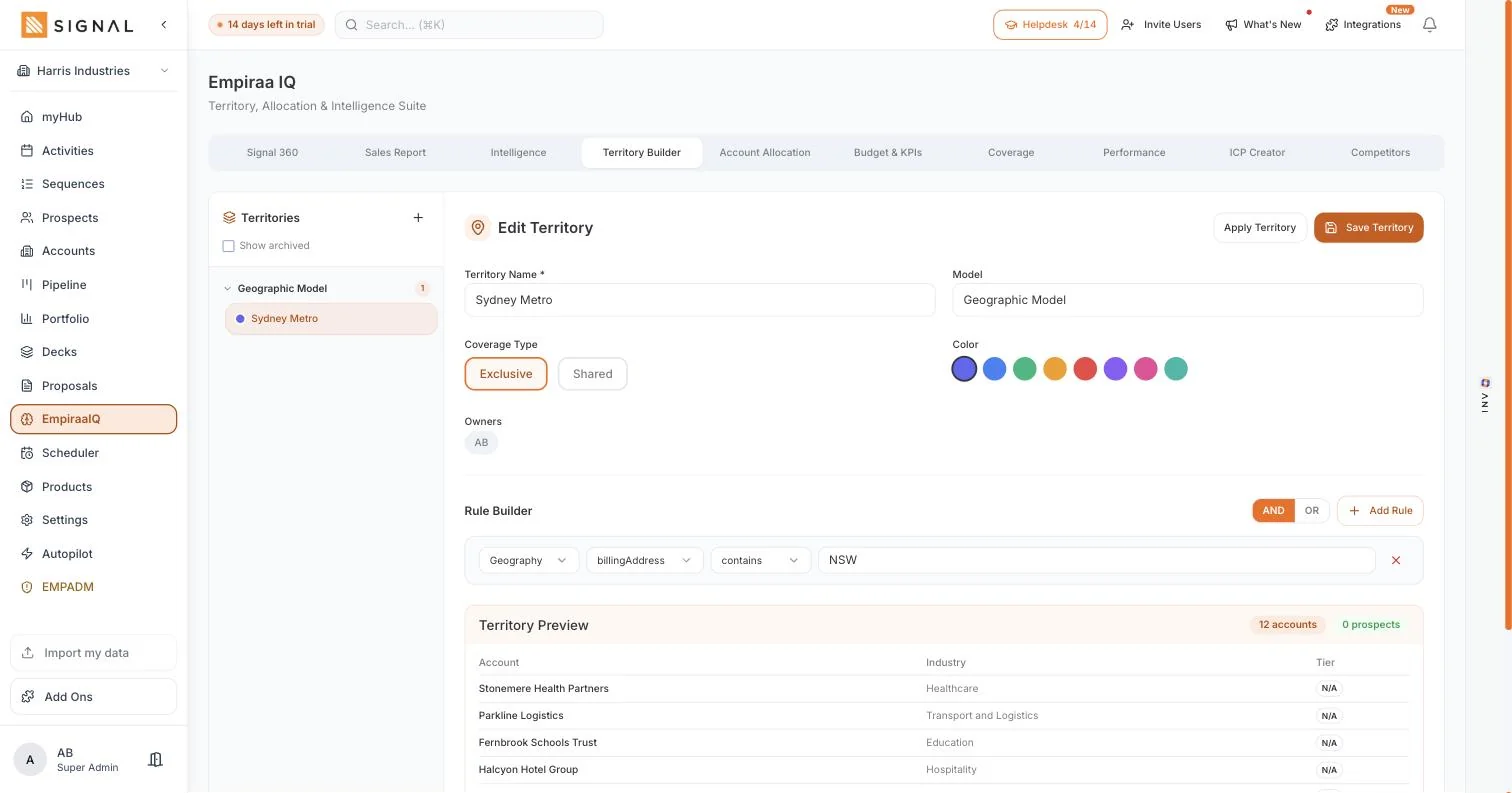
A territory is a rule and an owner: accounts in a region, in an industry, above a size. The builder previews exactly which accounts a rule catches before you save it, so you find the overlap and the uncovered patch on the screen rather than at the end of the year.
- Geographic territories from the account billing address
- A named owner on every one, changed in one place when a rep leaves
- The matched accounts listed with a count, before it goes live
See what the week actually covered
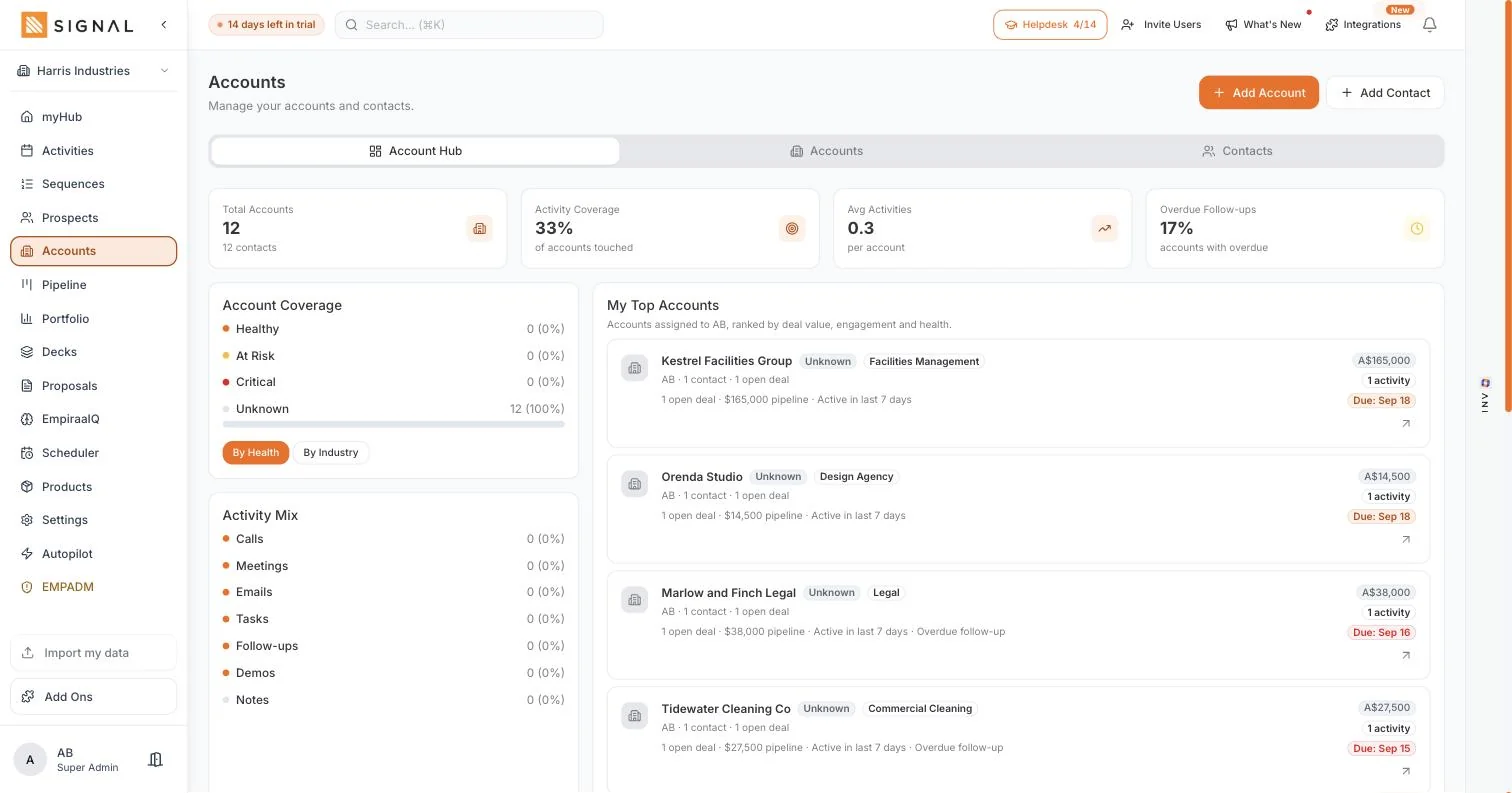
Activity coverage is the share of accounts anyone has touched in the period, and it can be read patch by patch. It is a blunt number and it is usually uncomfortable the first time, which is exactly why it is worth having.
- Coverage across the base and by territory
- Account health from activity and deal state rather than from opinion
- Accounts ranked by value, engagement and risk together
And one catalogue behind every quote
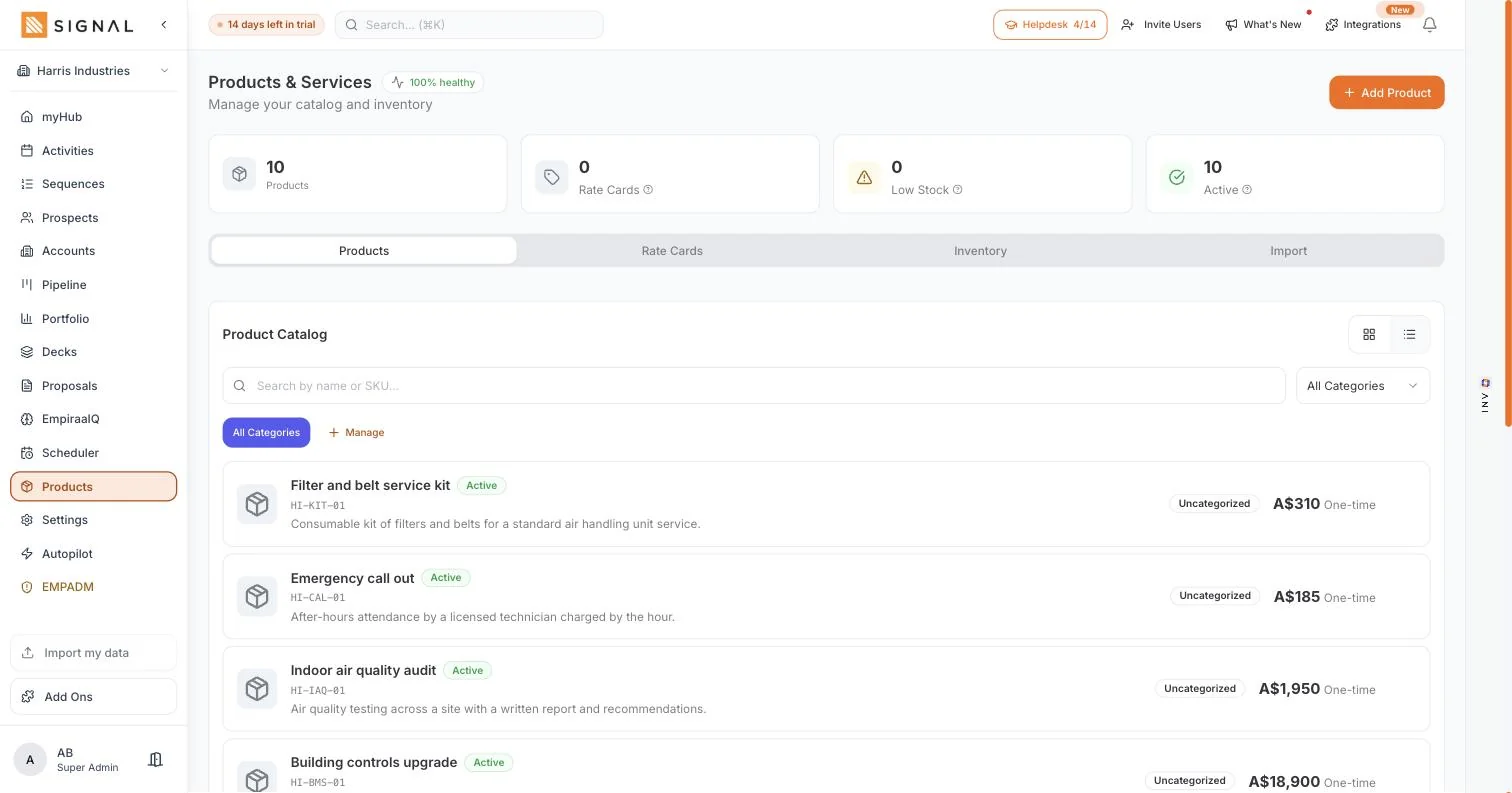
Products with a code, a category and a price, rate cards for the customers who are charged differently, and stock levels with reorder alerts. A quote prices from it, so the quote and the deal cannot disagree.
- Rate cards, so trade and contract pricing stay apart and stay consistent
- Inventory with reorder points, flagged on the home screen
- Import the price list rather than typing it in again
What you get
For a base that reorders, and a tail that does not.
For distributors
Territories by rule
Every account owned by somebody, with the rule previewed before it goes live.
Learn moreCoverage as a number
What share of the patch was actually visited, rather than how the week felt.
Learn moreRate cards
Trade, contract and one-off pricing, held apart and applied consistently.
Learn moreStock levels
Reorder points with low stock flagged, so a quote is not made on air.
Opening new accounts
Prospect Spark finds businesses in the patch that have never bought from you.
Learn moreUnlimited users
Road reps, internal sales and the counter, all in it, at no extra cost.
Learn moreGetting started
An honest coverage number in a week.
Four steps
- 30 minutes
Import the account base
Every trading account with its address, which is what the rules match on.
- 30 minutes
Draw the territories
Start with the patches you already treat as patches. Check what they catch.
- 2 hours
Load the catalogue
The lines you sell most, with the rate cards that go with them.
- 10 minutes
Read the coverage
The accounts nobody has touched this quarter are next week’s run.
Also for
Businesses like yours.
Other solutions
Trades and field services
Quotes out the same week as the site visit.
Learn moreCommercial HVAC
Service agreements and plant replacement, worked apart.
Learn moreBlue collar
When the person who quotes it is the person who does it.
Learn moreSales managers
Coverage, territories and a forecast you did not build by hand.
Learn moreQuestions
Distribution questions, answered.
We already have an ERP. Does this replace it?
No. Signal holds the catalogue, the rate cards, stock levels and reorder alerts, because a quote needs them. Purchasing, invoicing, the ledger and the warehouse stay in the system you run them in now.
Can reps have their own territories?
Yes. A territory is a rule with a named owner, and accounts follow the rule as they are added, so ownership stays right without anyone reassigning records by hand. More on territories.
Can different customers be on different prices?
Yes. Rate cards sit alongside the catalogue for the customers or contract types that are charged differently, and quotes price from whichever applies. More on products and pricing.
How do I know a patch is actually being worked?
Activity coverage, read by territory. It is the share of accounts in that patch anybody has logged a conversation with in the period, which is a different question from how much they ordered.
Can it help open accounts that have never bought?
Yes. Describe the kind of business you want, by area, industry and size, and Prospect Spark finds matching companies with the buying roles on them. That list is usually sitting in the same postcodes as your best accounts. More on Prospect Spark.
Is it priced per rep?
No. Every plan includes unlimited users and every limit is metered on the workspace, so road reps, internal sales and the counter can all be in it without changing the bill. See pricing.

Question not answered here? Ask ANI and get a straight answer.
Find out what your patch is really covering.
14 days free. No credit card. Unlimited users from the first minute.