

Signal Score
A lead score you can read the model for.
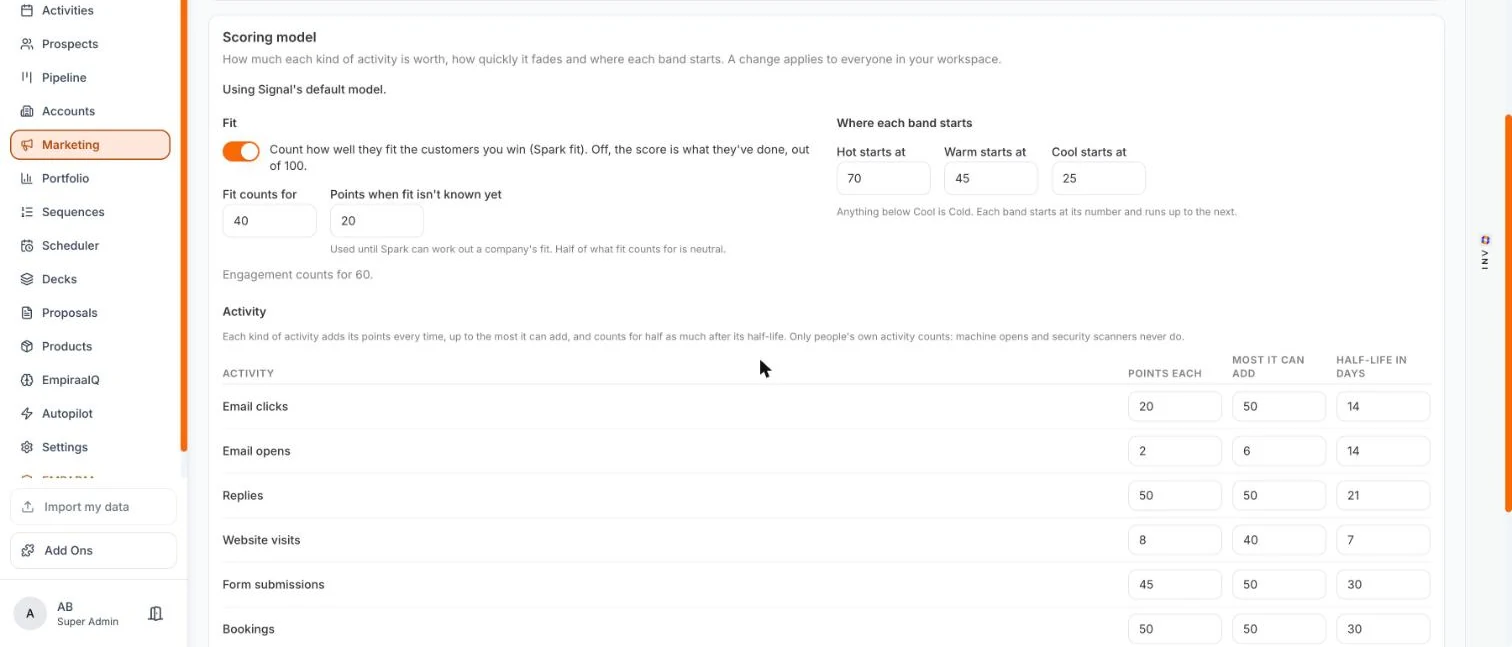
Every vendor says their score is accurate, and no buyer can check. So here is the whole model on one screen: what each activity is worth, the most it can ever add, how fast it fades, and where Hot, Warm and Cool begin. All of it editable, and all of it applying to your whole workspace.
14 days free. No credit card.
- 14 days free
- No credit card
- Unlimited users
Why most lead scores get ignored
A number nobody can explain is a number nobody acts on.
Three failures, and all three end with reps working the list by gut feel while the score sits in a column.
How scoring goes wrong
The model is hidden
A score appears and nobody can say why it is 64 rather than 40. The first time it disagrees with a rep who has spoken to the person, the score loses, and it keeps losing after that.
Opens are counted as interest
Since Apple Mail Privacy Protection, a large share of opens are machines. A score that treats them as engagement is measuring mail infrastructure and reporting it as intent.
Nothing ever fades
Someone who read three emails in March outranks someone who booked a meeting last week, because the points accumulated and never decayed. The list ends up sorted by how long people have been on it.
How the score is built
Fit, plus what they have done lately.
The model
Fit and engagement, weighted by you
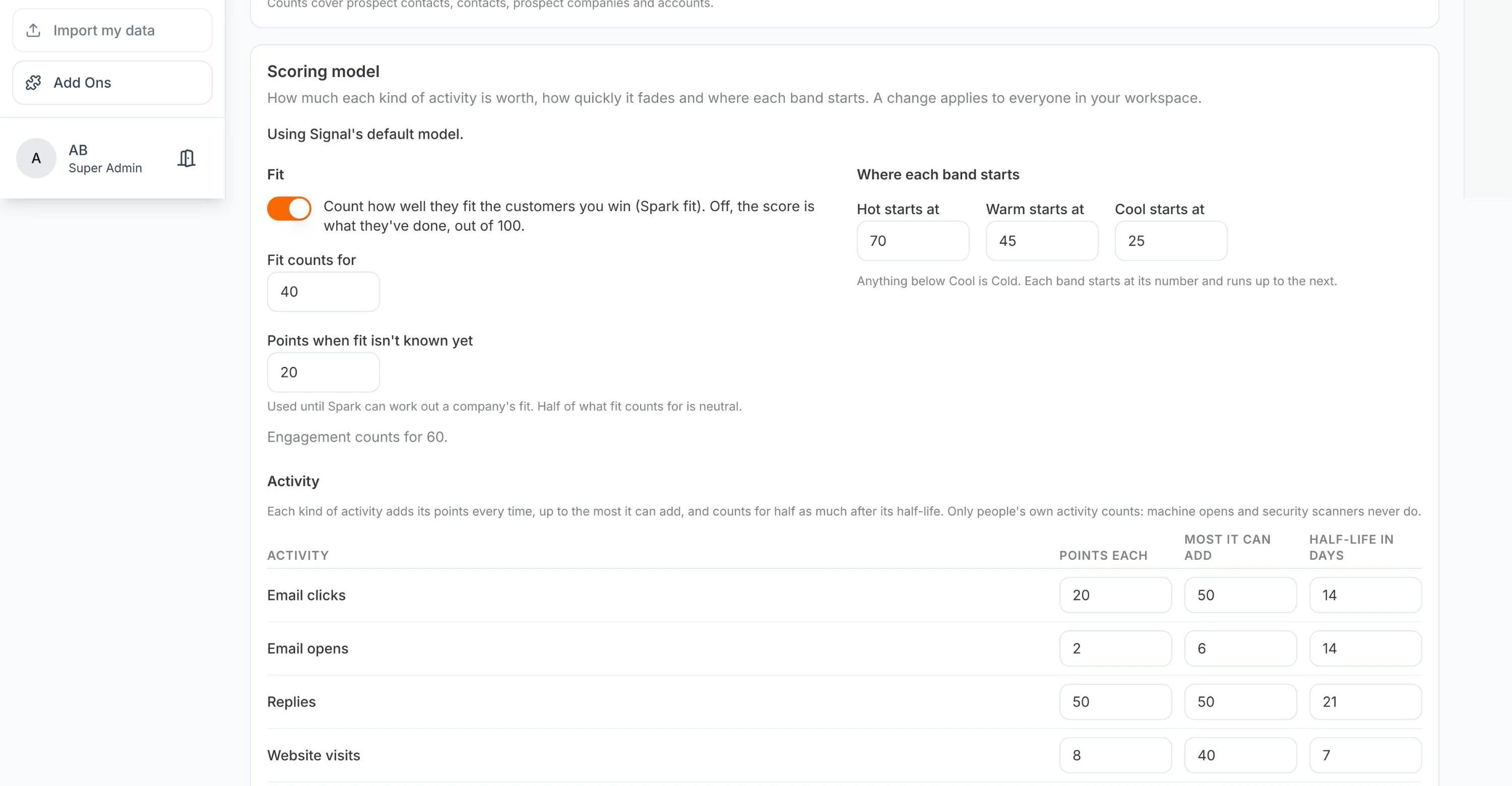
Fit is how closely they resemble the customers you actually win, worked out by Spark. Engagement is what they have done. By default fit counts for 40 and engagement for 60, and until Spark can work out a company’s fit it uses a neutral 20, which is half of what fit is worth. Turn fit off entirely and the score is purely behaviour, out of 100.- Fit 40, engagement 60, by default
- A neutral 20 while fit is still unknown
- Fit can be switched off completely
Every activity has three numbers
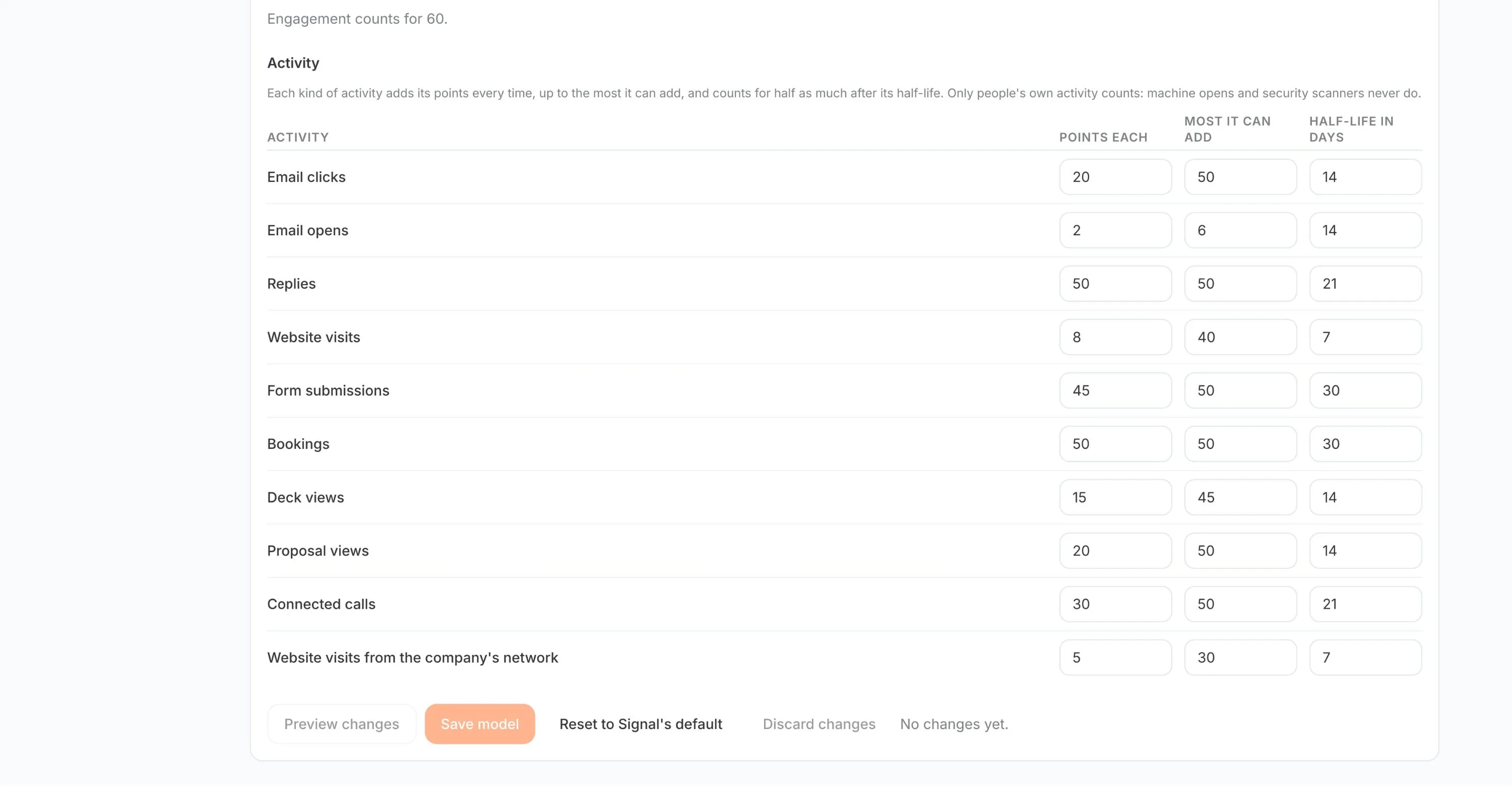
Points each, the most it can ever add, and a half-life in days. A reply is worth 50 and halves after 21 days. An email click is 20, capped at 50, halving after 14. An open is worth 2 and capped at 6, which is the honest weighting for a signal that is often a machine. A website visit is 8, capped at 40, halving after a week.- Replies 50, bookings 50, form submissions 45
- Opens 2 and capped at 6, deliberately low
- Half-lives from 7 days to 30, per activity
Bands you set, not bands you accept
Hot starts at 70, Warm at 45, Cool at 25, and anything below Cool is Cold. Those are defaults, not rules. Move them to match how your team actually triages, and the change applies to everyone in the workspace so nobody is working from a private definition of hot.- Four bands, with thresholds you choose
- One definition across the whole workspace
- Preview the change before you save it
Only people count
Machine opens and security scanners never add points. That one rule is why the score is worth reading at all after 2021, and it is also why the opens weighting is so low: an open is a weak signal even when a human did it, so it is capped at six points rather than allowed to accumulate into something that looks like intent.And it scores companies, not just people
Prospect contacts, contacts, prospect companies and accounts all carry a score, so you can see that three people at the same company have all been reading, which is the pattern that actually precedes a deal. Signal looks for new activity every fifteen minutes.Every plan has every feature. The difference between them is volume.
Explore Signal freeWhat to do with it
A score is a prompt to look, not a prediction.
It is worth saying plainly: this tells you who to open next, not who will buy. Treated as a forecast, any lead score eventually embarrasses itself and gets switched off.
Using the score
Segment on it
Signal Score 70+ is one of the segment ideas, so the people most engaged right now are a saved search rather than a manual sort.
Sort the follow-up queue
Not to ignore the cold ones, but to decide the order on a Tuesday when there are more names than hours.
Watch a company warm up
Several people at one account moving at once is a better buying signal than any single person’s score.
Tune it after a quarter
If your reps disagree with the score often, change the model rather than the reps. That is what the editable numbers are for.
Do not pay per contact for it
Scoring runs on every record in the workspace, and every Signal plan includes unlimited users.
Keep the default at first
Signal’s default model is a reasonable starting point. Change it once you have watched it for a cycle and know what it gets wrong.
Questions
Questions about Signal Score
What is Signal Score?
A score from 0 to 100 on every prospect contact, contact, prospect company and account, combining how well they fit the customers you win with what they have done recently, with newer activity counting for more. Hot, Warm, Cool and Cold are bands of that score. It is not Account Health, the Spark fit score or the AI enrichment score.
Can I see and change how the score is calculated?
Yes, all of it, on one screen. Points, the maximum each activity can contribute and its half-life in days are editable per activity, as are the band thresholds and the weighting between fit and engagement. A change applies to everyone in the workspace, and you can preview it before saving or reset to Signal’s default.
Do email opens count towards the score?
Only lightly, and only when a person did it. Machine opens and security scanners never count. By default an open is worth 2 points and capped at 6, against 20 for a click and 50 for a reply, because since Apple Mail Privacy Protection an open is a weak signal even when it is genuine.
What is a half-life in this context?
How long until an activity counts for half of what it did. A reply has a 21-day half-life, a website visit has 7 days. It means someone active last week outranks someone who was active in March, without you having to clear scores manually.
What are the default band thresholds?
Hot starts at 70, Warm at 45 and Cool at 25, with anything below Cool counted as Cold. Each band runs from its number up to the next. These are defaults rather than fixed rules, and most teams move them once they have watched the distribution for a cycle.
When does a record first get a score?
Once the person or company has done something: opened or clicked a campaign email, replied, visited your website, filled in a form, booked a meeting, or viewed a deck or proposal. Signal looks for new activity every fifteen minutes, so a score appears shortly after the first one.
How is this different from HubSpot lead scoring?
Two ways that matter. The model is visible and editable here rather than behind a higher tier, so you can answer why a record scores what it does. And the score is computed in the same system as your pipeline rather than synced into it, so it is current when a rep opens the record.

Working out whether it would fit your process? Ask ANI and get a straight answer.
Read the model before you trust the number.
14 days free, no credit card. Signal’s default model is on from the start, and every number in it is yours to change.