

The strategy library
Fifteen frameworks. Yours is one of them.
EOS, OKRs, the Balanced Scorecard, Hoshin Kanri, OGSM and ten more, each a ready-made plan you apply into a client’s workspace in one action and then change into your own version. The method stays yours. The software just runs it, and keeps running it in the eight weeks between your sessions.
- 220 plans in the library
- Framework-agnostic, not built around one
- Editable into your own template
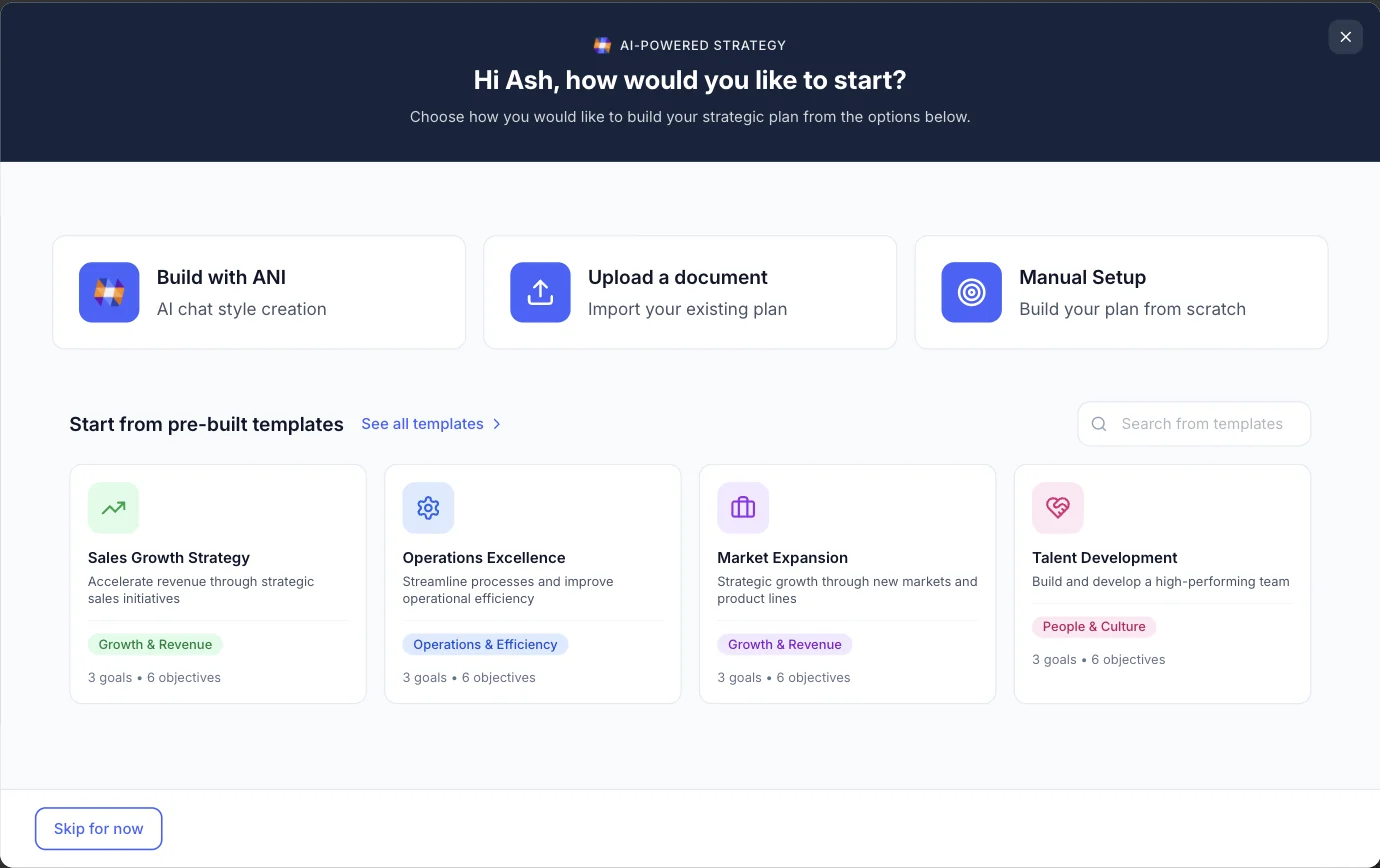
Build it with ANI
Answer a few questions and ANI drafts the goals, objectives and actions for you to edit.
Upload what you already have
Drop in the strategy document or deck you wrote last year. GPS turns it into a working plan.
Or start from a template
Templates come with goals and objectives already drafted for common plans.
Why this matters commercially
Software with opinions about methodology competes with you.
This is the part of the decision that has nothing to do with features. A firm sells a way of thinking, and a tool that arrives with its own is quietly teaching your client that the tool is the value.
Three things
The method is what you charge for
A firm sells a way of thinking. If the software arrives with its own methodology, it is competing with you inside your own client, and the client slowly learns that the system is the value rather than you. Every framework here is a plan structure you load, not a way of working you adopt.
Your version, not the textbook one
Nobody delivers a framework as published. Open any of these in the plan builder and change it: rename the goals, cut the objectives that never fit your clients, add the two you always add. It becomes one of your own templates, reusable across the book.
It runs when you are not there
A framework delivered in a workshop degrades the week after it. Loaded as a plan with owners, dates and measures, it is still running in week eight, which is when a client decides whether the engagement was worth it.
Pick one for a client you have in mind
Five questions, and a place to start.
Answer them about a real client. The second question is the one that decides; the others adjust it.
Where I would start
EOS (Traction)
Because an operating system rather than a goal format, which is what a client needs when the plan is fine and nothing happens on a Tuesday.
Driven mostly by: the plan exists and nothing happens
3 goals · 6 objectives, ready to apply into a client’s plan
Read the EOS (Traction) pageWorth a look either way: OGSM Framework, because a whole strategy on one page, which is what a business needs when the real problem is that nobody can state it.
A starting point, not advice. If you have been doing this for fifteen years you already know which framework this client needs, and the useful thing here is that all eleven have a page.
The fifteen
Every named framework, with what the plan carries.
The goal and objective counts are the product's own. 15 of the fifteen have a page of their own so far, and the rest are on the way; the ones that do are linked.
Setting goals
Structures for deciding what the year is for and how it is measured.
OKR Framework
Objectives with key results under them, each one measured rather than described. The client updates the number, so progress is a fact instead of a status colour somebody chose.
Strategy consultantsBusiness advisoryVenture capital
Read the pageSMART Goals
The plainest structure in the library, and the one to reach for with a client who has never written a plan down. Specific, measured, owned and dated, with nothing else to learn first.
Business advisoryAccountantsVenture capital
Read the pageMBO (Management by Objectives)
Individual objectives tied to the organisation’s, so a manager’s year and the company’s year are the same document. Pairs with a client who runs formal reviews.
Business advisoryStrategy consultants
Read the page
Operating systems
A rhythm the client runs on, not just a list of goals.
EOS (Traction)
Rocks, the scorecard and the accountability chart, running between your sessions rather than only in them. The weekly meeting has its agenda and the chart is live, not a PDF from the last offsite.
Business advisoryStrategy consultants
Read the pageHoshin Kanri
The deployment side of strategy: each level of the business carries the objective above it, so a plan agreed by the leadership team reaches the people who have to do it.
Strategy consultantsPrivate equity
Read the pageContinuous Improvement Plan
Incremental change with a place for it to be raised, voted on and tracked to done, rather than a suggestion box nobody empties.
Business advisoryStrategy consultants
Read the page
Scoring the business
Results beside the measures that produced them.
Balanced Scorecard
Four perspectives loaded as four goals, so financial results sit beside the customer, process and people measures that produced them. The version an accountant can hang actuals on.
AccountantsStrategy consultantsPrivate equity
Read the pageLean Strategy Map
Cause and effect drawn out, so the client can see which objective is supposed to move which result, and notices when one of them is doing nothing.
Strategy consultantsAccountants
Read the page
Reading the market
Position and competition turned into work with owners.
Porter's 5 Forces Plan
Competitive position turned into a plan: what the rivalry, the buyers, the suppliers, the substitutes and the new entrants each require you to do about them.
Strategy consultantsPrivate equity
Read the pageBlue Ocean Strategy
Value innovation as a structured plan rather than a workshop feeling. What to raise, what to cut, what to create, each with a measure on it.
Strategy consultantsPrivate equityVenture capital
Read the pageSWOT to Action
The workshop output most firms produce and then lose. Each strength, weakness, opportunity and threat becomes an objective with an owner, so the whiteboard turns into work.
Strategy consultantsBusiness advisory
Read the page
Phasing a plan
Getting from a three year intent to next Monday.
OGSM Framework
Objectives, goals, strategies and measures on one page. The framework that survives contact with a board because it fits on a single sheet and still carries numbers.
Strategy consultantsAccountants
Read the pageStrategic Roadmap
Strategy phased across time, so a three year intent has a next ninety days attached to it. The one to use when the gap between the vision and Monday is the actual problem.
Private equityStrategy consultantsAccountants
Read the pageMcKinsey 7S
Strategy, structure, systems, staff, skills, style and shared values as one diagnostic. Useful early, when you are being paid to work out what is actually wrong.
Strategy consultantsBusiness advisory
Read the pageGrowth Flywheel
Acquisition, retention and referral as one reinforcing loop rather than three departments. The plan that suits a client whose growth has to compound rather than be bought.
Venture capitalGTM specialistsStrategy consultants
Read the page
How a framework becomes a plan
Four steps, and the fourth is the one that compounds.
The first three get a client running. The fourth is how a practice stops starting from scratch.
- One
Pick the framework
From the fifteen below, or from one of your own templates if you have already built your version.
- Two
Preview it, then apply it
Read the goals and objectives it carries before anything touches a client. Then apply it into that client’s plan from myPortal, in one action.
- Three
Make it theirs
Owners, dates and the measures that matter to this client. The structure came ready-made; the content is the work you are paid for.
- Four
Save it as your own
Once you have changed it twice the same way, save it as a template. The next client starts from your version rather than the library’s.
And ten for your own practice
The firm is a business too.
These are plans about your own book rather than a client's, and they are the fastest way a partner gets fluent in the product before a client ever sees it.
Client Acquisition Engine
A predictable pipeline of qualified clients through systematic outreach, instead of a book that grows by referral and then stops.
Strategy consultantsBusiness advisorySales coachesSales consultantsGTM specialists
Recurring Revenue Model
Turning project work into advisory retainers. The plan most firms say they want and few write down.
Strategy consultantsAccountantsBusiness advisorySales consultants
White-Label Partnership
Scaling through partnerships and alliances, which is the same shape as the arrangement this page is offering you.
Strategy consultantsBusiness advisory
Delivery Optimization
Systemising delivery so the same engagement takes less of the partner and more of the method. Where practice margin actually comes from.
Strategy consultantsBusiness advisorySales consultants
Team Expansion Strategy
Building advisory capacity past the founder. Pairs with the capacity view, which tells you whether you needed the hire.
Strategy consultantsBusiness advisory
Strategic Partnerships
Growth through alliances with firms that sell to the same client for a different reason.
Strategy consultantsGTM specialists
Thought Leadership Authority
Content, speaking and recognition as a plan with measures on it, rather than a thing you do when a quarter is quiet.
Strategy consultantsSales coachesGTM specialists
Premium Pricing Strategy
Moving from a day rate to a price attached to the outcome. Hard to do without evidence of the outcome, which is the other half of what the product gives you.
Strategy consultantsSales coachesBusiness advisory
Technology Enablement
Using software to scale delivery and the client experience, which is the plan you are reading this page in the middle of.
Strategy consultantsBusiness advisoryAccountants
Client Success & Retention
Lifetime value through outcomes and relationships. A retained client is worth more than a won one, and costs a fraction as much.
Strategy consultantsAccountantsSales coaches
The rest of the library
220 plans across 18 categories.
The useful fact is not the total. It is that the client sitting in front of you is probably in one of these, and there is something written for them already.
- Miscellaneous (Blue Collar & Trades) (28)
- Financial & Performance (16)
- Operations & Efficiency (16)
- Frameworks (15)
- Marketing & Brand (15)
- Growth & Revenue (12)
- People & Culture (11)
- Consulting & Advisory Growth (10)
- Customer & Retention (10)
- Diversity, Equity & Inclusion (10)
- E-Commerce (10)
- Innovation & Technology (10)
- Launching a Business (10)
- Portfolio & Governance (10)
- Risk Management & Resilience (10)
- Strategic Partnerships & Alliances (10)
- Sustainability & ESG (10)
- Exit Strategy (7)
Counted in myPortal on 30 September 2026. If a category has grown since, the number here is the one to correct.
Questions
What firms ask about the frameworks.
Which strategy frameworks does Empiraa support?
Fifteen are ready-made plans in the library: OKR Framework, Balanced Scorecard, EOS (Traction), Hoshin Kanri, McKinsey 7S, OGSM Framework, SMART Goals, SWOT to Action, MBO (Management by Objectives), Continuous Improvement Plan, Porter's 5 Forces Plan, Blue Ocean Strategy, Lean Strategy Map, Growth Flywheel, Strategic Roadmap. Each one loads into a client’s plan as goals with objectives under them, and can be edited into your own version in the plan builder.
Is Empiraa affiliated with EOS Worldwide, Kaplan and Norton or any framework owner?
No. Empiraa supports these frameworks, which means the plan structures are in the library and the software runs them. It is not affiliated with, endorsed by, certified by or licensed by the people or organisations behind any of them. If you are a certified implementer of a methodology, your certification is yours and nothing here changes it.
Can I use my own framework instead?
Yes, and most firms end up doing exactly that. The plan builder in myPortal builds a plan structure from scratch or from one of these, and saves it as your own template. The library exists so a new client can start from something rather than an empty page, not so that you adopt somebody else’s method.
Is the software tied to one framework, like Ninety is to EOS?
No, and that is the difference worth understanding before you choose. Software built around one methodology is excellent at that methodology and cannot run another, which is a problem for a firm whose clients are not all on the same one. Empiraa GPS is framework-agnostic: the structure is data, so two clients in the same practice can run two different methods. Compared with Ninety.
How many plans are in the library altogether?
220 across 18 categories. Fifteen are the named methodologies on this page, ten are about running your own practice rather than a client, and the rest are written for a specific industry: 28 of them are blue collar and trades.
Do I have to use a framework at all?
No. Plenty of clients are better served by goals with owners and measures and no methodology on top, particularly a client who has never written a plan down. SMART Goals is the closest thing to that in the library, and starting there and adding structure later is a legitimate sequence rather than a failure to commit. SMART Goals.
Load the one you already sell.
Bring a client you have in mind and the framework you would use with them, and see what it looks like in their workspace under your logo.