

The flywheel, delivered to your clients
One test tells you if it is a flywheel. Most diagrams fail it.
Remove a step. If the other steps carry on at the same speed, you have drawn a process in a circle rather than a reinforcing loop. A real flywheel gets easier to turn, and that only happens if each step genuinely feeds the next, which is harder to find than it is to draw.
- Each step as an objective that feeds the next
- A measure on every turn
- A branded workspace per client
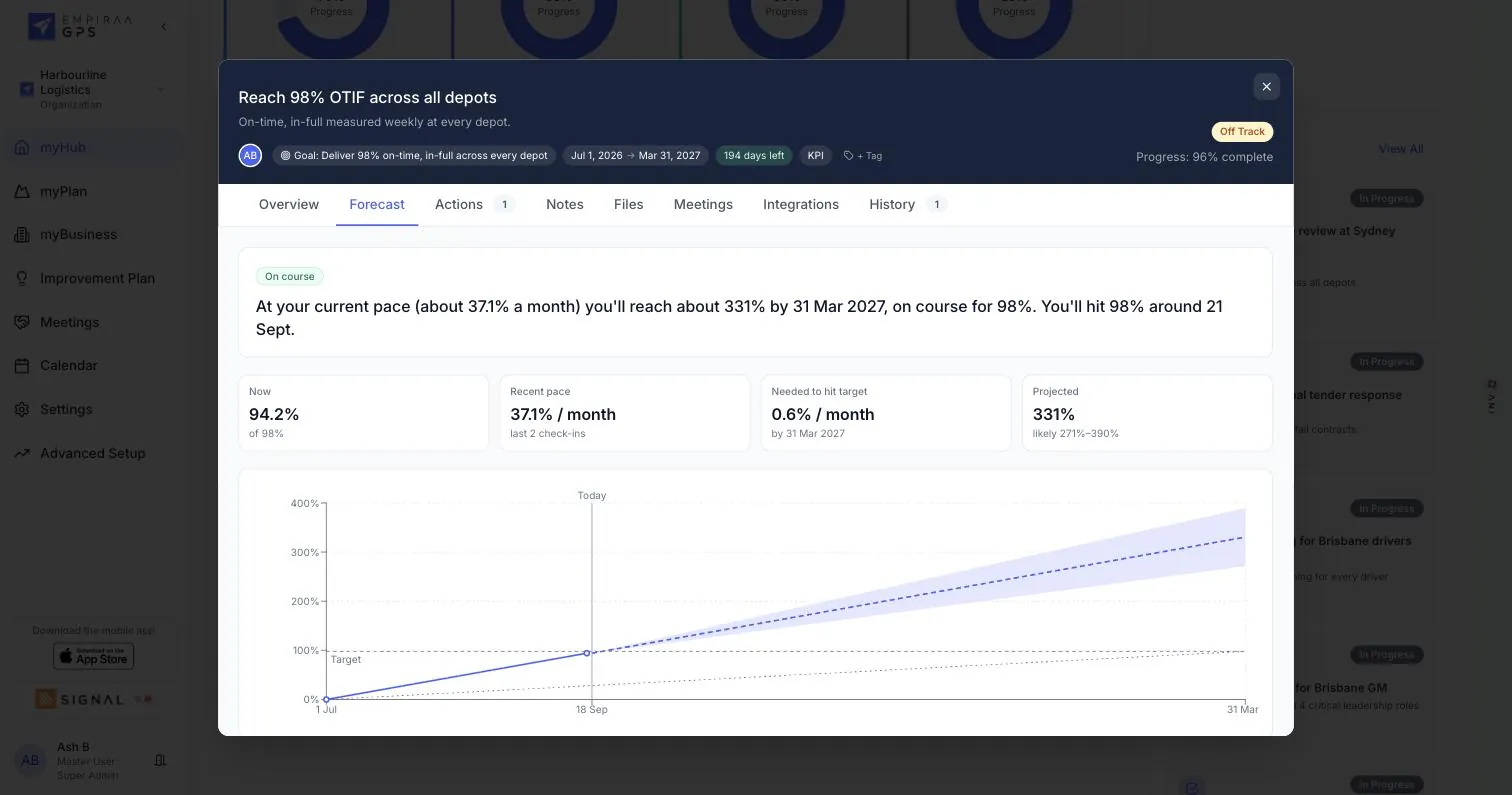
A plain-English forecast
Current pace, where it lands, and the date it hits target, in one sentence.
Recent pace
Worked out from the last check-ins, not from an average of the whole year.
The pace you need
What the number has to do each month from here to make the date.
Charted with a range
The projection with its likely band, so you can see how firm the call is.
What it is
A loop where each turn makes the next one easier.
Jim Collins set the flywheel out in Good to Great in 2001 and returned to it in Turning the Flywheel. The version most people have seen is HubSpot’s, which repositioned the sales funnel as a loop.
The mechanical image is the argument. A heavy flywheel takes enormous effort for the first few turns and almost none for the thousandth, because momentum accumulates. Collins’ observation was that the companies that made a durable leap could describe a small number of components where each one’s output was the next one’s input, so effort compounded rather than being spent again every quarter.
The classic business example is the one Collins drew with Amazon: lower prices bring more customers, more customers bring more sellers, more sellers widen selection, wider selection brings more customers, and the scale that results lowers the cost base, which lowers prices again. Each arrow is a real causal claim. That is what makes it a flywheel rather than a diagram.
Which gives you the test, and it is the most useful thing on this page. Take any step out. If the others keep turning at the same rate, the loop was not reinforcing and what you have drawn is a process with the ends joined up. Almost every flywheel in a client deck fails this, because it is a funnel bent into a circle: awareness, consideration, purchase, advocacy, back to awareness, with no actual mechanism by which advocacy produces awareness at scale.
The other half of the framework, which is easy to skip, is that a flywheel has a direction and a speed. You are meant to pick the one component that most constrains the loop and push there rather than everywhere, which is the same discipline Hoshin Kanri applies to deployment.
- Each component’s output is the next component’s input
- The test: remove a step and see whether the others slow down
- Momentum accumulates, so effort compounds rather than resetting
- Push on the one component that constrains the loop, not on all of them
In the library
Growth Flywheel is a ready-made plan, not a setting.
The ready-made plan holds the loop as objectives that feed each other, with a measure on each turn, so momentum is something the client can see rather than something you assert in a review.
3 goals · 6 objectives, loaded into a client’s workspace in one action
What the plan carries
Each step as an owned objective
Three or four components, one owner each, and the causal claim written down. An arrow nobody owns is a drawing, and an arrow nobody can defend is the step where the loop is actually broken.
A measure per turn
Not just the output at the end. If acquisition is meant to feed retention, retention needs its own number, or you cannot tell whether the loop is turning or whether one step is carrying all of it.
The constraint, named
One component is slowing the loop more than the others. Naming it and pushing there is the framework’s actual instruction, and it is the difference between compounding and four simultaneous half-efforts.
Whether the loop is actually turning
Every update to acquisition, retention and referral over time, so a flywheel that has stopped spinning shows as a flat line rather than as a feeling.
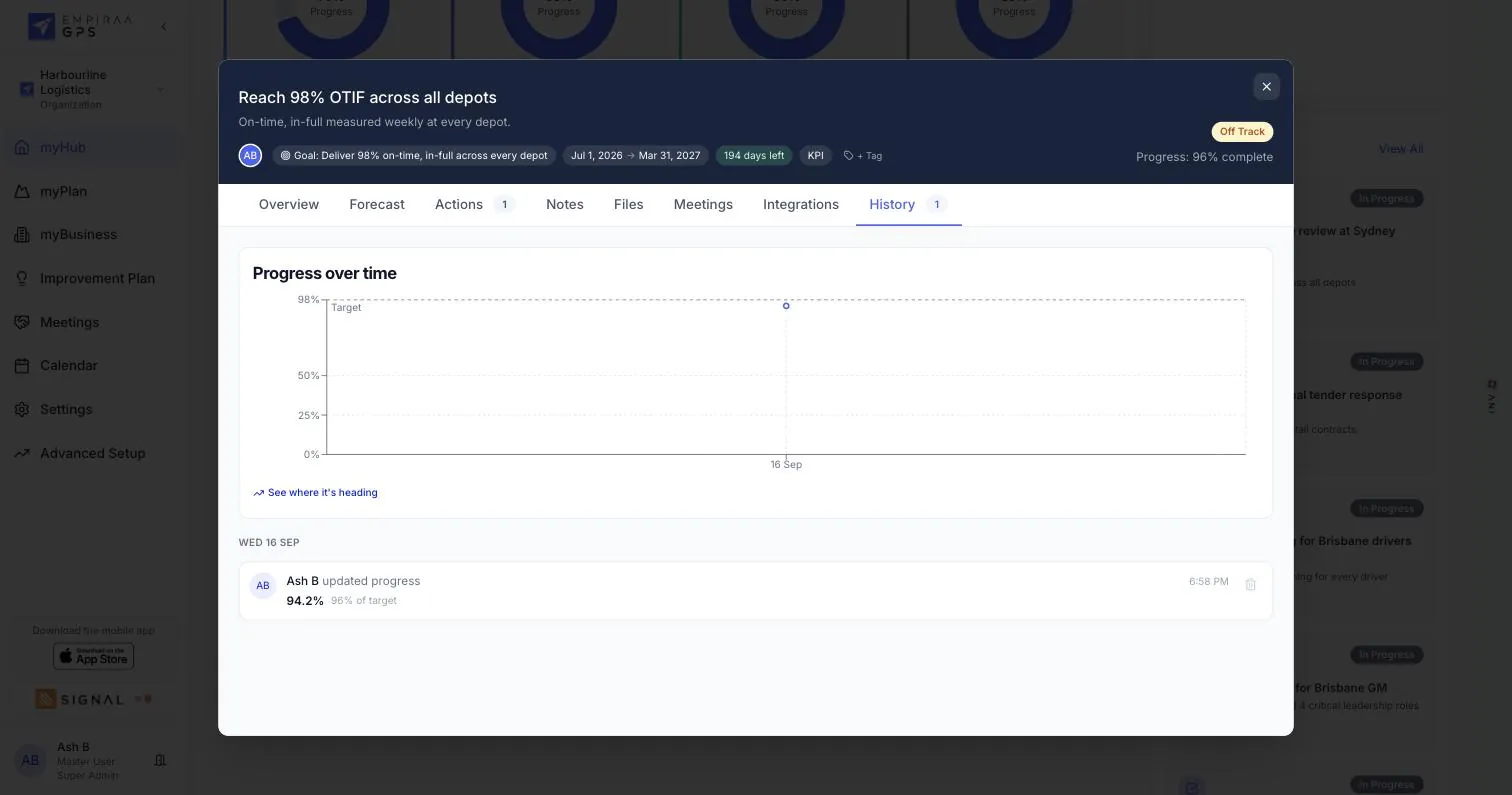
History sits on the objective
Not in a report somebody has to run. It is a tab on the thing it is the history of.
Every update, plotted
Against the target line, so a measure that moved once in a quarter looks like one that moved once in a quarter.
See where it is heading
Projected from the pace it is actually running at.
Who moved it, and when
Each change attributed, with the value and what share of target it reached.
Delivering it
Run the test in the room, before anybody draws anything.
Three steps, and the first one will save you an entire engagement built on a loop that was never a loop.
- One
Find the real causal arrows
For each proposed link, ask what mechanism makes it true and what would prove it. Where nobody can answer, the link is aspirational and the loop stops there. Better found in week one.
- Two
Pick the constraint and push on it
One objective with weight behind it, rather than four with a quarter each. This is the part clients resist, because pushing on one component looks like ignoring three.
- Three
Set the client’s expectations about time
Say out loud that the first turns are slow and that month three will look like failure. A client who has not been told that will stop before the compounding starts, which is the most common way this framework fails.
Where it does not fit
Three limits, and the second one ends most flywheel engagements.
The flywheel is a strong idea with a weak track record in practice, and the reasons are worth knowing before you sell one.
It is a metaphor, not a method
Nothing in the framework tells you what your loop is. Finding the genuine reinforcing components in a specific business is the entire difficulty, and the flywheel gives you a shape to put the answer in rather than a way of reaching it.
It needs more patience than a client has
Slow first turns are the design, not a fault, which means month three looks identical to failure. A client reading it quarterly against a revenue number will kill it in the exact period where it is working as intended. Set that expectation in the first session or do not use the framework.
A funnel in a circle passes for one
Because the diagram is easy and the test is not, most flywheels in circulation are processes with the ends joined. If your client already has one, run the removal test on it before building on top of it.
The client in front of you
Is Growth Flywheel the right call for this client?
Five questions about them, not about you. The answer is graded rather than yes or no, and it names what to compare against either way.
Yes
On these answers Growth Flywheel is where I would start.
Growth Flywheel is worth it here because a reinforcing loop rather than a funnel, for a business whose growth has to compound rather than be bought again each quarter.
Decided mostly by: growth has stalled and more of the same is not working
Also worth reading: Blue Ocean Strategy, because the four actions grid forces a client to choose what to stop, which is the move when more of the same has stopped working.
A starting point, not advice. You know this client and this tool does not, and the useful part is that whichever framework it names has a page with the plan already built.
Who reaches for it
The firms that arrive already selling this.
Each of these is a page in its own right, with the argument written for that profession rather than for a framework.
Venture capital
You have no governance rights and forty founders.
Read their argumentGTM specialists
You deliver a system. They have to buy five tools to run it.
Read their argumentStrategy consultants
You wrote the plan. Somebody has to run it.
Read their argumentOr read a framework that fits better
Blue Ocean Strategy
When the client needs a position rather than a loop. Blue ocean creates an advantage; a flywheel compounds one that already exists.
Read itHoshin Kanri
When the constraint is known and the problem is getting the whole business to push on it. Hoshin is the deployment discipline a flywheel assumes you already have.
Read itOKR Framework
When the client needs measured quarterly outcomes and the compounding story is a distraction from a team that is not hitting anything yet.
Read itQuestions
Growth Flywheel, answered.
What is a growth flywheel?
A small number of components arranged so that each one’s output is the next one’s input, which means effort accumulates instead of being spent again each quarter. Jim Collins set it out in Good to Great in 2001. The most widely seen version is HubSpot’s, which repositioned the sales funnel as a loop.
How do you tell a flywheel from a funnel drawn in a circle?
Remove a step. If the other steps carry on at the same rate, the loop was not reinforcing and what you have is a process with the ends joined up. Most flywheels in client decks fail this test, usually at the step where advocacy is assumed to produce awareness with no mechanism behind it.
Why do flywheel strategies fail?
Usually patience. Slow first turns are the design rather than a fault, so month three looks exactly like failure, and a client measuring quarterly against revenue will stop in the period where it is working as intended. The second reason is that the loop was never real. The third is pushing on all components at once instead of the one that constrains it.
Is the flywheel the same as the Amazon flywheel?
The Amazon loop is the best known example and Collins drew it with them: lower prices bring customers, customers bring sellers, sellers widen selection, selection brings customers, and scale lowers the cost base which lowers prices again. It is a good illustration because every arrow is a defensible causal claim, which is exactly what most drawn flywheels lack.
Is there flywheel software in Empiraa?
Growth Flywheel is a ready-made plan in the strategy library, with three goals and six objectives, shaped as components that feed each other with a measure on each turn. It does not draw the loop for you. It holds the loop you found, with owners on it, long enough for the compounding to show. Every framework in the library.
Bring one client and see.
Load the framework you already sell into a client's workspace under your own logo, and see whether it survives the eight weeks between your sessions.