

The five forces, delivered to your clients
Everybody can run the analysis. Almost nobody turns it into work.
A five forces analysis is a good week’s consulting and a terrible deliverable, because nothing in it has an owner or a date. Load it as a plan and each force that actually threatens the client becomes an objective somebody is accountable for, inside their own workspace under your branding.
- Each force becomes owned work
- A workspace per client, branded as you
- Pairs with a planning framework for the year
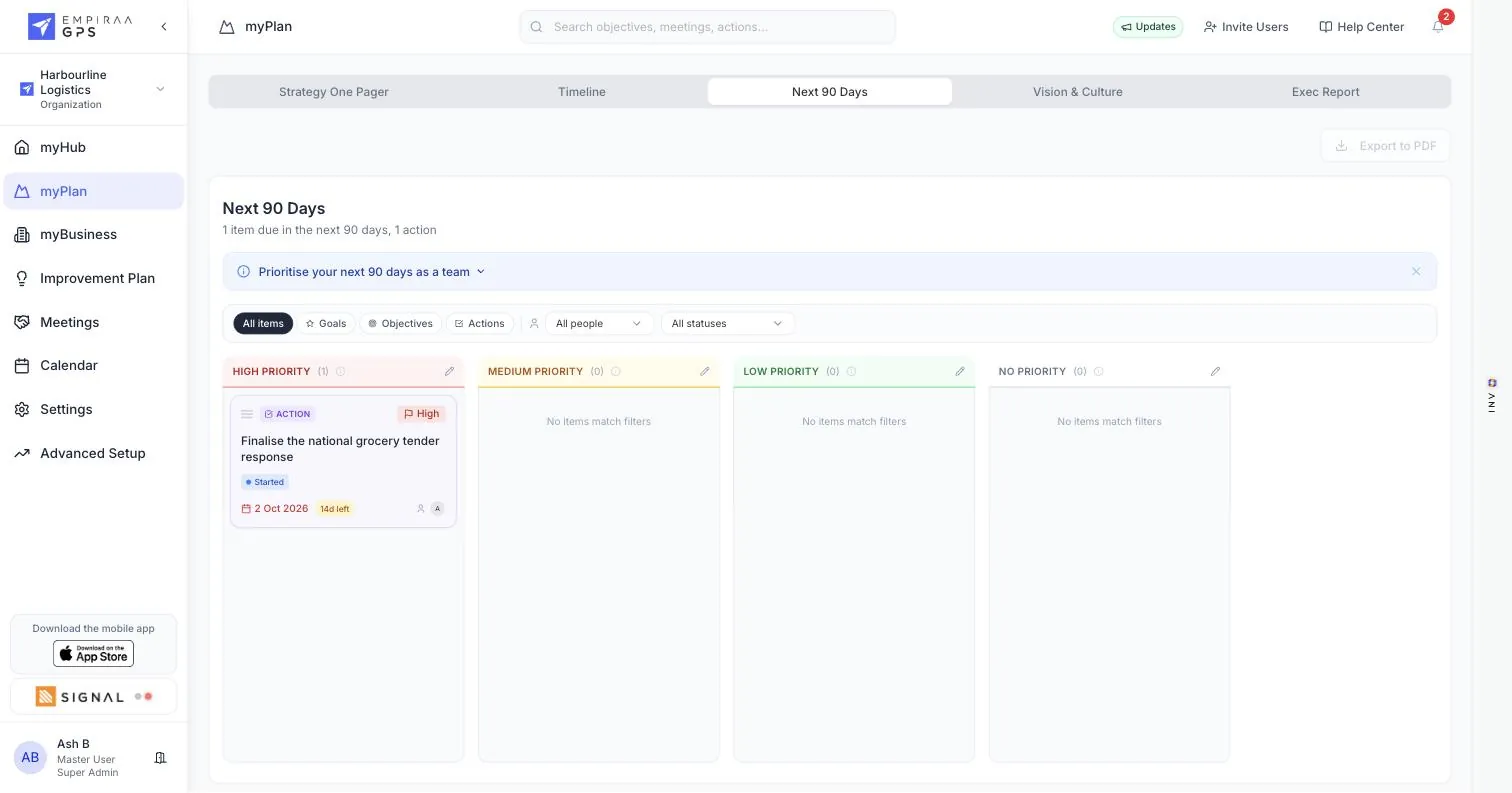
What is actually due
Everything landing in the next 90 days, pulled from the plan rather than typed up again.
Drag it into priority
High, medium, low or none. The argument happens here, once, instead of every week.
Empty columns are an answer
If nothing is medium priority, the team has said so out loud.
What it is
It is a model of industry profitability, not a list of your competitors.
This is the misreading that makes most five forces work useless, and Porter himself spent a 2008 revisit of the framework correcting it.
Michael Porter set the framework out in the Harvard Business Review in 1979 and expanded it in Competitive Strategy the following year. The question it answers is why some industries are structurally more profitable than others, and the answer is that five forces between them determine how much of the value created in an industry the companies in it get to keep.
Rivalry among existing competitors is the one everybody starts with, and it is only one of five. Threat of new entrants is about barriers: how hard is it for somebody to start doing this. Threat of substitutes is the one most often missed, because a substitute is not a competitor: it is a different way of solving the same problem, and it is usually what actually kills a business. Bargaining power of buyers and of suppliers are about who can squeeze the margin, which for most of your clients is the force with the most money attached to it.
The misreading is to treat it as a competitor audit. A firm names its three rivals, writes a paragraph under each heading, and produces a document that describes the industry to people who work in it. Porter returned to this in 2008 to say that managers define competition too narrowly, as if it occurred only among today’s direct competitors
. His point is structural: the forces explain the average profitability of the industry and what a company would have to do to sit above that average. Used properly it is uncomfortable, because the honest answer is sometimes that the industry is bad and the client’s margin problem is not a sales problem.
The second thing to be clear about is that the framework is an analysis. It diagnoses structure. It does not contain a strategy, it has no measures, and it will not tell a client which force to spend next year fighting. That choice is the consulting.
- Rivalry among existing competitors
- Threat of new entrants, which is a question about barriers
- Threat of substitutes, a different solution to the same problem
- Bargaining power of buyers, and of suppliers
In the library
Porter's 5 Forces Plan is a ready-made plan, not a setting.
The ready-made plan is built for the step after the analysis: the forces that genuinely threaten this client, each as an objective with an owner, a date and a measure that would show the position had improved.
3 goals · 6 objectives, loaded into a client’s workspace in one action
What the plan carries
Only the forces that bite
Three goals, not five, because a plan with an objective under every heading is a plan that has not made a choice. Two of the five usually do not matter much to a given client and saying so is the value.
A measure per position
Gross margin by segment for buyer power, win rate against a named substitute, cost to serve. Each objective carries the number that would show the position moved, tracked against where it should be by now.
How measures workReviewed on a cadence, because structure moves slowly
Industry structure does not change in a quarter, which is exactly why these objectives get abandoned. On a review cadence with progress visible, a two year position has somewhere to be six months in.
Position, with owners and dates on it
The reading of the market becomes actions somebody is accountable for. A five forces analysis that ends in a document has described the problem and changed nothing.
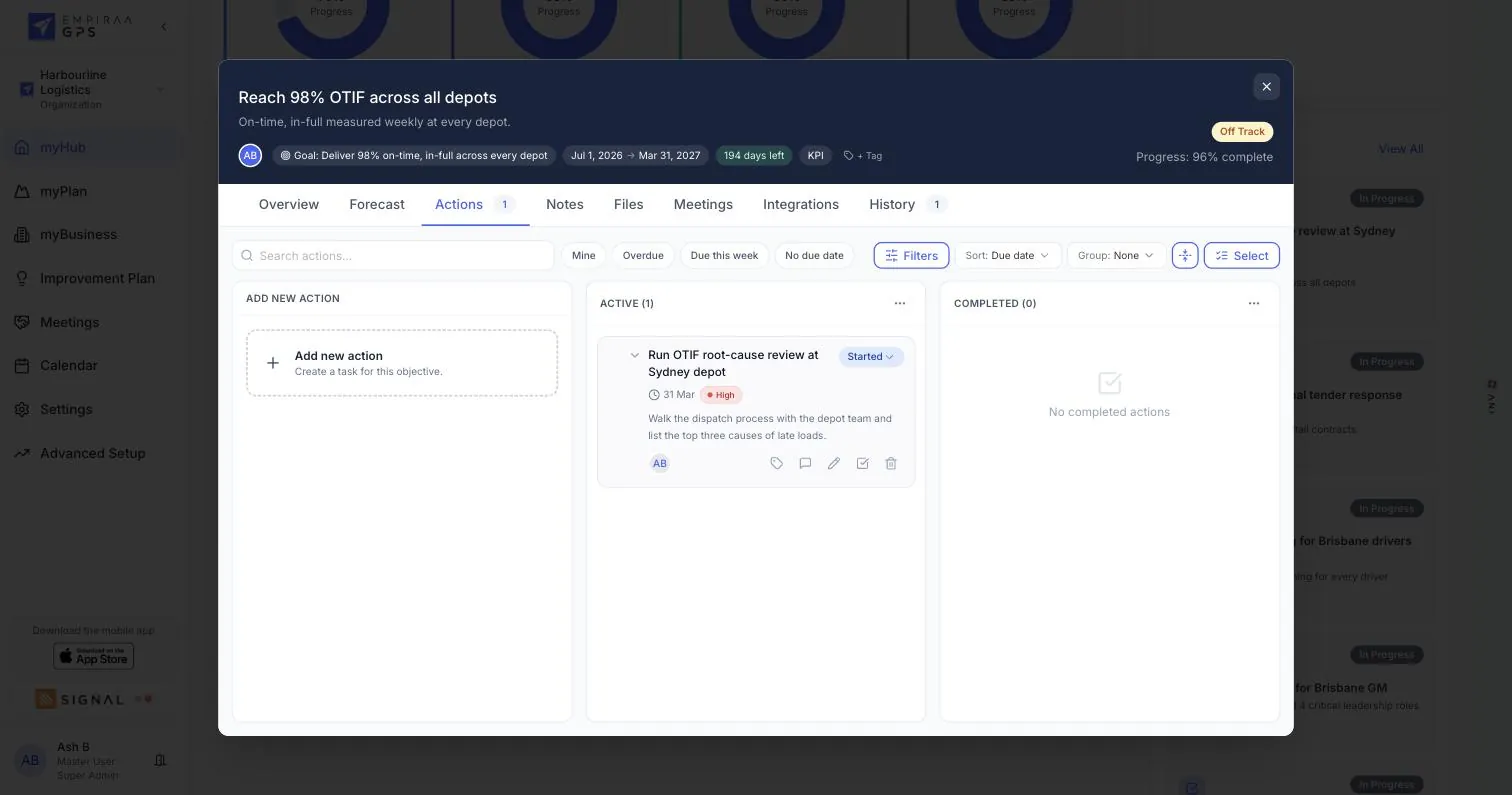
The goal it serves
Every objective is attached to one, so an action can be traced up to the strategy without a mapping document.
Off track, and by how much
Measured against where it should be by today, not against the deadline.
One action, with everything on it
Owner, due date, priority and status. An action with none of those is a note.
Completed, and how many
The column nobody fills in by hand, which is why it can be believed.
Delivering it
Three steps, and the second one is where the fee is.
The analysis is the part a client could have read about. Choosing which force to fight, and being right, is the part they cannot.
- One
Run the analysis at industry level
Structure, not a competitor list. The output you want is where the value in this industry leaks and to whom, which is often the supplier or the buyer rather than the rival.
- Two
Pick the two that matter, and say so
A plan against all five is a plan against none. Applied into the client workspace as two or three objectives with owners, so the choice is visible and defensible rather than buried in a report nobody disagrees with.
- Three
Give it a horizon it can survive
Structural positions take years. Put them on a plan with a review cadence rather than a quarter, or the client will conclude in month three that the work failed.
Where it does not fit
Three limits, two of them famous.
The framework has been argued with for forty years and the criticisms are worth knowing, because a client with an MBA will raise them.
It contains no strategy
Five forces tells a client the shape of the industry they are in. It does not say what to do, and a client expecting a recommendation out of the framework itself is a client who will be disappointed by the analysis and blame the analyst.
It is industry level, so it misses the firm
Two businesses in the same industry face the same five forces and perform completely differently, which the framework cannot explain. That gap is what resource and capability thinking fills, and it is why five forces is normally one input rather than the engagement.
It needs you to say what the industry is
The framework works best where the boundary is clear. Where platforms and ecosystems blur it, the analysis gets argued about before it gets used, and somebody proposes a sixth force. Worth knowing that Porter answered that himself in 2008: government and complements are not a sixth force, they matter only through their effect on the five. Useful line to have ready.
The client in front of you
Is Porter's 5 Forces Plan the right call for this client?
Five questions about them, not about you. The answer is graded rather than yes or no, and it names what to compare against either way.
Yes
On these answers Porter's 5 Forces Plan is where I would start.
Porter's 5 Forces Plan is worth it here because a structured read of industry position, which is where a losing business usually finds the reason it is losing.
Decided mostly by: they are losing and nobody can say to whom
Also worth reading: Blue Ocean Strategy, because the four actions grid forces a client to choose what to stop, which is the move when more of the same has stopped working.
A starting point, not advice. You know this client and this tool does not, and the useful part is that whichever framework it names has a page with the plan already built.
Who reaches for it
The firms that arrive already selling this.
Each of these is a page in its own right, with the argument written for that profession rather than for a framework.
Strategy consultants
You wrote the plan. Somebody has to run it.
Read their argumentPrivate equity
Fourteen companies, fourteen spreadsheet formats.
Read their argumentOr read a framework that fits better
Blue Ocean Strategy
The natural answer when the five forces conclusion is that the industry is structurally unattractive. One framework says the fight is bad; the other says stop having it.
Read itMcKinsey 7S
If the analysis says the industry is fine and the client is still losing. That is an internal problem and five forces cannot see it.
Read itOGSM Framework
What comes after. Once you have chosen which force to fight, OGSM is how the year gets written down so a board can read it.
Read itQuestions
Porter's 5 Forces Plan, answered.
What are Porter's Five Forces?
Rivalry among existing competitors, the threat of new entrants, the threat of substitutes, the bargaining power of buyers and the bargaining power of suppliers. Michael Porter set them out in the Harvard Business Review in 1979 and expanded them in Competitive Strategy in 1980. Together they explain why some industries are structurally more profitable than others.
Is it about competitors or about the industry?
The industry. This is the most common misuse: the framework is treated as a competitor audit, three rivals get a paragraph each, and the output describes the industry to people who already work in it. Porter’s argument is structural, about the average profitability of an industry and what a company would have to do to sit above it, and he revisited the framework in 2008 partly to make that point again.
Which force is most often missed?
Substitutes. A substitute is not a competitor, it is a different way of solving the same problem, which means it does not show up in a competitor list and it is frequently what actually takes the market. Buyer power is the second most often underweighted, and it is usually the one with the most money attached.
Does the analysis tell you what to do?
No, and it is not supposed to. It diagnoses industry structure. Choosing which force to spend next year on, and being right, is the consulting, and that is the step the ready-made plan is built for: two or three objectives with owners and measures rather than a paragraph under all five headings.
Is there five forces software in Empiraa?
Porter's 5 Forces Plan is a ready-made plan in the strategy library, carrying three goals and six objectives. It is not an analysis tool: it is the structure for the work that follows the analysis, so the positions you chose have owners, dates and measures inside the client’s own workspace.
Is there a sixth force?
Porter’s answer is no. Government and complementary products are the two most often proposed, and he addressed both when he revisited the framework in 2008: they matter only through their effect on the five forces, by changing barriers to entry or buyer power or the threat of substitution, so treating either as a force of its own double counts. Where the criticism does land is that the framework is industry level and cannot explain why two businesses facing identical forces perform differently.
Can I run it alongside a planning framework?
Yes, and it is the normal sequence. Five forces or 7S for the diagnosis, then OGSM or the Balanced Scorecard for the year, both applied into the same client workspace. The plan structure is data, so two frameworks coexist rather than competing. Every framework in the library.
Bring one client and see.
Load the framework you already sell into a client's workspace under your own logo, and see whether it survives the eight weeks between your sessions.