

For business advisory and coaching firms
The rhythm is you. It has to work when you are not in the room.
The week you facilitate, it works. The five weeks after it, the scorecard goes stale, the accountability chart is a PDF from the last offsite, and the quarterly priorities are in a spreadsheet only the operations person opens. Load the rhythm as a plan in the client’s own workspace and it is still running when you walk back in.
- EOS loads as a ready-made plan
- The accountability chart, live
- A branded workspace per client
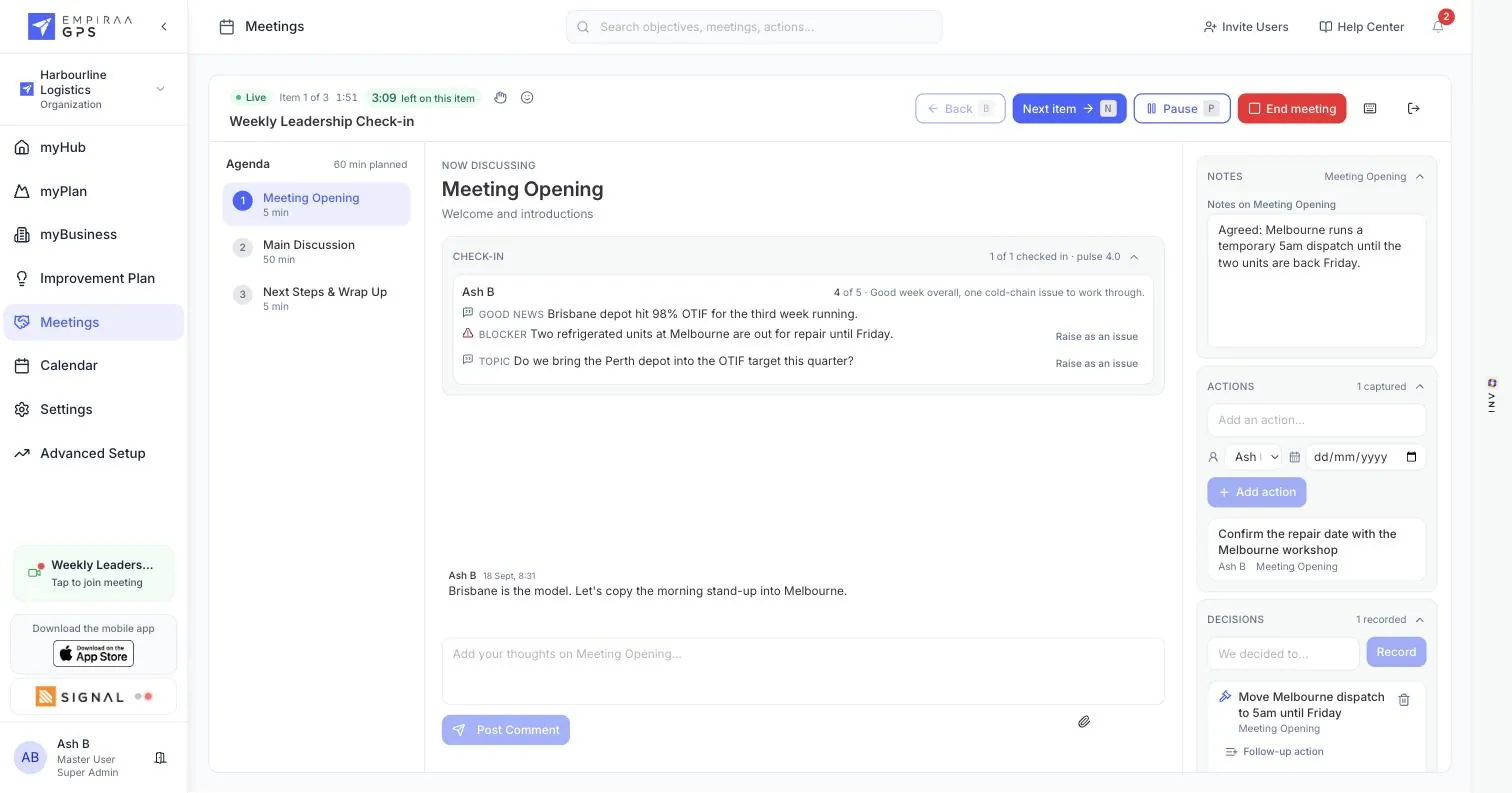
A clock on every item
Time left on this item, in front of everyone. Meetings finish when they are meant to.
The check-ins in front of you
Headlines and blockers roll up under the item, and a blocker becomes an issue in one click.
Actions as they are agreed
An owner and a date, captured without anyone leaving the meeting to write it down.
Decisions on the record
What the team decided, kept and searchable afterwards.
What they are paying you for
A cadence, and the discipline to keep it.
The weekly leadership meeting that ends in decisions. The quarterly reset that picks three things and drops the rest. The scorecard that makes a number going the wrong way a conversation rather than a surprise. A chart that says who owns what, so the same issue stops arriving in two different meetings.
None of that is knowledge the client lacks. It is behaviour the client cannot sustain alone, which is why they hire a person rather than buy a book, and why your renewal depends on whether the behaviour held rather than on whether the framework was explained well.
Where it stops working
The gap between sessions, every time.
The rhythm has a single point of failure and it is you being in the room. In the gap, the scorecard is a tab somebody forgot, the priorities drift out of anybody’s eyeline, and the issues list becomes whatever was raised loudest last Tuesday.
So the next quarterly is not facilitation, it is restarting. You spend the morning rebuilding what should have been maintained, the client privately concludes the process needs you to work, and they are right, which is flattering for exactly as long as it takes them to decide that is too expensive.
- The scorecard degrades within two weeks of a session
- The accountability chart is a document, so it is wrong the moment somebody moves
- Quarterly priorities live where only one person looks
- Every session opens with a reconstruction instead of a discussion
What is different
The artefacts stay alive in the gap.
Four things. The last one is the one no other tool in this category does, and it is what turns a practice from you into a method.
- EOS loads as a plan, so the rocks, the scorecard and the measures are in one place the client opens on a Monday rather than one you bring with you
- The weekly meeting has its agenda, its check-ins and its issues list in the product, and what was agreed becomes an action with a name on it before anybody leaves
- The accountability chart is live, and it flags a leader carrying more objectives than the rest of the team, which is the conversation you were going to have to open carefully anyway
- You set how the client’s AI behaves once, across every client, so the advice they get between your sessions sounds like your practice and not like a general-purpose chatbot
Implementers are hired for the rhythm and judged on whether it survived the gap. This closes the gap.
How an engagement runs
Your sessions, unchanged. The weeks between them, visible.
Nothing here facilitates for you or replaces a single minute of the work you are actually good at.
- At the offsite
Load the framework as their plan
EOS, or your own version of it, applied into the client’s workspace in one action, so the priorities are in the system before the room empties rather than typed up on Thursday.
- Every week
The meeting runs from the plan
Build the agenda once as a template and reuse it across every client. Check-ins arrive before the call, an issue can be raised from one, and what is agreed leaves with a name and a date on it.
- In the gap
Watch the drift, and name it early
Priorities against expected pace across your whole book. A client that stopped updating in week three shows up in week three, and a message then is worth an hour at the quarterly.
The chart is live, so the hard conversation opens itself
A leader carrying more objectives than the rest of the team is flagged by the product rather than raised by you. That is a different conversation from the one where you have to be the person who noticed.
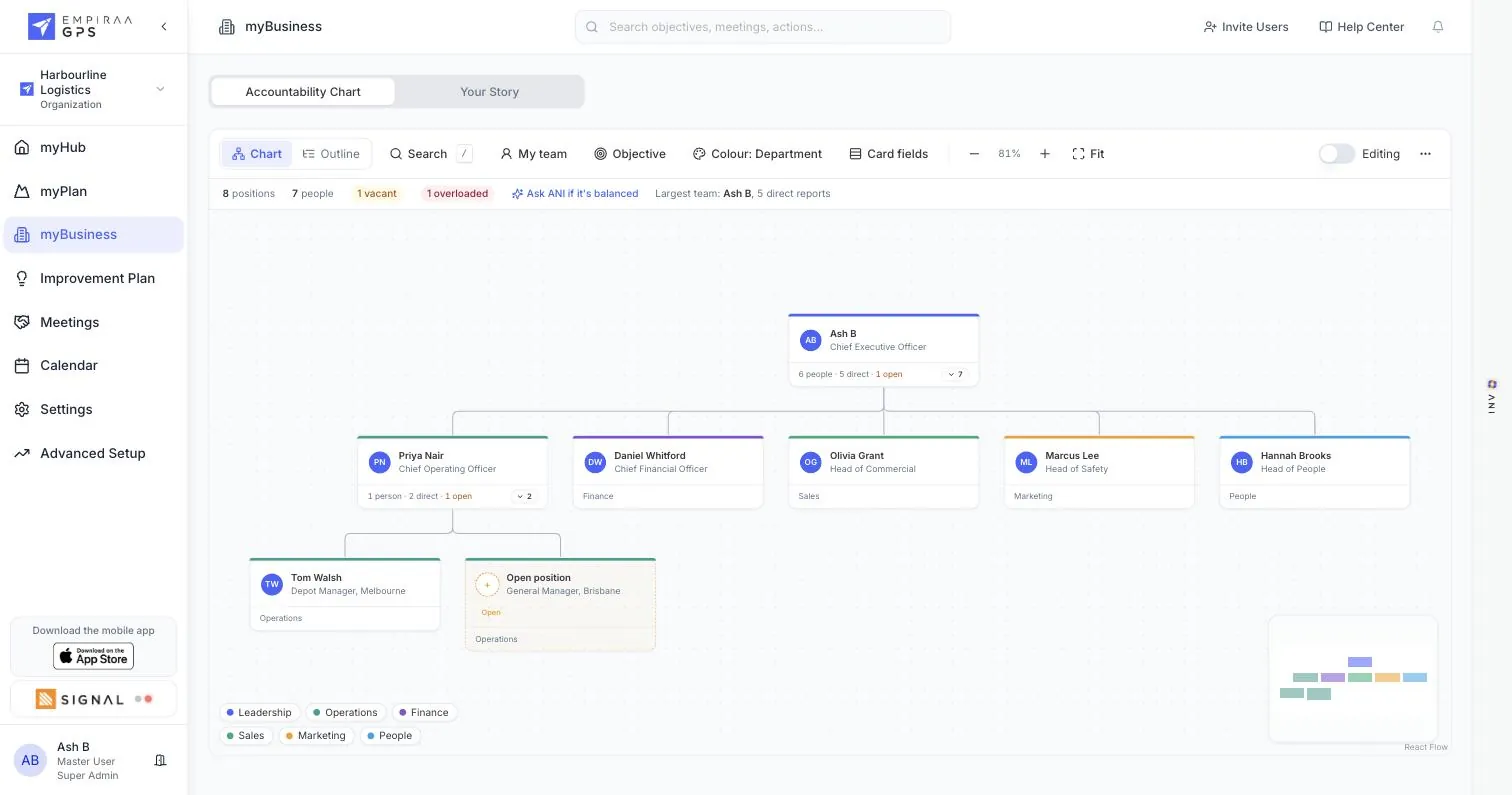
Vacant and overloaded, flagged
GPS counts the seats and the load, and tells you where the plan is exposed.
An open position
The roles you have not filled sit on the chart, so the gap is visible before it bites.
Objectives on the seat
Every card carries what that seat owns, so accountability is a fact rather than an assumption.
Ask ANI if it is balanced
A second opinion on whether the work is spread properly.
The frameworks you already sell
Loaded as plans, not adopted as a way of working.
The method is what you charge for. If the software arrives with its own, it is competing with you inside your own client. These are the ones this profession reaches for first.
EOS (Traction)
Rocks, the scorecard and the accountability chart, running between your sessions rather than only in them. The weekly meeting has its agenda and the chart is live, not a PDF from the last offsite.
Read the pageMBO (Management by Objectives)
Individual objectives tied to the organisation’s, so a manager’s year and the company’s year are the same document. Pairs with a client who runs formal reviews.
Read the pageContinuous Improvement Plan
Incremental change with a place for it to be raised, voted on and tracked to done, rather than a suggestion box nobody empties.
Read the pageSWOT to Action
The workshop output most firms produce and then lose. Each strength, weakness, opportunity and threat becomes an objective with an owner, so the whiteboard turns into work.
Read the pageThe rocks you left them with
Which of last quarter’s rocks could survive five weeks without you?
Put in three from the last offsite. The test is not whether they were the right rocks, it is whether anything other than your memory was holding them.
nothing measures it, so progress is an opinion; no date, so it is never late and never done.
nobody owns it, so nobody is asked about it; nothing measures it, so progress is an opinion; no date, so it is never late and never done.
1 of 3
Only 1 of these could be run by something other than you.
One is close and missing a field, which is the easiest kind to fix and the kind that quietly never gets fixed.
One is a statement of intent. Worth having in the document, impossible for anybody to act on.
A rock with an owner, a number and a date is a row in a workspace the client opens on a Monday. A rock without them is something you have to be in the room to hold, which is why the rhythm degrades in the five weeks you are not.
What this does not do
Three honest limits for an implementer.
If you run this for a living you will test all three in the demo, so they are here rather than there.
The scorecard is not a thirteen-week grid
Objectives are measured against where they should be by now, with current and target values. If the thirteen-column weekly grid read left to right is the centre of your session, look at this specifically before deciding. Some implementers run it happily; some want the grid.
The EOS page says moreIt cannot make anybody honest in a room
Somebody saying the uncomfortable thing, an issue being solved rather than aired, a leader admitting a priority will not land: that is the whole craft and it is entirely yours. A tool claiming to supply it would be selling you something.
It is not practice management
No invoicing, no WIP, no utilisation reporting for your own firm. Time logged against a client’s retainer tells you whether they have been served, not what to charge. Your own systems keep doing that.
If that is not quite you
Business advisory is one of ten. These are the ones next to it.
Closely related work, bought for different reasons. If one of these describes your week better, read that page instead.
Business coaches
You work on the owner and the business around them rather than on a leadership team’s operating rhythm, and you are usually the only outsider in the room.
Read that pageStrategy consultants
You are hired to work out what the business should do, you deliver that as a plan and a set of choices, and the engagement is scoped to end at approval.
Read that pageAccountants
You already hold the client’s numbers, and the advisory work sitting on top of them is the thing you are trying to make repeatable and properly priced.
Read that pagePricing
Plans for your client workspaces.
Compare Professional Services plans by client workspace capacity.
Questions
Business advisory, answered.
Is there EOS software for implementers in Empiraa?
Yes. EOS (Traction) is a ready-made plan in the strategy library, and applying it gives a client a plan already shaped around quarterly priorities, an accountability chart and a weekly meeting. Empiraa is not affiliated with, endorsed by or certified by EOS Worldwide, and EOS and Traction are their registered marks. The EOS page.
How does this compare to Ninety?
Ninety is built around EOS and is very good at it, and that is also its limit: software built for one methodology cannot run another, which matters if your clients are not all on the same one. Empiraa GPS is framework-agnostic, and myPortal adds the layer Ninety has no equivalent of, which is your whole client book on one screen with your branding in every workspace and capacity across your consultants. Empiraa GPS compared with Ninety.
Is there an accountability chart?
Yes, and it is called that. Seats by function with the person in each, the ones still open marked, and a flag on a leader carrying more objectives than the rest of the team. It is live rather than a document, so it is right at the next session without anybody redrawing it. How the chart works.
Can I set how the AI talks to my clients?
Yes, and this is the part that turns a practice into a method. You set tone, how assertive it is, how strictly it sticks to the client’s own data and what it must not do, once, and every client inherits it unless you give one an override. You can read the exact instruction going into every answer for an account, word for word. The Autopilot tab.
Can I use my own version of the framework?
Yes, and most implementers do after two clients. Open any of the fifteen in the plan builder, rename the goals, cut what never fits, add what you always add, and save it as one of your own templates for the whole book. The fifteen frameworks.
Do my clients see each other?
No. Every client is a separate sub-account with its own workspace and users. The book view is yours, and no client can tell how many others you have.
Does this help me turn project work into a retainer?
That is the argument, and the arithmetic is worth doing with your own fees rather than taking ours. A retainer is not a pricing decision, it is an evidence problem: a client pays in month four when something visible happened in month three. A live plan is what makes that true, and the model on the consultants page compares the same delivery work priced both ways. The project against retainer model.
What do I earn on a client I bring?
30% recurring for the first twelve months they are with us, and once you hold three or more clients your own Empiraa Signal workspace is free for as long as you hold three. The partner terms.
Bring one client and see.
Fifteen minutes with one real client in mind, ideally the one you are slightly worried about.