

For business and executive coaches
They agree to three things. They do one.
You find out which one in the first twenty minutes of the next session, which is twenty minutes of the hour they are paying for. Put what was agreed somewhere with an owner and a date on it, and walk in already knowing.
- What was agreed, with dates on it
- Your branding in their workspace
- Progress visible between sessions
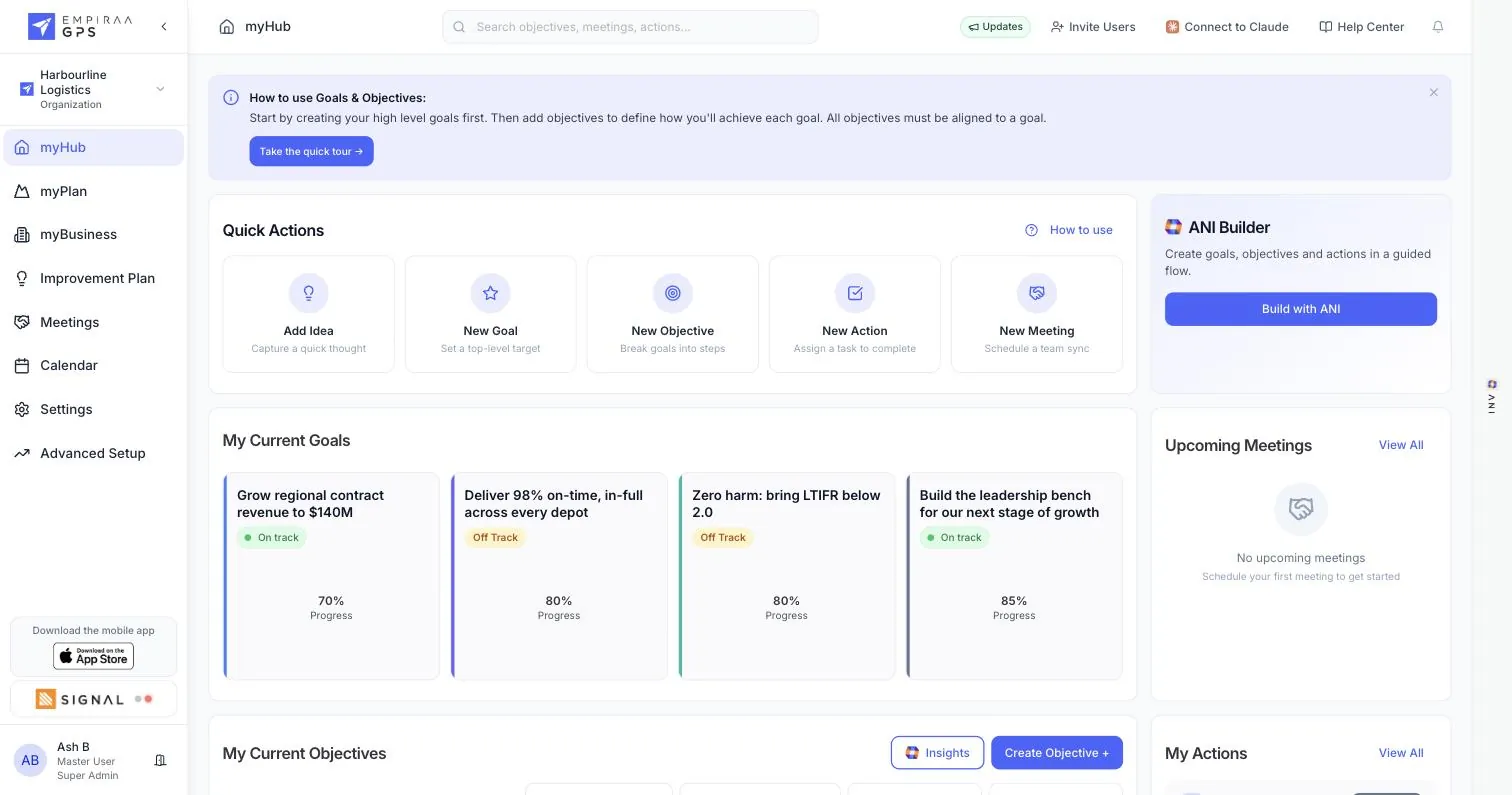
Your goals, with live progress
On track and off track at a glance, without asking anyone for an update.
Add anything in one click
An idea, a goal, an objective, an action or a meeting, from wherever you are.
Build with ANI
The guided flow that turns a thought into goals, objectives and actions.
What is coming up
The meetings and actions due, beside the plan they move.
What they are paying you for
The owner, and the business around them.
Clarity about what actually matters this year. The discipline to work on the business rather than in it. A structure for decisions the owner has been circling for eighteen months. And somebody who will ask the question nobody on their payroll is able to ask.
You are usually the only outsider in the room, which is the source of both the value and the problem: there is no second witness. Whatever happens between sessions happens without you, and the only record of it is what the owner tells you afterwards.
Where it stops working
The fortnight in between.
The session is good. They leave clear, they commit to three things, and the fortnight closes over the top of it. One gets done, usually the easiest. The second gets started. The third was the one that mattered and it has a reason attached to it by the time you next speak.
So the first twenty minutes of the next hour go on establishing which of the three you are dealing with, from an owner who is reconstructing their own fortnight while they tell you. That is a third of the session spent on discovery you should not have to do, and it happens every time.
- Three commitments, one done, and no way to know which until you are in the room
- A third of every session spent finding out what happened
- The only record of the fortnight is the owner’s account of it
- Renewal turns on rapport, because rapport is the only thing either of you can point at
What is different
The fortnight stops being invisible.
None of this coaches anybody. It removes the reason you have been coaching from memory.
- What was agreed becomes goals with owners and dates in the client’s own workspace, so the fortnight has something in it other than intention
- You can see what moved before the session, so the hour starts at the thing that did not move instead of at a status round
- The accountability chart shows an owner carrying work that should have been handed on, which is usually the conversation underneath the one they booked you for
- You set how the AI in their workspace behaves once, across every client, so what they hear between your sessions sounds like your coaching and not like a general-purpose chatbot
Coaching that can only see the room it happens in is priced as time. Coaching that can see the fortnight in between is priced as a result.
How an engagement runs
The same session. A different first twenty minutes.
Four things, and the second is the one that does the work.
- First session
Put the year somewhere they will open
The three or four things this year is actually for, in their own workspace under your logo rather than in your notes or a shared document nobody opens twice.
- End of every session
What was agreed becomes something with a date
The commitments come out of the session as actions with an owner and a date, in the same place as the goals they serve. That takes two minutes at the end of the hour and changes what the fortnight contains.
- Between sessions
Look before you walk in
What moved, what did not, and what has been sitting untouched since you last spoke. You arrive at the third thing rather than spending twenty minutes working out that it is the third thing.
- Quarterly
Show them the quarter they had
What was agreed, what happened and what did not, generated from the plan. An owner who can see the quarter renews on the record rather than on how the sessions felt.
You arrive knowing what did not move
Progress between sessions without asking for it, so the hour opens on the two things that slipped rather than on twenty minutes of finding out which two they were.
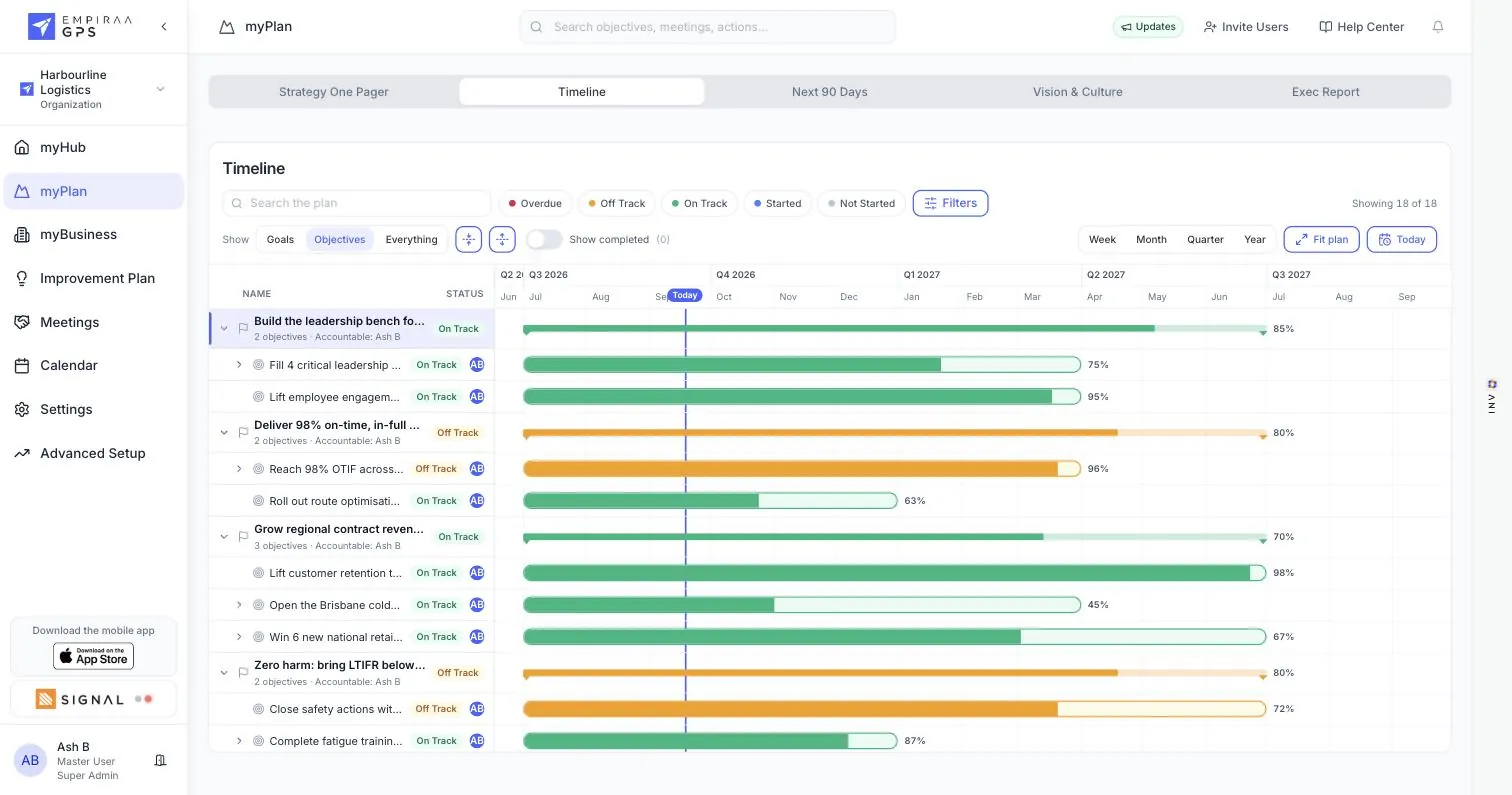
The today line
Every bar is read against it, so late work shows up as a gap rather than a status someone typed.
Filter to the problem
Overdue, off track, on track, started or not started, across every team.
Week to year
Zoom out for the board, in for the quarter, or fit the whole plan on one screen.
A goal and its objectives
Open a goal to see the measures under it and which one is dragging.
The frameworks you already sell
Loaded as plans, not adopted as a way of working.
The method is what you charge for. If the software arrives with its own, it is competing with you inside your own client. These are the ones this profession reaches for first.
SMART Goals
The plainest structure in the library, and the one to reach for with a client who has never written a plan down. Specific, measured, owned and dated, with nothing else to learn first.
Read the pageEOS (Traction)
Rocks, the scorecard and the accountability chart, running between your sessions rather than only in them. The weekly meeting has its agenda and the chart is live, not a PDF from the last offsite.
Read the pageSWOT to Action
The workshop output most firms produce and then lose. Each strength, weakness, opportunity and threat becomes an objective with an owner, so the whiteboard turns into work.
Read the pageMBO (Management by Objectives)
Individual objectives tied to the organisation’s, so a manager’s year and the company’s year are the same document. Pairs with a client who runs formal reviews.
Read the pageWhat they agreed to last time
Which of these could you check before the next session?
Put in three things the owner committed to at the last session. The question is whether anything other than the next conversation was holding them.
nothing measures it, so progress is an opinion; no date, so it is never late and never done.
nobody owns it, so nobody is asked about it; nothing measures it, so progress is an opinion; no date, so it is never late and never done.
1 of 3
Only 1 of these could be run by something other than you.
One is close and missing a field, which is the easiest kind to fix and the kind that quietly never gets fixed.
One is a statement of intent. Worth having in the document, impossible for anybody to act on.
They agree to three things and do one, and you find out which one in the first twenty minutes of the next session. A commitment with an owner, a number and a date is one you can see before you walk in, which is the difference between an hour of coaching and forty minutes of it.
What this does not do
Three things this will not do for you.
Worth saying plainly, because the category is full of software that claims the opposite and this audience has met all of it.
It does not create accountability
Accountability is a relationship, and it is most of what an owner is paying you for. A date on a task does not make somebody do it. What this does is remove the ambiguity about what was agreed, which is a different and much smaller thing, and it is the thing that was actually missing.
It is not a coaching platform
No session notes template, no coaching content library, no assessments, no CPD. It is where the client’s plan lives and where what you agreed gets tracked. Whatever you use for your own practice management stays.
An owner who will not open it will not open it
This works because the client uses it for their own reasons, not because you asked them to. An owner who wants a fortnightly conversation and nothing else is a real client, and for that engagement this adds very little.
If that is not quite you
Business coaches is one of ten. These are the ones next to it.
Closely related work, bought for different reasons. If one of these describes your week better, read that page instead.
Business advisory
You are hired for a rhythm rather than a document, you are in the room every quarter, and you are judged on whether the cadence survived the gap between visits.
Read that pageStrategy consultants
You are hired to work out what the business should do, you deliver that as a plan and a set of choices, and the engagement is scoped to end at approval.
Read that pagePricing
Plans for your client workspaces.
Compare Professional Services plans by client workspace capacity.
Questions
Business coaches, answered.
How is this different from the sales coaches page?
Different job, different platform. A sales coach changes how a team sells and needs visibility of activity and pipeline, which is Empiraa Signal. A business coach works on the owner and the direction of the business, which is Empiraa GPS. If you do both, you would run both, and plenty of coaches do. The sales coaches page.
Does the client see my branding?
Yes. Your logo, four interface colours and your typeface across every client workspace, set once. For a solo coach that matters more than it does for a large firm, because the workspace is one of very few things the client sees with your name on it between sessions. What the branding covers.
Can I set how the AI talks to my clients?
Yes, once, across your whole book. How it speaks, how hard it pushes, how strictly it sticks to the client’s own data, and what it must not do. You can load your own material and have it read before anything external, so what an owner hears at 11pm on a Tuesday sounds like your coaching rather than like a general-purpose chatbot. See the practice view.
I run EOS or Scaling Up. Does it have opinions about that?
No, and that is the point. Fifteen named methodologies are ready-made plans in the library including EOS, and your own version of any of them saves as a template for your whole book. Software with opinions about methodology competes with you inside your own client. The fifteen frameworks.
Most of my clients are one owner and a small team. Is this too much?
For some of them, honestly, yes. An owner with no leadership team who wants a fortnightly conversation is a real client and this adds little for them. It earns its place when there are other people who have to do things, because that is when what was agreed stops being something one person can hold in their head.
How many clients can I run in it?
Each client is their own workspace, and myPortal is the layer above them: every client as a row ordered by who needs you, how far through their plan they are, and which of them has gone quiet. That view is the reason a coach with fifteen clients uses this rather than fifteen separate documents. See the practice view.
How do I start?
One client, ideally the one who agrees to things warmly and does the easy one. Fifteen minutes is enough to see whether the fortnight looks different, and a 30-day pilot with that client proves it better than any argument here does.
Bring one client and see.
Fifteen minutes with one real client in mind, ideally the one you are slightly worried about.