

For accounting firms
You already have the actuals. There is nothing to hang them on.
Compliance work has a system. Advisory work has a spreadsheet you rebuild every quarter, which is why the most valuable thing your firm sells is the only thing it cannot price. Give the numbers a plan to sit in, connect the ledger, and generate the pack instead of assembling it.
- Xero connects to the plan
- A branded workspace per client
- Board packs generated from live data
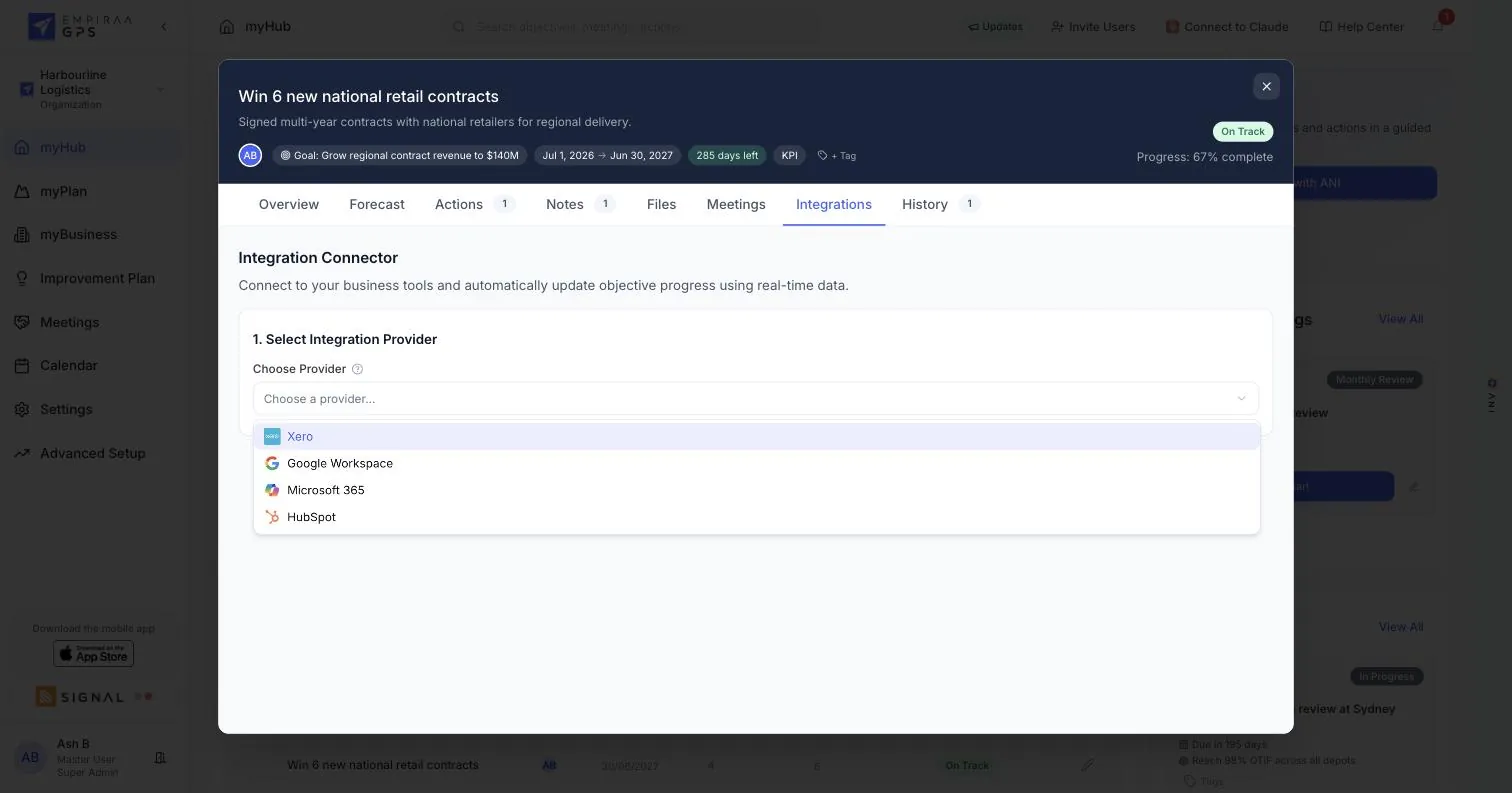
One measure, one source
Connect this objective to the system the number really lives in.
Pick the provider
Xero, HubSpot, Microsoft 365 or Google Workspace, or push values in through the API.
Then it updates itself
The measure moves with the data, so the plan is current without a monthly chase.
What they are paying you for
Not the numbers. What the numbers mean.
Compliance is the reason they hired you and advisory is the reason they stay. A client who knows where they stand, a budget that gets revisited rather than filed, a board pack that reads like somebody thought about it, a conversation in March that changes what happens in June.
You are unusually well placed to sell it, because you already hold the one thing every other adviser has to ask the client for. The ledger is in your hands monthly. What you do not have is anywhere for it to mean something.
Where it stops working
The two days you cannot charge for properly.
Every quarter, the same model rebuilt. Figures you already have retyped into a spreadsheet, last quarter’s commentary edited, a pack that took two days and reads like it took two hours. Then the client asks what it costs to have you do that four times a year and you cannot answer, because the work has no shape.
So advisory gets priced as a favour, or as a vague uplift, or it gets done in the gaps of a busy season and quietly stops. It is the highest value thing on your service list and the only one without a system, and those two facts are the same fact.
- The model is rebuilt from scratch each quarter, so the cost is unpredictable
- Figures already in the ledger get retyped into a spreadsheet
- Nothing between quarters, so the client only hears from you in arrears
- A client drifting for two months looks identical to a client doing fine
What is different
Advisory gets a system, which is what lets you price it.
Four things. The second is the one that removes the retyping, and the fourth is the one that keeps clients.
- Goals carry measures the client updates themselves, so the number in the review is theirs and the conversation starts past the reconciliation
- Xero connects, so actuals land against the goal they belong to instead of being retyped into a model
- The board or management report is generated from the plan, with the variance against expected progress already in it, and you edit rather than assemble
- Every client sits in one book, so you can see which of them is drifting in the eight weeks before they would have told you
Advisory stops being the work you do at the end of a long week the moment it has a system behind it.
How an engagement runs
The same quarterly cycle, without the two days.
This does not change your judgement or your commentary. It changes how the numbers arrive and how the pack gets built.
- Setup
Connect Xero and map the measures
Each financial objective maps to the accounts behind it and the ledger syncs daily, so budgets and actuals land against the goal they belong to rather than being pulled into a model.
- Monthly
The client updates the non-financial measures
Headcount, pipeline, retention, whatever the goals actually need. The number in the review is theirs, which means the conversation starts past the reconciliation instead of inside it.
- Quarterly
Generate, then edit
The report comes out of the plan with variance against expected progress already in it. You spend the time on the commentary, which is the part that is worth money.
The pack is edited, not assembled
Type, period, tone, length and the sections to include, then the report arrives written from the plan with the variance in it. The two days this used to take were never the valuable part of the work.
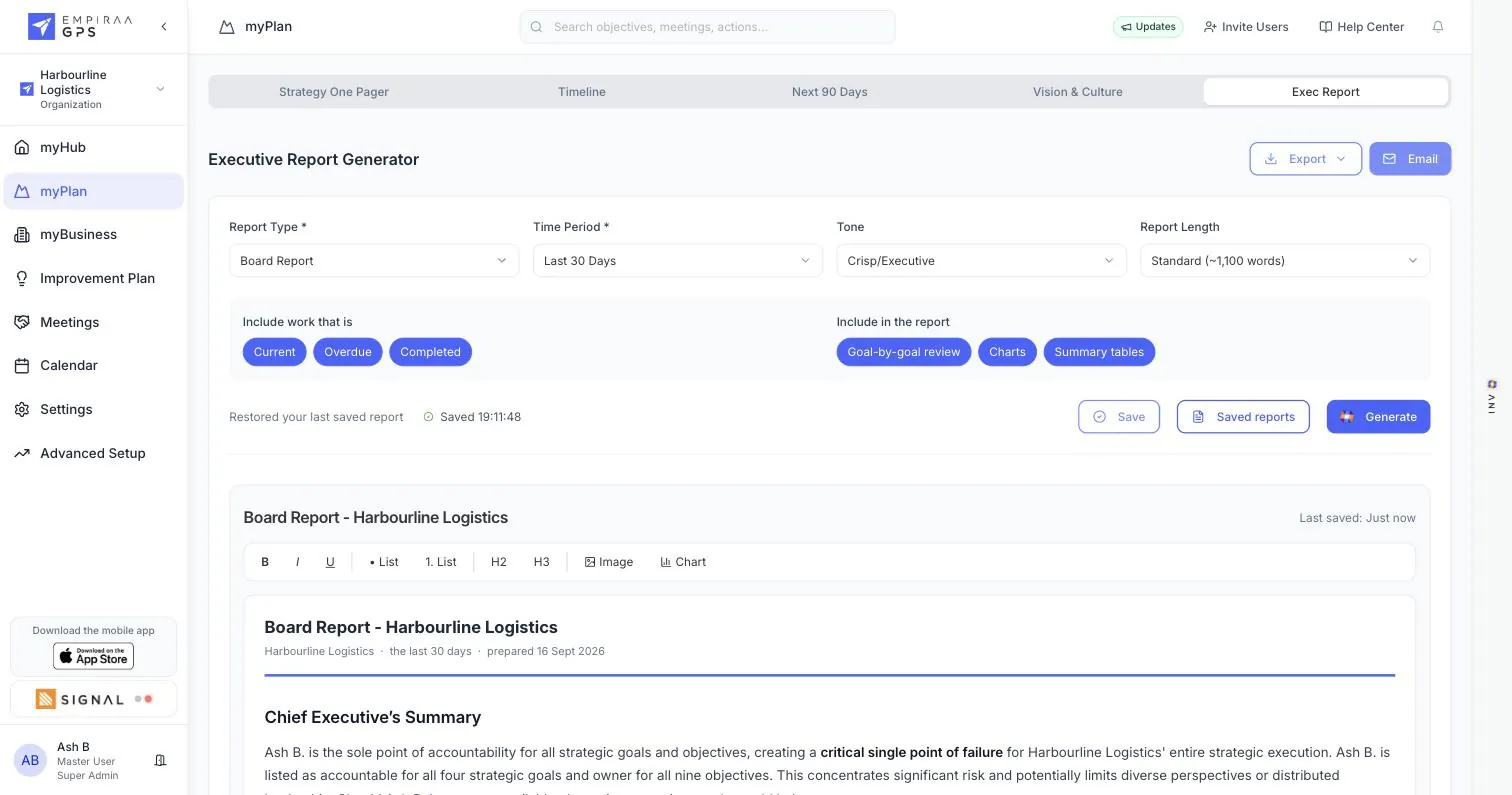
Six report types
Board report, leadership update, financial and forecast alignment, and more.
Set the tone and the length
Crisp for the board, fuller for the leadership team. Same data either way.
Choose what goes in
Goal-by-goal review, charts and summary tables, current, overdue and completed work.
Edit it like a document
GPS writes the draft from live data. You keep the last word, then export or email it.
The frameworks you already sell
Loaded as plans, not adopted as a way of working.
The method is what you charge for. If the software arrives with its own, it is competing with you inside your own client. These are the ones this profession reaches for first.
Balanced Scorecard
Four perspectives loaded as four goals, so financial results sit beside the customer, process and people measures that produced them. The version an accountant can hang actuals on.
Read the pageOGSM Framework
Objectives, goals, strategies and measures on one page. The framework that survives contact with a board because it fits on a single sheet and still carries numbers.
Read the pageLean Strategy Map
Cause and effect drawn out, so the client can see which objective is supposed to move which result, and notices when one of them is doing nothing.
Read the pageStrategic Roadmap
Strategy phased across time, so a three year intent has a next ninety days attached to it. The one to use when the gap between the vision and Monday is the actual problem.
Read the pageThe goals in the pack
Which of these could update themselves?
Put in three goals from the last board pack. The question is not whether the numbers were right, it is whether you had to go and get them.
no date, so it is never late and never done.
nobody owns it, so nobody is asked about it; nothing measures it, so progress is an opinion; no date, so it is never late and never done.
1 of 3
Only 1 of these could be run by something other than you.
One is close and missing a field, which is the easiest kind to fix and the kind that quietly never gets fixed.
One is a statement of intent. Worth having in the document, impossible for anybody to act on.
A goal with a measure mapped to the ledger arrives already updated, and the two days you used to spend assembling the pack were never the part the client was paying for.
What this does not do
Three things it is not, before you ask in the demo.
Accounting firms evaluate software carefully and for good reason. None of these are things it does badly, they are things it does not do.
It is not a forecasting model
No three-way forecast, no scenario modelling, no cash flow waterfall. It holds goals with measures and tracks them against expected pace. If you build three-way forecasts, you keep building them where you build them now and connect the outputs.
Xero brings figures in, it does not do your work
Budgets and actuals against mapped accounts, synced daily, with variances flagged. It does not reconcile, it does not journal, and it does not replace anything in your compliance workflow. It removes retyping, which is worth having and is all it claims.
What the Xero integration doesThere is no time billing or WIP
Time logged against a client’s retainer tells you whether they have been served this month. It is not a timesheet, it does not produce a bill, and your practice management system keeps doing that job.
If that is not quite you
Accountants is one of ten. These are the ones next to it.
Closely related work, bought for different reasons. If one of these describes your week better, read that page instead.
Virtual CFO
You are not advising on the numbers from outside, you are running the finance function from inside, two days a month, and you answer for the forecast.
Read that pageBusiness advisory
You are hired for a rhythm rather than a document, you are in the room every quarter, and you are judged on whether the cadence survived the gap between visits.
Read that pageStrategy consultants
You are hired to work out what the business should do, you deliver that as a plan and a set of choices, and the engagement is scoped to end at approval.
Read that pagePricing
Plans for your client workspaces.
Compare Professional Services plans by client workspace capacity.
Questions
Accountants, answered.
What is advisory software for accountants?
Software that gives client advisory a repeatable structure, rather than a spreadsheet rebuilt each quarter. In practice that means the client’s goals carry measures they update themselves, the ledger connects so actuals land against the goal they belong to, the board or management report is generated from the plan, and every client sits in one book so drift is visible between meetings.
How does the Xero integration work?
You connect your client’s Xero organisation, map each financial KPI to the accounts behind it, and the ledger syncs daily. Budgets and actuals then sit against the objective they belong to, with variances flagged, so a financial goal reflects the books without anybody retyping a figure. The Xero integration.
Can I use this for compliance-only clients?
You could, but there is little point. A client with no plan and no goals gets nothing from a planning tool. Where it earns its place is the client you already have an advisory conversation with, or the one you would like to, and it is usually easier to add a second client than to make the case for the first.
Does the board pack come out formatted?
It generates from the plan with the goals, the objectives under them, progress against expected progress, the variance, the owner and the due date, then opens in an editor. Six report types, different lengths and tones. You edit rather than assemble, which is the two days this is meant to give back. How reporting works.
Does the client workspace carry my firm’s branding?
Yes. Your logo, four interface colours and your typeface, set once and pushed into every client workspace. The client signs in to something that looks like your firm, which matters more for an accountant than for most, because your competition is the firm down the road offering the same compliance work.
Does this help me turn project work into a retainer?
That is the argument, and the arithmetic is worth doing with your own fees rather than taking ours. A retainer is not a pricing decision, it is an evidence problem: a client pays in month four when something visible happened in month three. A live plan is what makes that true, and the model on the consultants page compares the same delivery work priced both ways. The project against retainer model.
What do I earn on a client I bring?
30% recurring for the first twelve months they are with us, and your own Empiraa Signal workspace free for as long as you hold three or more clients. For a firm converting compliance clients to advisory, the share and the advisory fee are two separate lines. The partner terms.
Which frameworks suit an accounting practice?
The Balanced Scorecard, because it puts financial results beside the customer, process and people measures that produced them, which is the conversation an accountant is uniquely able to have. OGSM for a one page plan a board will read. A strategic roadmap when the gap between the three year intent and this quarter is the actual problem. The fifteen frameworks.
Bring one client and see.
Fifteen minutes with one real client in mind, ideally the one you are slightly worried about.