

For private equity operating and deal teams
Fourteen companies. Fourteen spreadsheet formats.
Reporting arrives late, in a different shape from each company, and an associate spends two weeks making it comparable. By then the quarter it describes is over and the only companies you understand properly are the two in trouble. One plan structure across the portfolio means the quarter gets read rather than assembled.
- One structure across every company
- Operating partner capacity twelve weeks out
- The value creation plan, with owners
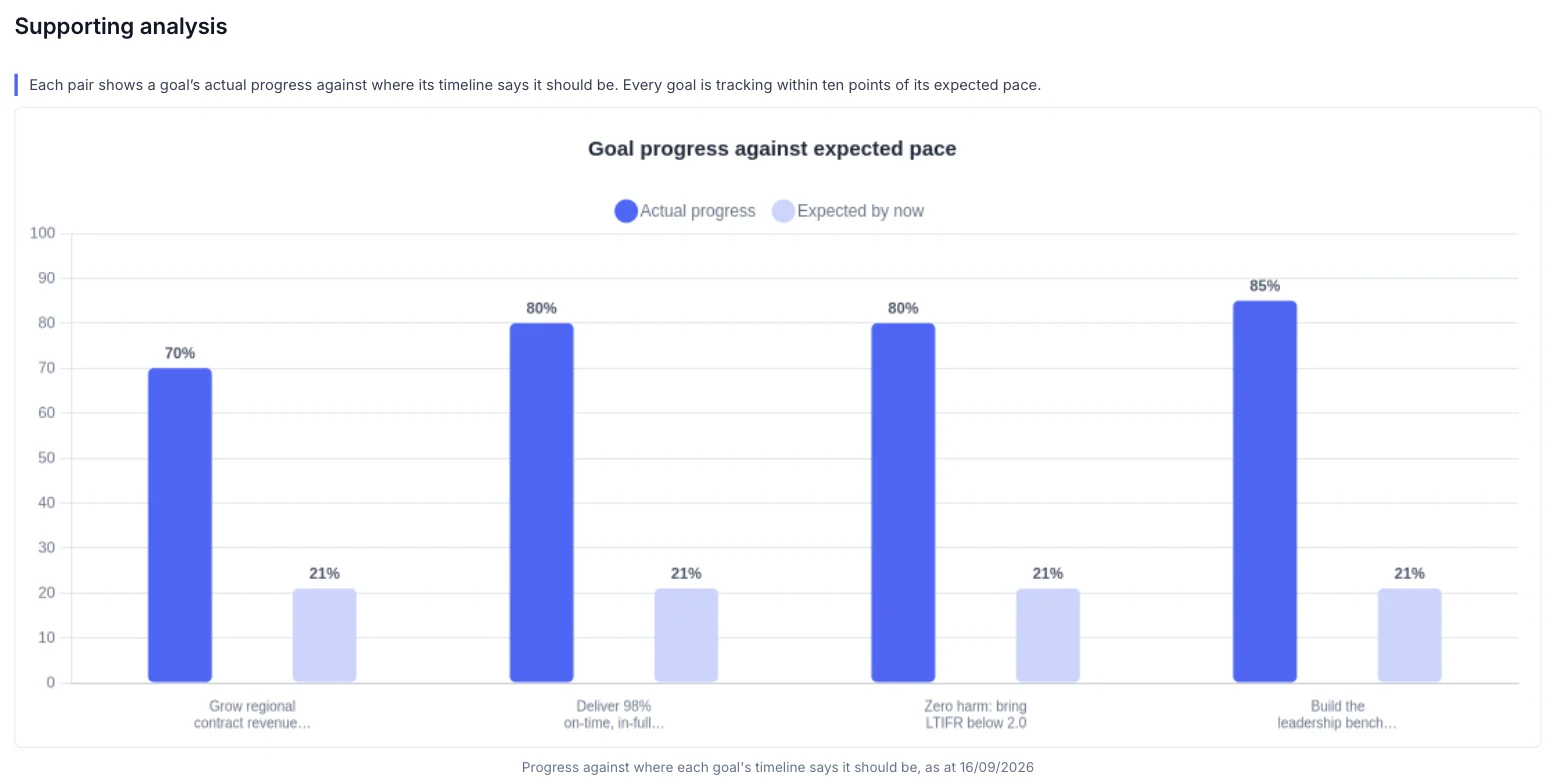
Actual progress
Where each goal really is on the date of the report.
Expected by now
Where the timeline says it should be, beside it, in the same chart.
Dated, so it holds up
The report is a snapshot of live data, not a number someone remembered.
What they are paying you for
A thesis, and a hold period that has to end in a number.
The model said what this business would be worth if three things happened. The operating plan says who makes them happen and by when. Everything between close and exit is the work of finding out whether the three things are happening, early enough to do something when one of them is not.
Which makes information latency the actual product risk. A thesis that was right and a thesis that was executed are worth completely different multiples, and the difference is usually decided in quarters where nobody upstairs could see clearly.
Where it stops working
The two weeks an associate spends making a quarter comparable.
Each company reports in its own shape, on its own timetable, with its own definition of the same metric. Somebody consolidates. By the time it is readable the information is six to ten weeks old, and the only thing you can genuinely do with it is note it.
Meanwhile the value creation plan agreed at close is in a slide deck nobody has opened since the hundred day review. The operating team is working hard on things that are probably in it, and nobody can say which of the plan’s twelve initiatives has actually stopped.
- Twelve to fourteen reporting formats, consolidated by hand each quarter
- Information is six to ten weeks old by the time it is comparable
- The value creation plan lives in a deck rather than in the business
- Two companies cannot be compared without somebody reformatting both
What is different
The quarter becomes readable, and so does the operating team.
Four things. The fourth is the one no portfolio monitoring tool does, because they report on companies rather than on your own bandwidth.
- Every portfolio company runs the same plan structure, so the quarter can be read rather than consolidated, and two companies can be compared without anybody reformatting anything
- The value creation plan agreed at close becomes goals with owners inside the company, so the operating team is executing the thesis rather than remembering it
- Progress is visible without a request, so the associate’s two weeks go on the companies that are behind
- The capacity view shows which operating partner is carrying more than their weeks hold, twelve weeks out, before it becomes a missed board meeting
A value creation plan nobody can see the progress of is an intention. This makes it an instrument.
How an engagement runs
From close to the board meeting, in one structure.
This is not a replacement for however you monitor financials. It is where the plan lives and where progress against it is visible.
- At close
Load the value creation plan into the company
Each initiative becomes a goal with objectives, owners and measures inside the portfolio company’s own workspace, so the operating team is executing the thesis rather than remembering it.
- Monthly
Read rather than request
Progress against expected pace, in the same shape in every company. The associate’s two weeks goes on the three companies that are behind instead of on formatting the eleven that are not.
- Quarterly
Board packs from the plan, and capacity for the next twelve weeks
The company’s pack generates from its own plan. Separately, your operating partners’ allocated weeks are visible twelve weeks out, so an over-committed partner is a scheduling problem in October rather than a missed board meeting in November.
The value creation plan, against today
What was agreed at close as bars across the year, so a company drifting shows months before it shows in a board pack, and the associate’s two weeks go on the companies that are behind.
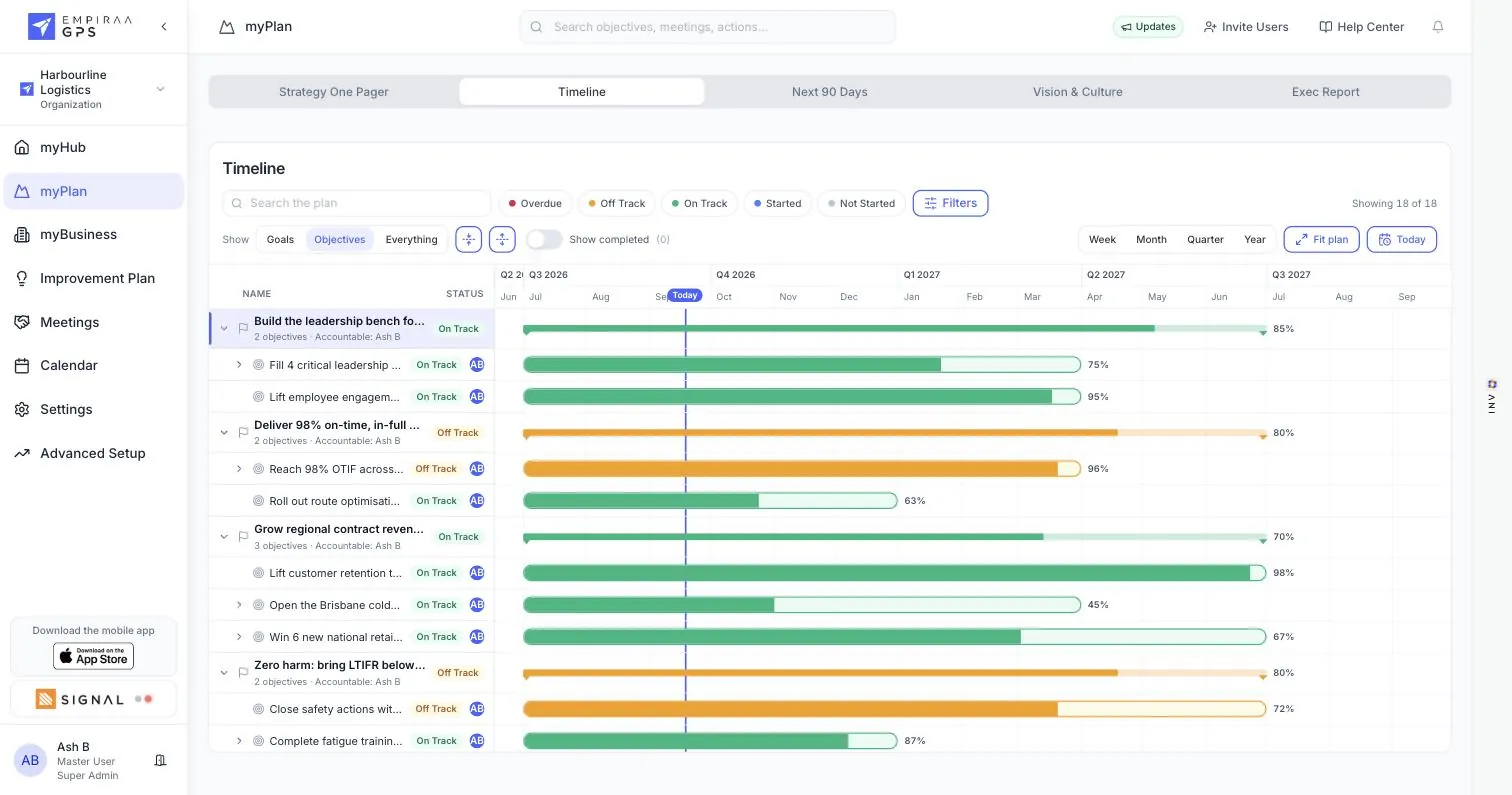
The today line
Every bar is read against it, so late work shows up as a gap rather than a status someone typed.
Filter to the problem
Overdue, off track, on track, started or not started, across every team.
Week to year
Zoom out for the board, in for the quarter, or fit the whole plan on one screen.
A goal and its objectives
Open a goal to see the measures under it and which one is dragging.
The frameworks you already sell
Loaded as plans, not adopted as a way of working.
The method is what you charge for. If the software arrives with its own, it is competing with you inside your own client. These are the ones this profession reaches for first.
Strategic Roadmap
Strategy phased across time, so a three year intent has a next ninety days attached to it. The one to use when the gap between the vision and Monday is the actual problem.
Read the pageHoshin Kanri
The deployment side of strategy: each level of the business carries the objective above it, so a plan agreed by the leadership team reaches the people who have to do it.
Read the pageBalanced Scorecard
Four perspectives loaded as four goals, so financial results sit beside the customer, process and people measures that produced them. The version an accountant can hang actuals on.
Read the pageBlue Ocean Strategy
Value innovation as a structured plan rather than a workshop feeling. What to raise, what to cut, what to create, each with a measure on it.
Read the pageThe value creation plan
How much of the plan agreed at close can be read without asking?
Put in three initiatives from a portfolio company’s plan. The test is whether the fund can see them move without an associate rebuilding a spreadsheet.
nothing measures it, so progress is an opinion.
nobody owns it, so nobody is asked about it; nothing measures it, so progress is an opinion; no date, so it is never late and never done.
1 of 3
Only 1 of these could be run by something other than you.
One is close and missing a field, which is the easiest kind to fix and the kind that quietly never gets fixed.
One is a statement of intent. Worth having in the document, impossible for anybody to act on.
An initiative with an owner inside the company, a measure and a date is something the quarter can be read off. One without them is the reason portfolio reporting takes two weeks and describes a quarter that is already over.
What this does not do
Three things this is not, which matters if you already own a monitoring platform.
This holds whether the plan is happening inside each company. It holds nothing about the fund.
It is not fund administration
No LP reporting, no capital accounts, no waterfall, no valuations, no fee calculations. Whatever you use for the fund keeps doing all of that, and nothing here touches it.
It is not a financial consolidation tool
It does not roll up portfolio financials, normalise charts of accounts or produce a consolidated P&L. Xero connects per company so actuals land against the objectives they belong to, which is a different job from consolidation.
It cannot create management will
Standardising the format does not create the intent. If a portfolio company’s management team is not going to keep a plan current, you will get a beautifully structured plan that nobody updates. That is information too, and it usually arrives faster this way than the other way.
If that is not quite you
Private equity is one of ten. These are the ones next to it.
Closely related work, bought for different reasons. If one of these describes your week better, read that page instead.
Venture capital
You have no governance rights and a portfolio too large to help one company at a time, so everything you do has to be something a founder opens voluntarily.
Read that pageStrategy consultants
You are hired to work out what the business should do, you deliver that as a plan and a set of choices, and the engagement is scoped to end at approval.
Read that pageBusiness advisory
You are hired for a rhythm rather than a document, you are in the room every quarter, and you are judged on whether the cadence survived the gap between visits.
Read that pagePricing
Plans for your client workspaces.
Compare Professional Services plans by client workspace capacity.
Questions
Private equity, answered.
What is portfolio reporting software meant to solve?
The latency and the shape. Every portfolio company reports differently and on its own timetable, so making a quarter comparable takes an associate a fortnight and the result is weeks out of date. One plan structure in every company means the quarter can be read as it happens, and two companies can be compared without anybody reformatting either.
Does this replace our portfolio monitoring platform?
Probably not, and it is not trying to. Monitoring platforms are built for financial and LP reporting. This is built for whether the value creation plan is happening inside each company: initiatives as goals with owners, measures against expected pace, and a board pack generated from the plan. Firms run both.
Do the portfolio companies have to want it?
Yes, and this is the honest constraint. A management team that will not keep a plan current produces a well-structured plan nobody updates. The version that works is where the company gets something out of it too, which is usually the weekly rhythm and the board pack rather than the reporting. It is worth noting that a company refusing to keep its plan current is itself a finding, and it surfaces faster this way.
Can I see which operating partner is over-committed?
Yes, and this is the part most portfolio tools have no equivalent of. Capacity shows allocated time and booked meetings against each operating partner’s week, twelve weeks ahead, and says plainly when a week does not fit. For a lean operating team that is usually the constraint that actually binds. The capacity view.
Which frameworks suit a portfolio company?
A strategic roadmap when the gap between the hold period thesis and this quarter is the problem. Hoshin Kanri where the company is multi-site and the plan dies between the leadership team and the operations. The Balanced Scorecard where the board is reading financial results without the measures that produced them. Blue Ocean Strategy when the honest answer is that the industry is structurally unattractive. The fifteen frameworks.
Can each company have its own branding?
The branding is set at your level and pushed into the companies, so they carry your firm’s mark rather than each their own. For a fund that is usually what you want. It is set per sub-account, so selecting which companies receive it is possible.
What do we earn on companies we bring?
30% recurring for the first twelve months each company is with us, and your own Empiraa Signal workspace free for as long as you hold three or more. For a fund the share is usually a rounding error against the reason for doing this, but it is there and it is stated. The partner terms.
Bring one client and see.
Fifteen minutes with one real client in mind, ideally the one you are slightly worried about.