

SMART goals, delivered to your clients
Doran wrote Assignable. Somebody swapped in Achievable, and it cost us the owner.
The A in the original SMART meant defining responsibility clearly. It was replaced with achievable, which is a sentiment rather than a field, and the thing that actually decides whether a goal happens quietly left the acronym. Put it back and SMART becomes the plainest useful structure there is.
- The original five, not the drifted ones
- A branded workspace per client
- The simplest place to start a client
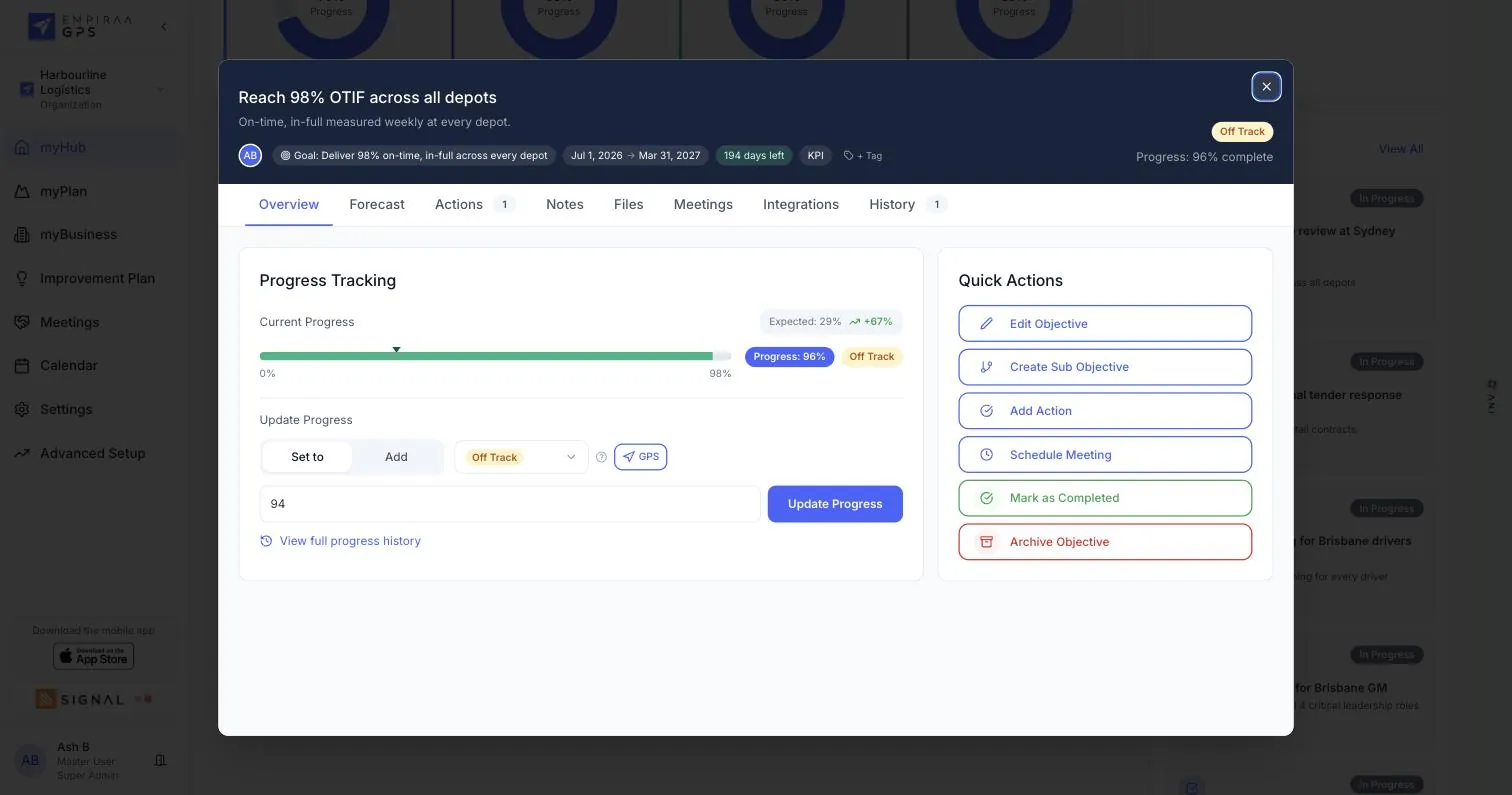
Expected, not just actual
GPS works out where this measure should be by today, and shows the gap.
Off track, early
Status comes from pace, so a measure turns amber weeks before the quarter closes.
Updating takes seconds
Set a new value or add to the last one, pick a status, and you are done.
Everything from here
Sub-objectives, actions, a meeting, or mark it complete.
What it is
Five letters, and two are not the ones you were taught.
George Doran published SMART in Management Review in November 1981. The version most people can recite is not his.
Doran’s five were Specific, targeting a particular area for improvement; Measurable, quantifying or at least suggesting an indicator of progress; Assignable, defining responsibility clearly; Realistic, outlining attainable results with the resources available; and Time-related, including a timeline.
The modern version usually reads achievable and relevant. Achievable replaced assignable, and the two are not the same kind of thing at all. Assignable is a field: a name, or a box that is visibly empty. Achievable is a feeling somebody had in a workshop, and it cannot be left blank because it was never written down.
That matters because of the failure every consultant has watched. A plan full of well-written goals, every one specific and measured and dated, and nothing happens, because “somebody should do this” was never resolved into a person. Doran had the answer in the acronym and it was traded for a synonym of realistic.
Worth knowing too: SMART tells you how to write a goal, not which goal to write. It has nothing to say about whether the goal matters, and a beautifully SMART objective aimed at the wrong thing is still aimed at the wrong thing.
- Specific: a particular area for improvement, not a direction of travel
- Measurable: a number, or at minimum an indicator of progress
- Assignable: a person, which is the letter the acronym lost
- Realistic and Time-related: possible with what you have, and dated
In the library
SMART Goals is a ready-made plan, not a setting.
The plainest plan in the library, and the right one for a client who has never written a plan down. Nothing to learn before you start, and the owner field is not optional.
3 goals · 6 objectives, loaded into a client’s workspace in one action
What the plan carries
An owner on every objective
The assignable letter, restored as a field rather than a sentiment. An objective with no name against it shows as an objective with no name against it, which is the most useful blank space in any plan.
A number, not a status colour
Current value and target value, with progress read against where it should be by now. A goal at 40% in month two is on track or behind depending entirely on the date, which is the point.
A date inside a quarter
Time-related survived the drift and is the letter most often set to the end of the financial year, which means nothing is late until it is far too late. Three months is short enough for a goal to be visibly not happening.
Every update, and who made it
Progress over time with each change attributed. For a client who has never written a plan down, the history is what proves the habit took.
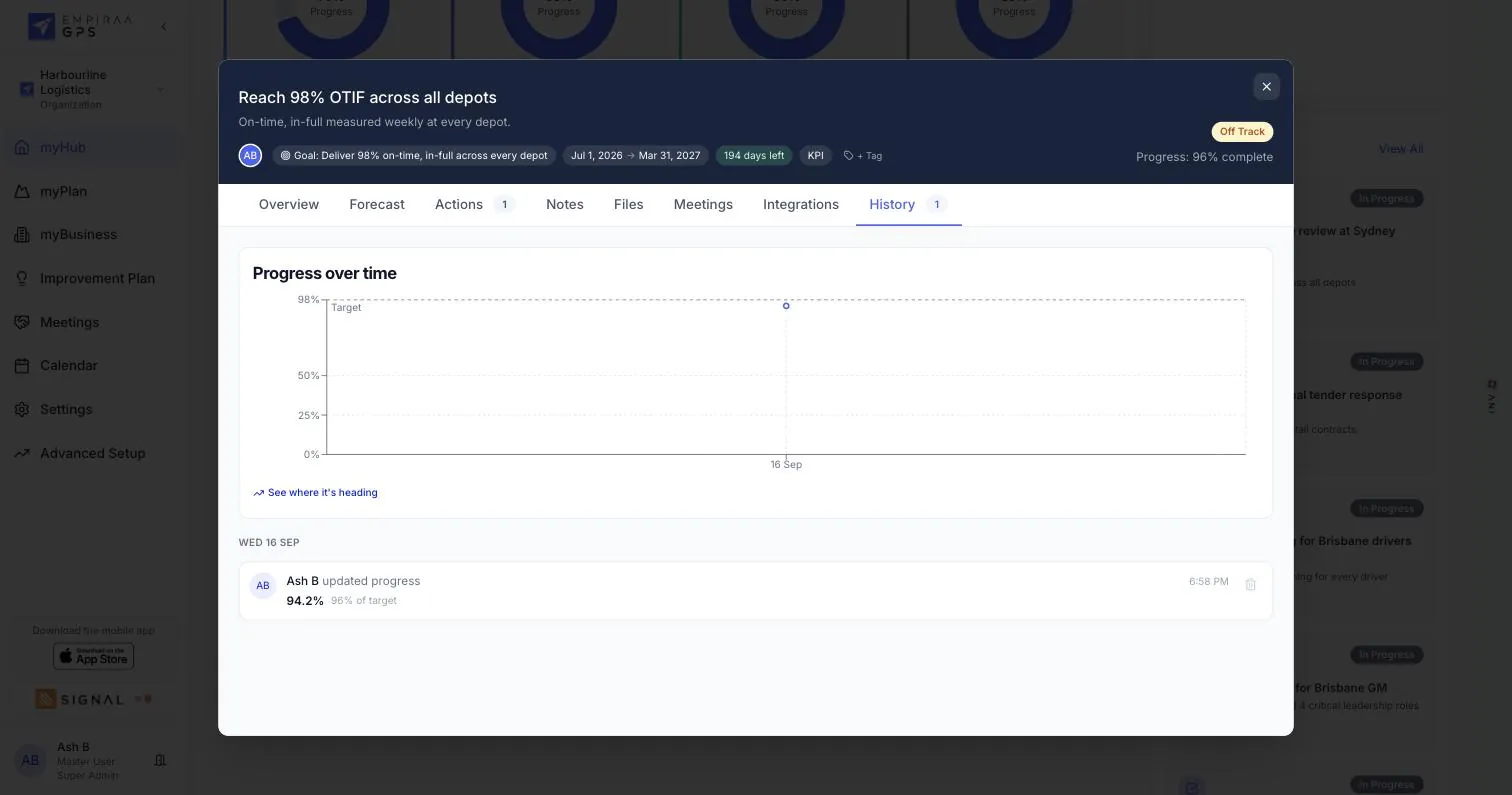
History sits on the objective
Not in a report somebody has to run. It is a tab on the thing it is the history of.
Every update, plotted
Against the target line, so a measure that moved once in a quarter looks like one that moved once in a quarter.
See where it is heading
Projected from the pace it is actually running at.
Who moved it, and when
Each change attributed, with the value and what share of target it reached.
Delivering it
Where SMART earns its place, and where to leave it behind.
This is the structure to start a client on, not the one to keep them on forever, and being clear about that is a better sale than pretending otherwise.
- One
Use it with a client who has never written a plan down
More clients than admit it. There is nothing to teach before the first session, which means the session goes on their business rather than on your methodology.
- Two
Fight for the owner field
This is the engagement in miniature. A leadership team will happily write eight specific measured dated goals and leave every owner as the leadership team. Resolving that is the work.
- Three
Move them on when they outgrow it
Once there are teams to align rather than five people in a room, OKRs or a real operating framework serves them better. Starting simple and adding structure later is a legitimate sequence, not a failure to commit.
Where it does not fit
Three fair criticisms, and the first is structural.
SMART is the most widely taught and most widely criticised goal framework there is. The criticisms are largely correct.
Achievable quietly punishes ambition
A criterion asking whether a goal is attainable rewards goals nobody has to stretch for, which is the opposite of what a stretch objective is for. OKRs handle this by expecting to miss. SMART has no equivalent, and a client using it to set a ceiling is using it correctly.
It says nothing about whether the goal matters
SMART is a way of writing a goal, not of choosing one. Five perfectly formed objectives pointed at the wrong thing are five perfectly formed objectives pointed at the wrong thing, and the framework will not tell you.
The evidence base is thinner than its ubiquity suggests
Doran wrote two pages for a management magazine, not a study. Research on goal setting is genuinely mixed about whether specificity always helps, and in some contexts vaguer or harder goals do better. Useful to know if a client with an academic background pushes back.
The client in front of you
Is SMART Goals the right call for this client?
Five questions about them, not about you. The answer is graded rather than yes or no, and it names what to compare against either way.
Yes
On these answers SMART Goals is where I would start.
SMART Goals is worth it here because the plainest structure there is, and the right place to start a client with nothing written down. Nothing to teach before the first session.
Decided mostly by: nobody in the business can state the strategy
Also worth reading: OGSM Framework, because a whole strategy on one page, which is what a business needs when the real problem is that nobody can state it.
A starting point, not advice. You know this client and this tool does not, and the useful part is that whichever framework it names has a page with the plan already built.
Who reaches for it
The firms that arrive already selling this.
Each of these is a page in its own right, with the argument written for that profession rather than for a framework.
Business advisory
The rhythm has to work when you are not in the room.
Read their argumentAccountants
You have the actuals. There is nothing to hang them on.
Read their argumentVenture capital
You have no governance rights and forty founders.
Read their argumentOr read a framework that fits better
OKR Framework
The step up. Key results are true or false at the end of the period and are expected to be missed, which handles the ambition problem SMART has no answer to.
Read itMBO (Management by Objectives)
Roughly where SMART came from. If the client needs individual objectives tied to the organisation’s rather than a handful of company goals, this is the closer fit.
Read itEOS (Traction)
When the problem is not how the goals are written but that nothing happens on a Tuesday. That is a rhythm problem and no goal format fixes it.
Read itQuestions
SMART Goals, answered.
What does SMART stand for?
In George Doran’s original, published in Management Review in November 1981: specific, measurable, assignable, realistic and time-related. The version most people recite today replaces assignable with achievable or attainable and realistic with relevant, which are later substitutions rather than the original criteria.
Is it assignable or achievable?
Doran wrote assignable, meaning define responsibility clearly. Achievable is the drifted version and it is a worse criterion, because assignable is a field that can be left visibly blank and achievable is a feeling somebody had in a workshop. The most common reason a well-written plan produces nothing is that no goal was resolved into a person, which is exactly what the original letter was for.
Are SMART goals still useful?
For a client who has never written a plan down, yes, and better than anything more sophisticated, because there is nothing to learn first. For a business with teams to align, OKRs or an operating framework serves them better. Starting with SMART and moving on is a sensible sequence rather than an admission of anything.
What is the main criticism of SMART goals?
That the achievable criterion rewards goals nobody has to stretch for, which is the opposite of what stretch objectives are for. Two more: SMART says how to write a goal and nothing about whether it is the right one, and its evidence base is thin given how universally it is taught, with research on goal setting genuinely mixed about whether specificity always helps.
Is there SMART goals software in Empiraa?
SMART Goals is a ready-made plan in the strategy library, with three goals and six objectives, and the structure enforces the letter the acronym lost: every objective carries an owner, a current and target value, and a date. It is the simplest of the fifteen named frameworks and the right one to start a client on. Every framework in the library.
Bring one client and see.
Load the framework you already sell into a client's workspace under your own logo, and see whether it survives the eight weeks between your sessions.