

The 7S diagnostic, delivered to your clients
7S tells you what is broken. It does not tell you what to do about it.
That is not a criticism, it is the design: the model was built to expose misalignment, not to prescribe. The gap it leaves is where an engagement either becomes work or becomes a deck. Turn each finding into an objective with an owner in the client’s own workspace and the diagnostic has somewhere to go.
- Findings become objectives with owners
- A workspace per client, branded as you
- Pairs with a planning framework for what comes next
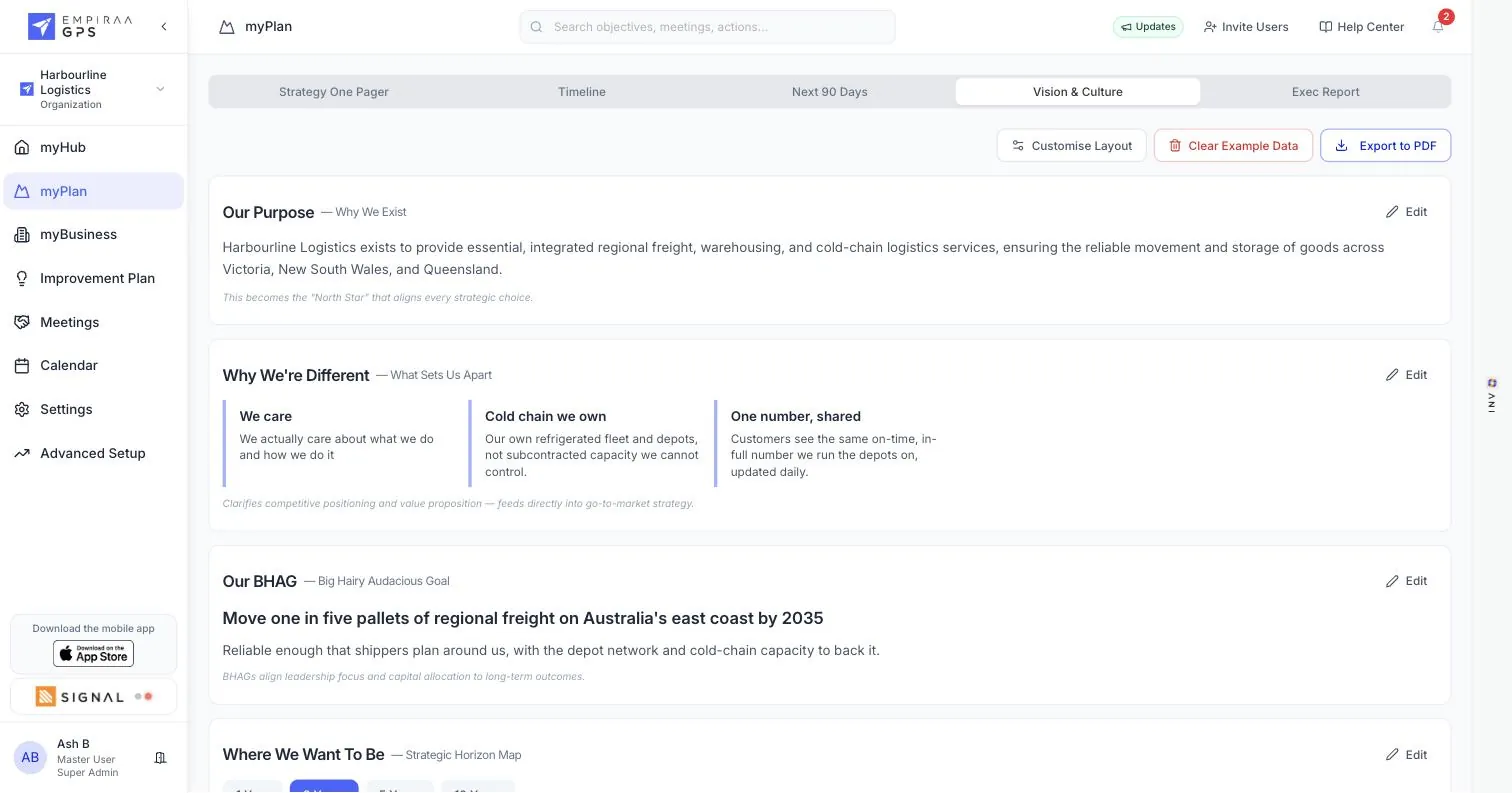
Why the business exists
The purpose that every strategic choice is measured against.
What sets you apart
The two or three things you win on, written down so the plan can back them.
The long bet
The big goal ten years out, with the horizon map and the enablers underneath it.
What it is
Seven elements, and the argument is that you cannot change one.
Robert Waterman, Tom Peters and Julien Phillips set it out in "Structure is not organization" in 1980, and it reached everybody through In Search of Excellence two years later. Its claim is structural, and that is still the useful part.
The seven are conventionally split into three hard elements and four soft ones. Strategy, structure and systems are the hard ones: what the business is trying to do, how it is organised, and the processes and tools it runs on. These are the ones a leadership team can change by deciding to.
Shared values, skills, style and staff are the soft ones: what the organisation actually believes, what it is genuinely capable of, how its leaders behave, and who is in it. Shared values sits at the centre of the usual diagram, and the placement is the argument.
The model’s real claim is that all seven are interdependent, so a change to one that ignores the others does not take. A new strategy with the old structure produces a reorganisation nobody asked for. A new structure with the old style produces the same decisions made by different people. This is why 7S is most often used early, when a client has already tried something and it did not work, and the question is why.
What the model deliberately does not do is tell you which element to move first, or by how much, or what good looks like. It has no measures and no sequence. It produces a list of places where the organisation is arguing with itself, which is exactly what you want in week two and not nearly enough by week ten.
- Hard: strategy, structure, systems. Changeable by decision.
- Soft: shared values, skills, style, staff. Changeable slowly, if at all.
- All seven interdependent, which is the model’s actual claim
- No measures, no sequence, no prescription. That is scope, not a flaw.
In the library
McKinsey 7S is a ready-made plan, not a setting.
This is the shortest plan in the library, and deliberately so: a diagnostic should not arrive pretending to be a twelve month plan. Two goals and five objectives is enough to turn findings into owned work and no more.
2 goals · 5 objectives, loaded into a client’s workspace in one action
What the plan carries
Each misalignment as an objective
A finding with no owner is a paragraph in a report. As an objective it has a name, a date and a measure, and the client can see in month two whether anything moved.
Hard and soft kept apart
The two goals hold the two halves, because they move at completely different speeds. A client reading one list watches the systems objective land in six weeks and concludes the culture one has failed.
Then the planning framework on top
Once the diagnosis is work, the client usually needs a planning framework to run the rest of the year. OGSM or the Balanced Scorecard applied into the same workspace, alongside these objectives rather than replacing them.
OGSMStructure and staff, two of the seven
The chart with real owners, vacant seats and an overloaded leader flagged. Four of the seven elements are soft, which is exactly why they need somewhere to be written down.
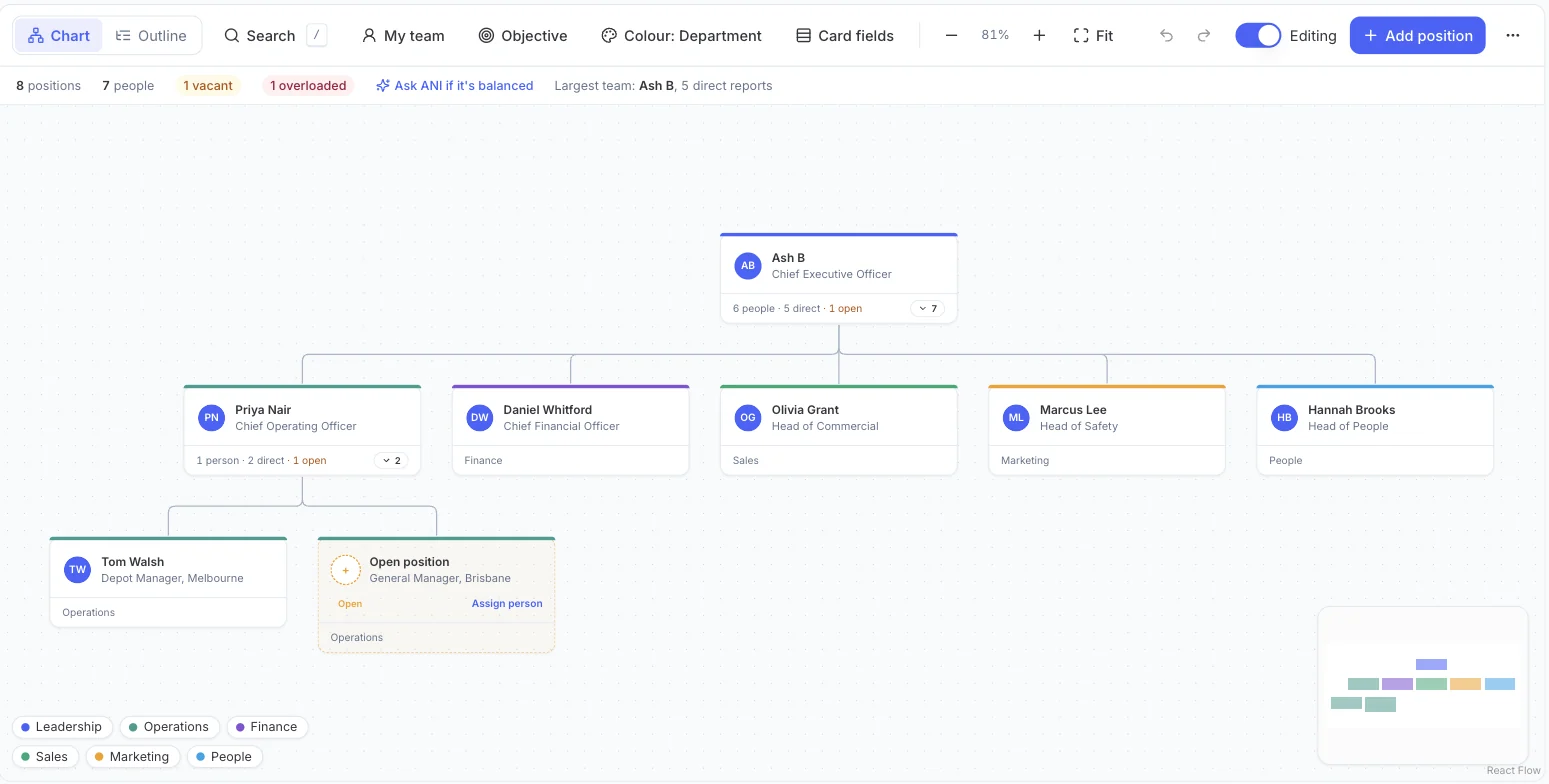
Eight seats, seven people
One vacant and one overloaded, flagged on the chart rather than raised at the quarterly.
A seat, not a person
The role, who sits in it, how many report in and how many of those seats are open.
The open position
General Manager, Brisbane. Still on the chart, still carrying work, with a button to fill it.
Ask ANI if it is balanced
It reads the spans and the objectives on each seat and says which leader is carrying too much.
Delivering it
The usual failure is that the diagnosis is the deliverable.
A 7S report is genuinely valuable and it is also the easiest thing in consulting to leave behind unimplemented, because nothing in it has a date.
- One
Run the diagnostic as you always do
Interviews, observation, whatever your method is. Nothing about this changes the part you are actually good at.
- Two
Land the findings as objectives, not chapters
Each misalignment becomes an objective with an owner inside the client workspace, split between the hard and the soft so nobody compares their pace.
- Three
Layer the planning framework over it
The diagnostic tells the client what to fix. A planning framework tells them what the year is for. Both in one plan means the second is not quietly ignoring the first.
Where it does not fit
Three things 7S cannot do, and none of them are software problems.
These are properties of the model. Any tool that claimed to solve them would be misrepresenting the framework.
It is not prescriptive, by design
The model names seven places to look and stops. It will not say which to move first or what good looks like. That judgement is the engagement, and a client who expected a recommendation from the framework itself needs that expectation reset early.
It is a snapshot, so it goes stale
A 7S assessment describes an organisation on the week you did it. Six months on, after a restructure and two departures, the report is a historical document. Findings held as objectives with progress on them age better than findings held in a deck.
It has no measures at all
Nothing in the model tells you whether style has improved. You have to supply the measure, and for the four soft elements that usually means a proxy you have to defend. Worth agreeing with the client in the session rather than at the review.
The client in front of you
Is McKinsey 7S the right call for this client?
Five questions about them, not about you. The answer is graded rather than yes or no, and it names what to compare against either way.
Yes, with one to compare
McKinsey 7S fits this client. So does OGSM Framework, slightly better on these answers.
McKinsey 7S is worth it here because a diagnostic across seven interdependent elements, for finding where a business is arguing with itself before prescribing anything.
Decided mostly by: nobody in the business can state the strategy
Read instead: OGSM Framework, because a whole strategy on one page, which is what a business needs when the real problem is that nobody can state it.
A starting point, not advice. You know this client and this tool does not, and the useful part is that whichever framework it names has a page with the plan already built.
Who reaches for it
The firms that arrive already selling this.
Each of these is a page in its own right, with the argument written for that profession rather than for a framework.
Strategy consultants
You wrote the plan. Somebody has to run it.
Read their argumentBusiness advisory
The rhythm has to work when you are not in the room.
Read their argumentOr read a framework that fits better
OGSM Framework
What comes after the diagnostic. 7S says the organisation is arguing with itself; OGSM says what the year is for and who owns each choice.
Read itPorter's 5 Forces Plan
If the problem turns out to be outside the business rather than inside it. 7S looks inward, and a client losing to industry structure will not find the reason in their own seven elements.
Read itSWOT to Action
A lighter diagnostic for a smaller client, and one most leadership teams can participate in without being taught a model first.
Read itQuestions
McKinsey 7S, answered.
What are the seven elements of the McKinsey 7S model?
Strategy, structure and systems, which are the hard elements a leadership team can change by deciding to; and shared values, skills, style and staff, which are the soft ones that change slowly. Shared values sits at the centre of the usual diagram. The model’s claim is that all seven are interdependent, so changing one while ignoring the others does not take.
Is the 7S model a strategy framework or a diagnostic?
A diagnostic. It exposes where an organisation is misaligned and deliberately does not prescribe what to do, in what order, or what good would look like. That is why it is usually used early in an engagement and why it is normally paired with a planning framework such as OGSM or the Balanced Scorecard for the work that follows.
Is there McKinsey 7S software in Empiraa?
There is a ready-made 7S plan in the strategy library, carrying two goals and five objectives, which is the shortest plan of the fifteen frameworks. It is there so the findings from a diagnostic become objectives with owners and dates inside the client’s workspace rather than chapters in a report.
How do you measure the soft elements?
With a proxy you have chosen and can defend, agreed with the client in the session rather than argued about at the review. The model supplies no measures for any of the seven, and pretending otherwise is how a culture objective ends up marked complete because a workshop happened.
Can I run this alongside another framework for the same client?
Yes, and it is the normal sequence. Apply 7S for the diagnosis and a planning framework for the year, both into the same client workspace. The plan structure is data, so two frameworks coexist in one plan and you are not choosing between diagnosing and planning. Every framework in the library.
Is Empiraa affiliated with McKinsey?
No. Empiraa is not affiliated with, endorsed by or certified by McKinsey & Company. The framework is widely published and supported here, which means the plan structure is in the library and the software runs it.
Bring one client and see.
Load the framework you already sell into a client's workspace under your own logo, and see whether it survives the eight weeks between your sessions.