

For virtual and fractional CFOs
You are there two days a month. The business runs for the other nineteen.
Half of your first day goes on finding out what happened rather than deciding what to do about it, because the figures moved and nobody logged why. Put the measures in the client’s own workspace, connect the ledger, and arrive at the numbers instead of arriving to collect them.
- Xero feeds the measures
- Your branding in the client workspace
- The pack generated, not assembled
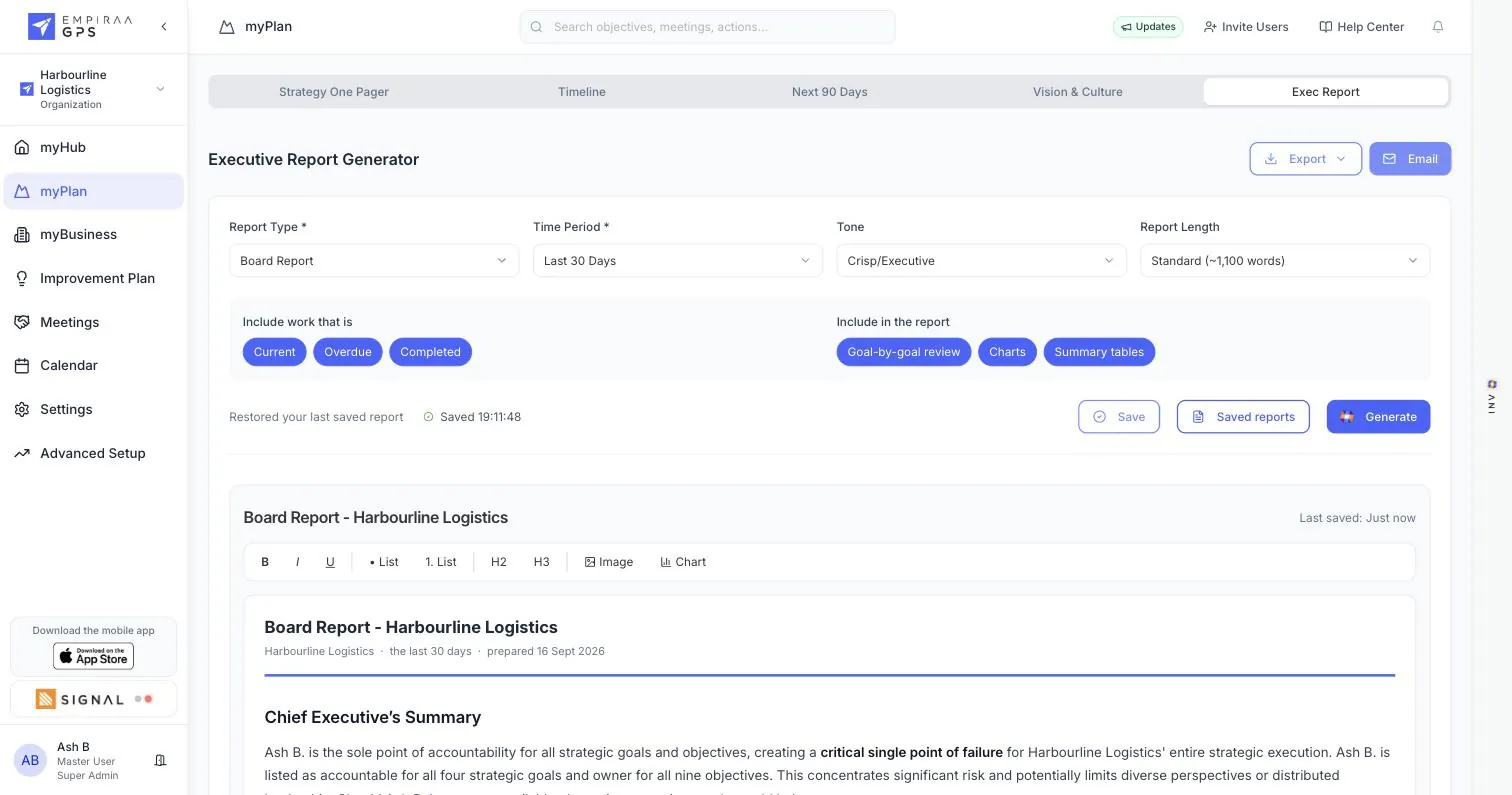
Six report types
Board report, leadership update, financial and forecast alignment, and more.
Set the tone and the length
Crisp for the board, fuller for the leadership team. Same data either way.
Choose what goes in
Goal-by-goal review, charts and summary tables, current, overdue and completed work.
Edit it like a document
GPS writes the draft from live data. You keep the last word, then export or email it.
What they are paying you for
A finance function, without the hire.
Forecasting, cash, the board pack, the pricing conversation nobody in the business was having, and somebody senior enough to say no to the founder. A business that cannot justify a full-time CFO can justify two days of one, and what it is buying is judgement applied to its own numbers.
Which means your product is the thinking, and everything else is overhead you are absorbing. You are not paid for the hours spent finding out what the figures did, and yet those hours are the ones that scale with every client you add.
Where it stops working
The month nothing goes wrong.
You rebuild the model each visit because the figures moved and nobody wrote down why. The management accounts are late, the sales number came from a different place than last month, and the first half day is reconstruction. It is the least valuable work you do and it is the work that grows fastest as your book does.
Then there is the harder problem. The quarters you do your best work in are the quarters where nothing goes wrong: cash did not get tight, the pricing held, the bad hire did not happen. Nothing visibly happened, so there is nothing to point at, and the renewal conversation turns on whether the owner liked having you around.
- Half the first day spent finding out what happened, every visit
- A model rebuilt monthly because nothing between visits was recorded
- The board pack assembled rather than generated
- Your best quarters are the ones with nothing to show for them
What is different
You arrive at the numbers, not to collect them.
Four things, and the fourth is the one that changes the renewal rather than the workload.
- The measures live in the client’s own workspace and their team updates them between your days, so you arrive at the numbers rather than arriving to collect them
- Xero feeds the actuals against the goal they belong to, so the model stops being a monthly rebuild and starts being a thing you interrogate
- Expected progress is calculated, so a measure turns amber on the client’s screen in week five instead of in your review in week twelve
- The board pack is generated from the plan you are already running, which turns two days of assembly into an hour of editing
A fractional CFO is renewed on whether the owner can see what changed. The quarters where nothing went wrong are the ones you did your best work in, and they are the ones you cannot currently prove.
How an engagement runs
The same two days, spent differently.
Nothing here adds a day. It moves the collection out of your day and into the month.
- Setup
Put the measures where the client can see them
The eight or ten numbers you actually run the business on, in their workspace with a target and an owner, under your branding rather than ours.
- Once
Map what the ledger can answer
Connect Xero and point the financial measures at the accounts that feed them. From then on those numbers arrive against the goal they belong to rather than being retyped.
- Between visits
The client updates what the ledger cannot
Headcount, pipeline coverage, the operational measure that lives in somebody’s spreadsheet. Their team updates it, which is a reasonable ask when it takes seconds and they can see the result.
- Your day
Open on the two that moved the wrong way
Expected progress is calculated, so the amber ones are already amber. The half day of reconstruction becomes half an hour of reading, and the pack is generated for you to edit.
The model stops being a monthly rebuild
Actuals arrive from the ledger against the goal they belong to, and expected progress is calculated, so a measure turns amber on the client’s screen in week five rather than in your review in week twelve.
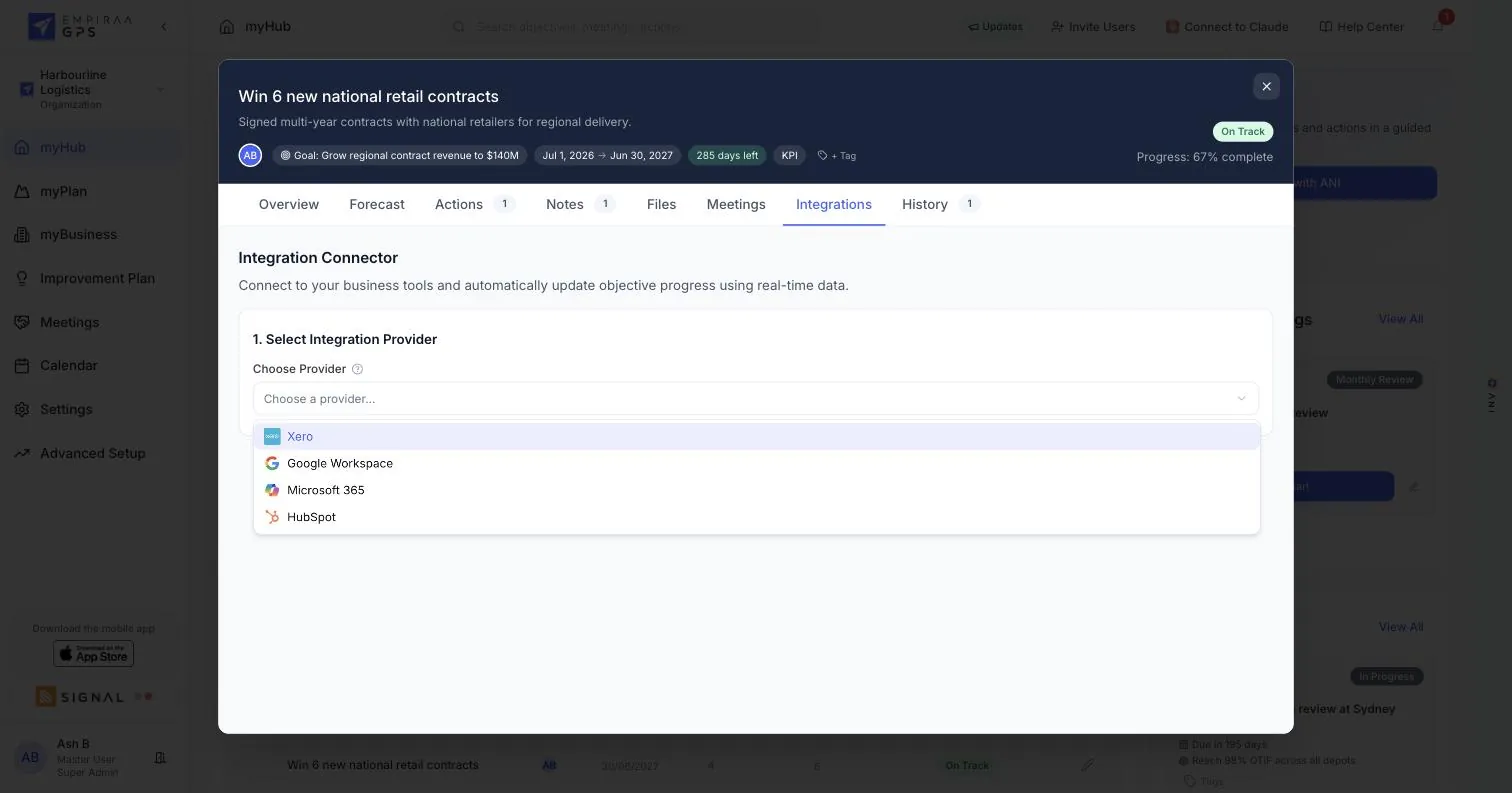
One measure, one source
Connect this objective to the system the number really lives in.
Pick the provider
Xero, HubSpot, Microsoft 365 or Google Workspace, or push values in through the API.
Then it updates itself
The measure moves with the data, so the plan is current without a monthly chase.
The frameworks you already sell
Loaded as plans, not adopted as a way of working.
The method is what you charge for. If the software arrives with its own, it is competing with you inside your own client. These are the ones this profession reaches for first.
Balanced Scorecard
Four perspectives loaded as four goals, so financial results sit beside the customer, process and people measures that produced them. The version an accountant can hang actuals on.
Read the pageStrategic Roadmap
Strategy phased across time, so a three year intent has a next ninety days attached to it. The one to use when the gap between the vision and Monday is the actual problem.
Read the pageOGSM Framework
Objectives, goals, strategies and measures on one page. The framework that survives contact with a board because it fits on a single sheet and still carries numbers.
Read the pageContinuous Improvement Plan
Incremental change with a place for it to be raised, voted on and tracked to done, rather than a suggestion box nobody empties.
Read the pageThe numbers you report on
How many of these update without you touching them?
Put in three from the last board pack you built. The test is not whether they were the right numbers, it is how much of your two days went on collecting them rather than on what they meant.
no date, so it is never late and never done.
nobody owns it, so nobody is asked about it; nothing measures it, so progress is an opinion; no date, so it is never late and never done.
1 of 3
Only 1 of these could be run by something other than you.
One is close and missing a field, which is the easiest kind to fix and the kind that quietly never gets fixed.
One is a statement of intent. Worth having in the document, impossible for anybody to act on.
A measure mapped to the ledger arrives already updated, and one that somebody has to be asked for is the reason the first half of your day goes on finding out what happened instead of deciding what to do about it.
What this does not do
Three things it does not do, and one of them matters more than the others.
You are the finance function. This is where the plan and the measures live, which is a smaller claim than it sounds and a more useful one.
It does not produce a forecast
There is no forecasting model in it, no scenario engine and no driver tree. It projects a measure from the pace it is running at, which is a straight line and says so. The forecast is still yours, built where you build it now, and this is where the result of it gets tracked.
It is not a ledger and it does not reconcile
Xero stays the source of truth for the accounts. The integration brings budgets and actuals into the plan and maps measures to accounts. Nothing here touches a journal, and if the ledger is wrong this shows the wrong number faithfully.
It cannot make a client update anything
The measures the ledger cannot answer still need somebody in the business to put a number in. It takes seconds and they can see why it matters, which is a much better position than a spreadsheet emailed on the 5th, but a client determined not to will not.
If that is not quite you
Virtual CFO is one of ten. These are the ones next to it.
Closely related work, bought for different reasons. If one of these describes your week better, read that page instead.
Accountants
You already hold the client’s numbers, and the advisory work sitting on top of them is the thing you are trying to make repeatable and properly priced.
Read that pageBusiness advisory
You are hired for a rhythm rather than a document, you are in the room every quarter, and you are judged on whether the cadence survived the gap between visits.
Read that pagePrivate equity
You own the business, you hold a board seat, you can mandate how a company reports, and the hold period has to end in a number.
Read that pagePricing
Plans for your client workspaces.
Compare Professional Services plans by client workspace capacity.
Questions
Virtual CFO, answered.
What is the difference between this and what an accounting firm uses?
The product is the same and the job is not. An accounting firm sells advisory alongside compliance and is engaged to prepare the numbers. A virtual CFO is the finance function, inside the business, answering for the forecast. The accountants page is written for the first and this one for the second, and a firm doing both reads whichever matches the engagement. The accountants page.
Does it connect to Xero?
Yes. Budgets and actuals come into the plan, a measure can be mapped to the accounts that feed it, variances against expected progress are flagged, and the ledger syncs daily. It does not reconcile anything and it is not a ledger. What the Xero integration does.
Can I run several clients in it?
Yes, and that is the normal pattern. Each client is a separate workspace with their own plan and their own data, and myPortal is the layer above them: every client as a row ordered by who needs you, the retainer hours logged against each, and which of them has gone quiet. See the practice view.
Does the client see my branding or yours?
Yours. Your logo, four interface colours and your typeface, applied across every client workspace in one action, so a client signing in on a Tuesday is opening your system. The one thing that stays ours is the address they sign in at, and we say so rather than letting you find out. What the branding covers.
How does this help at renewal?
Because the quarter has a record. Actual against expected on every measure, dated, with what moved and who updated it. In a quarter where nothing went wrong that record is the only evidence that the reason nothing went wrong was you, and it is the conversation you cannot currently have.
What does it cost?
Empiraa GPS for Professional Services is published and priced by client workspace, so a virtual CFO carrying four clients pays for a small tier and a firm carrying twenty pays for a larger one. There is a self-serve 30-day free pilot. A card is required, your chosen plan limits apply, and it converts automatically unless cancelled. Partners earn 30% recurring for the first twelve months on every client they bring. What your clients pay.
How do I start?
One client, ideally the one whose management pack takes longest to build. Fifteen minutes on their actual numbers is enough to see whether the collection problem goes away, and a 30-day pilot with that client is how it gets proven rather than argued.
Bring one client and see.
Fifteen minutes with one real client in mind, ideally the one you are slightly worried about.