

White label
The interface is yours. The address bar is not, and here is that out of the way first.
Your logo in the sidebar, four interface colours, your typeface, set once and pushed into every client workspace in one action. What you do not get is a custom domain: clients sign in at plan.empiraa.app. You would find that out in the first minute of a demo, so you may as well find it out here.
- Your logo in every client workspace
- Four interface colours and your typeface
- No custom domain
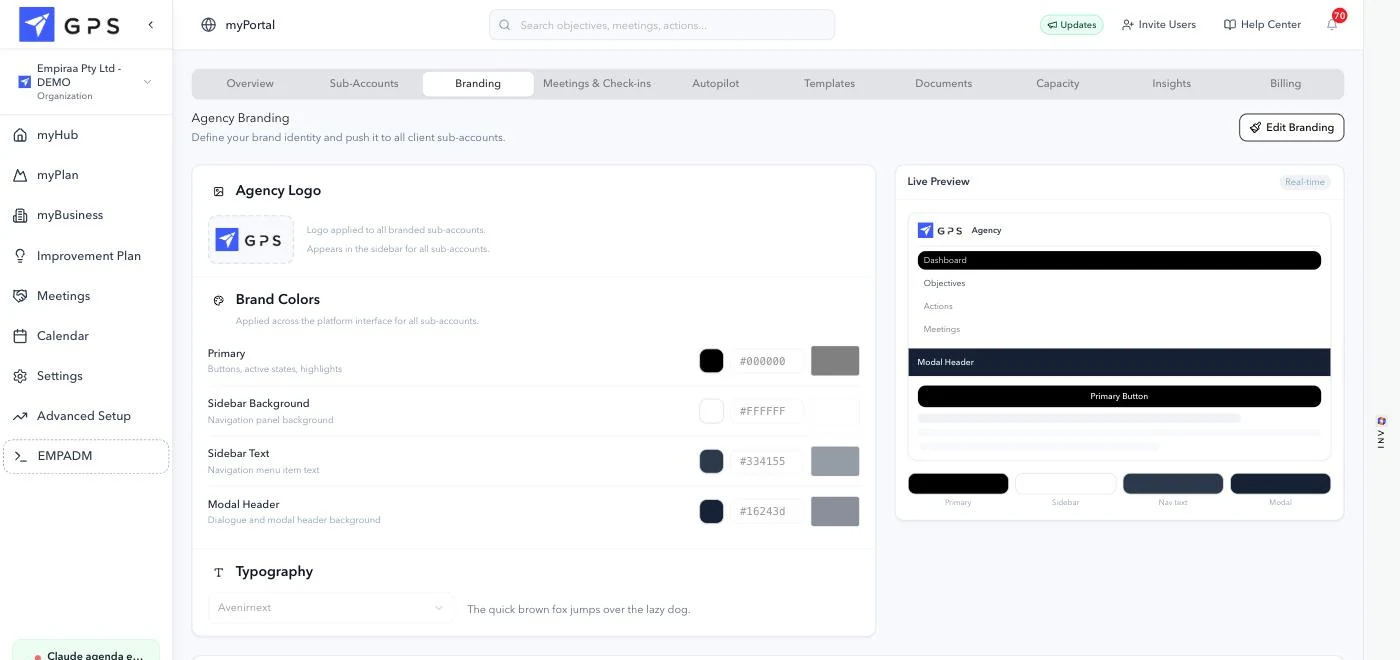
Your logo
Applied to every branded sub-account, and it appears in the sidebar of all of them.
Four colour slots
Primary, sidebar background, sidebar text and modal header. Those four are the whole interface.
Your typeface
Set once here, used across every client workspace.
A live preview
The client workspace rendered in your brand, updating as you change a slot.
What carries your brand
Three things, set once at practice level.
Not an accent colour in a corner. The navigation, the buttons, the active states and the dialogue headers.
Your logo, in the sidebar
The mark a client sees every time they open their plan, on every screen, in every client workspace you run.
Four interface colours
Primary, Sidebar background, Sidebar text, Modal header. Not an accent colour: the navigation, the buttons, the active states and the dialogue headers.
Your typeface
Set at practice level, so the client workspace reads in the same face as the report you sent them.
What does not
Two things, and the first one is the one you were going to ask about.
A page selling white label that buries the domain question is a page that gets found out thirty seconds into a demo. Here it is instead.
The address bar
Clients sign in at plan.empiraa.app. There is no custom domain and no vanity URL, and if a domain-level white label is a hard requirement for your firm then this is not that and you should know now rather than in a demo.
The name, entirely
Your branding covers the interface. It is not a claim that the word Empiraa appears nowhere, and the honest thing is to look at the workspace yourself and decide whether what is left bothers you.
Try it with your own colours
What your client signs into.
The four slots below are the product's own, named as the Branding tab names them. Change them and the workspace changes, which is a better argument than a screenshot of somebody else's brand.
In the product this is your logo file. Here it is text, because we are not going to ask you to upload anything to look at a preview.
What your client signs into
Your firm
Dashboard
Objectives
Actions
Meetings
Reports
This quarter
Add an objective
Decorative. The four colours, the logo in the sidebar and the typeface are what the Branding tab sets; the address is what it does not.
Why it matters commercially
A client who sees somebody else's logo has been shown you are separable.
This is the argument, and it has nothing to do with vanity.
Every engagement has the same slow risk in it. You bring a method, a rhythm and a system, and over eighteen months the client gets good at all three. At some point they ask themselves what they are still paying you for, and the answer depends entirely on whether the system feels like part of you or like something you introduced them to.
A client signing in daily to a workspace with a vendor’s mark on it is being told, every day, that the system is separable from the adviser. Your mark on that screen is the cheapest defence against that there is, and it costs you one afternoon in the Branding tab.
Which is also why the domain matters less than it feels like it should. A client knows there is software underneath whatever you deliver, the same way they know you did not write your own accounting package. What they see every morning is whose name is on it. A position that depends on them never finding out is fragile whatever the URL says.
What it buys you, in plain terms
- The client opens your system rather than a subscription you recommended
- A new client is onboarded into something that already looks like your firm
- Your report, your workspace and your deck are in the same typeface
- A rebrand reaches every client in one action rather than a project
- Nothing on the screen invites the question of who they are really working with
- The system stops being the separable part of what you sell
How it works
Three steps, and the second is the one that saves a rebrand.
It previews live as you set it, so nothing reaches a client on a guess.
- One
Set it once, at practice level
Logo, the four colours and the typeface, in the Branding tab in myPortal. It previews live as you change it, so nothing goes to a client on a guess.
- Two
Push it to every client, or to some
One action applies it across every sub-account, or to the ones you select. That second option is the one that matters the week you rebrand and want to test it on two clients first.
- Three
New clients inherit it
A sub-account added afterwards carries the practice branding from the first time the client signs in, rather than needing a step somebody forgets.
Questions
What firms ask about branding.
Is Empiraa white label?
The interface is. Your logo goes in the sidebar, four interface colours and your typeface are set at practice level, and one action pushes them into every client workspace. The domain is not: clients sign in at plan.empiraa.app. If a custom domain is a requirement for your firm, this is not that.
Can I use my own domain?
No. There is no custom domain or vanity URL, and we would rather say that on this page than in a demo. What the client sees at that address is your logo, your colours and your typeface.
What exactly can I change?
Your logo in the sidebar, your typeface, and four interface colours: primary for buttons, active states, highlights; sidebar background for navigation panel background; sidebar text for navigation menu item text; modal header for dialogue and modal header background. It previews live before anything reaches a client. The Branding tab in myPortal.
Does the domain actually matter to clients?
Less than it feels like it should, and this is an argument rather than a fact. A client knows there is software underneath whatever you deliver, the same way they know you did not build your accounting system. What they notice daily is whose mark is on the screen they open. A firm whose position depends on the client never finding out has a fragile position regardless of the URL.
Can different clients have different branding?
Branding is set at practice level and pushed down, so all your clients carry your brand rather than each their own. You choose which sub-accounts receive a push, which is how you roll out a rebrand gradually, but it is one brand per practice rather than one per client.
Do my clients know they are using Empiraa?
They can find out, and most will. The address is ours and we are not pretending otherwise. What the branding does is make the system feel like part of what you deliver rather than a tool you resold, which is a different and more defensible thing than concealment.
Why does branding matter commercially?
Because a client who signs in and sees somebody else’s software has been shown that the system is separable from you. Once the system is the value and you are the person who introduced it, your renewal is a procurement decision. Your mark on the screen every day is the cheapest defence against that there is.
What does it cost?
Branding is part of myPortal rather than an add-on. Empiraa GPS for a practice is agreed against the size of your book, and partners earn 30% recurring for the first twelve months on each client they bring. Pricing, and what you earn.
Bring one client and see.
Put your colours in, look at what a client would open, and decide whether the address bar is a problem for your firm.