

Blue Ocean Strategy, delivered to your clients
Everyone remembers the metaphor. The grid is the part that makes a plan.
Red oceans and blue oceans is a way of describing a conclusion. Eliminate, reduce, raise and create is a way of reaching one, and it is the only part of the framework that produces work with a name and a date on it. Load the grid as a plan and the workshop becomes a quarter.
- The four actions as owned objectives
- A branded workspace per client
- Pairs with a diagnostic framework
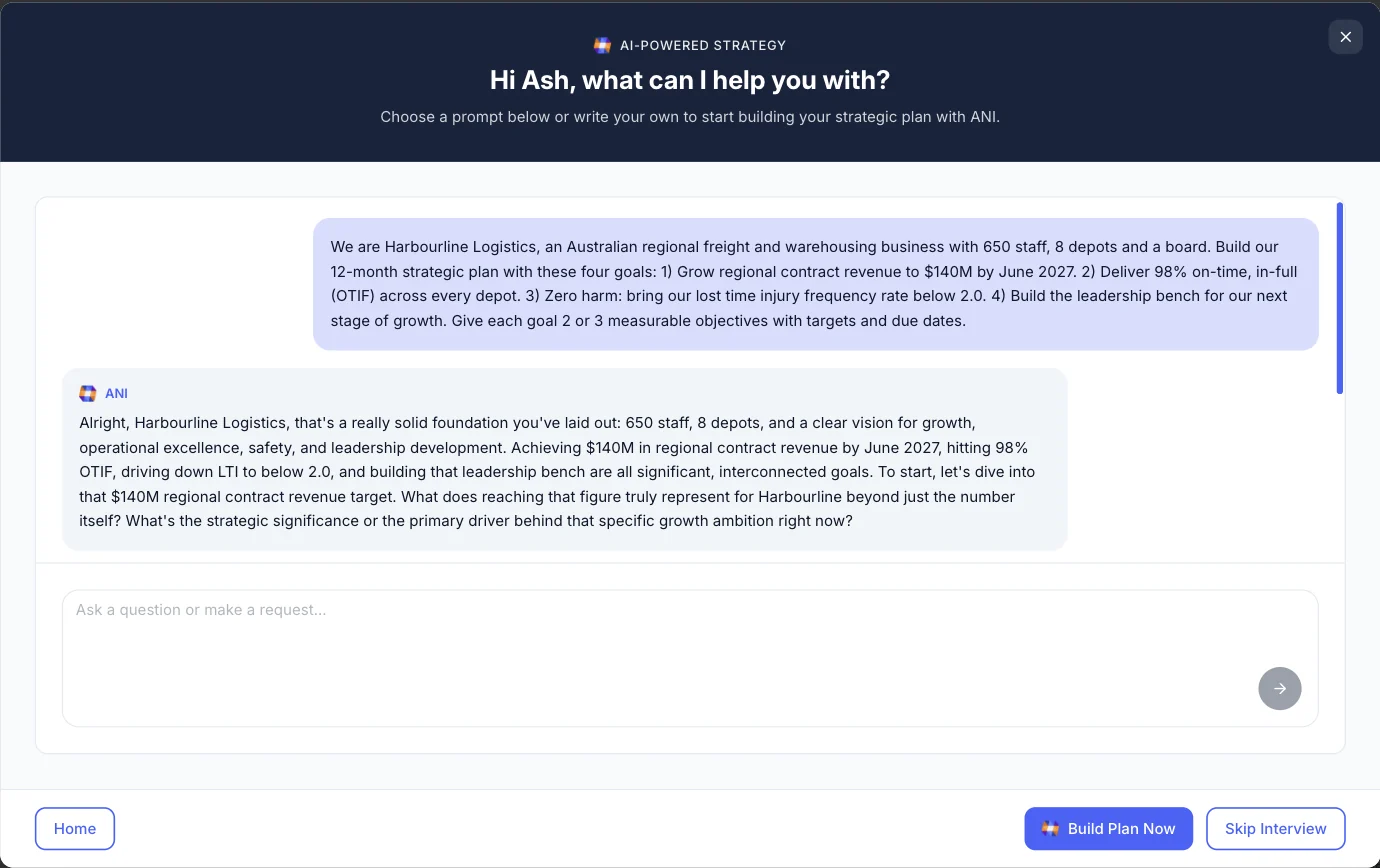
Describe the business
A few sentences about what you do and what you are aiming at is enough to start.
It digs into each goal
ANI asks what sits behind every goal, so the plan has measures and not just headings.
Build when you are ready
You get goals, objectives and actions with owners, targets and due dates, ready to edit.
What it is
Value innovation, and the grid that operationalises it.
W. Chan Kim and Renee Mauborgne of INSEAD set it out in Blue Ocean Strategy in 2005, and the central claim is a rejection rather than a recipe.
The claim is that the trade-off between differentiation and low cost is not a law. Most strategy teaching says pick one, because being better costs more. Blue ocean argues you can do both at once, by being dramatically better at the few things buyers actually value and dropping the things an industry does out of habit. They call that value innovation.
A red ocean is an existing market where the boundaries are known, everybody competes on the same factors, and margin thins as more entrants arrive. A blue ocean is demand that does not exist yet, so there is nothing to undercut you. That framing is memorable and it is also the part of the book that does the least work, because naming the destination does not get you there.
The four actions framework does. For the factors your industry competes on, ask what to eliminate entirely, what to reduce well below the standard, what to raise well above it, and what to create that the industry has never offered. Four lists, and every one of them is a decision rather than an observation.
The thing consultants know and the write-ups skip: eliminate and reduce are where the value is and where the engagement gets hard. Raise and create are fun to run a workshop about. Telling a client to stop doing something that looks profitable, and that somebody in the room built their career on, is the hardest sale in this business, and a blue ocean plan with nothing in the first two columns has not been done.
- Value innovation: differentiation and low cost at once, rather than a trade-off
- Eliminate: factors the industry competes on that buyers do not value
- Reduce and Raise: below and above the industry standard, deliberately
- Create: something the industry has never offered
In the library
Blue Ocean Strategy is a ready-made plan, not a setting.
The ready-made plan is built for the step after the canvas: each of the four actions you actually committed to, as an objective with an owner, a date and a measure that would show the position had moved.
3 goals · 6 objectives, loaded into a client’s workspace in one action
What the plan carries
Eliminate and reduce, with owners
The two columns that get abandoned, held as objectives with a name against them. Stopping something has a date and a person or it does not happen, and this is where a blue ocean plan usually dies.
Raise and create, with measures
Being dramatically better at something is a claim until there is a number on it. What would move if the raise worked, and what would exist that does not now.
A horizon that can survive it
Repositioning takes longer than a quarter, which is exactly why these objectives get quietly dropped. On a plan with a review cadence, a two year move has somewhere to be six months in.
Raise, cut and create, on one page
The four decisions sitting beside the vision they serve, each with a measure. A strategy canvas that never becomes goals is an illustration.
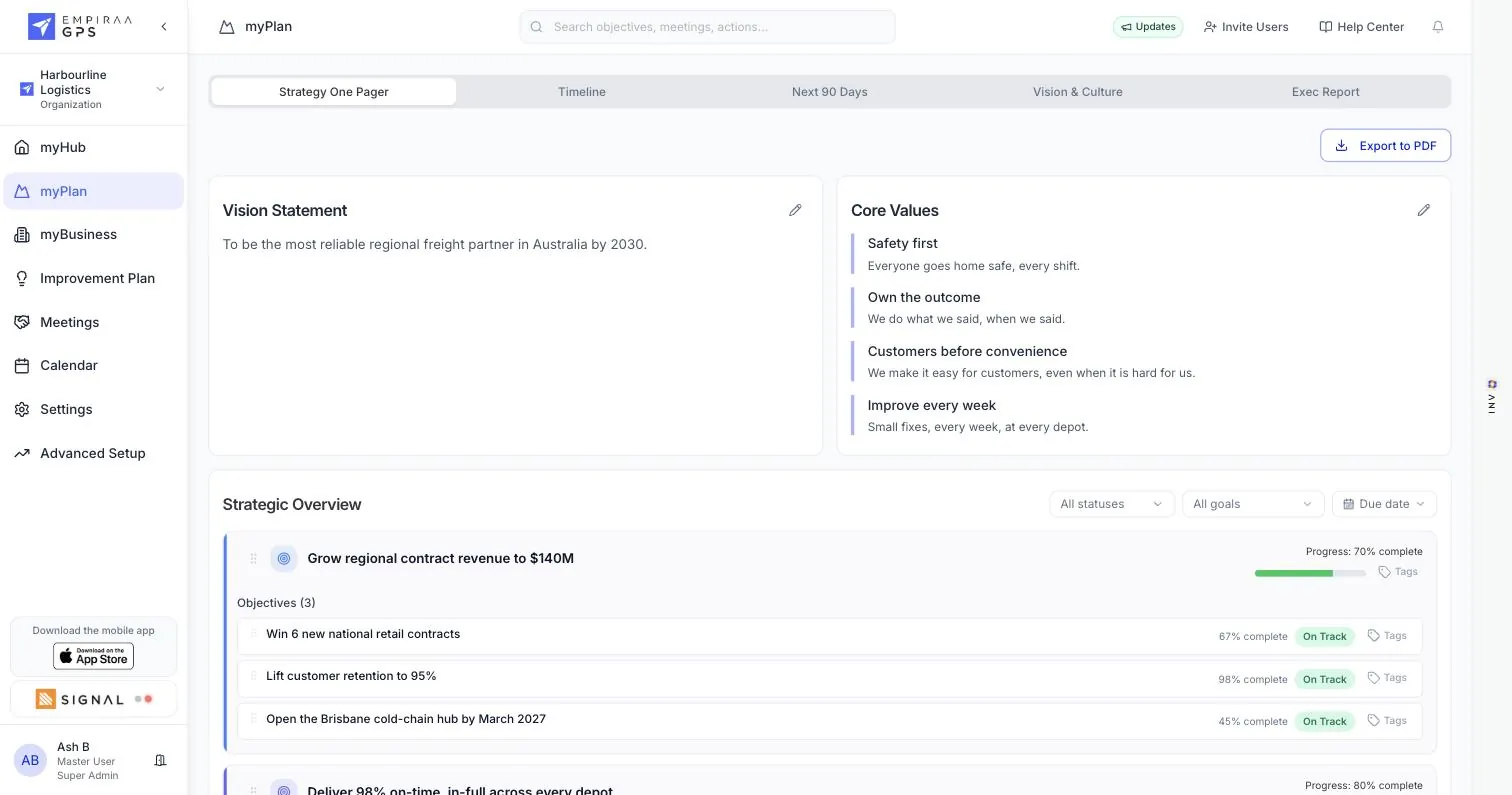
Vision
The one sentence everything else has to serve, in front of everyone who works on the plan.
Core values
How the business behaves, kept beside the numbers rather than on a poster.
Live progress on every goal
No one rebuilds this page for a meeting. It is right whenever you open it.
Export to PDF
The same page as a PDF for the offsite or the board pack.
Delivering it
The canvas is the easy morning. The first two columns are the engagement.
Three steps, and the second is the one you are actually being paid for, because nobody in the client can do it.
- One
Map what the industry competes on
The factors, and where the client and their rivals sit on each. Straightforward, and usually the first time anybody has written the list down.
- Two
Push hard on eliminate and reduce
This is the whole value of an outsider. A client will not propose dropping the thing they are known for, and a plan with an empty eliminate column is a plan to be slightly better at the same fight.
- Three
Give each action an owner and a measure
Then it is a plan rather than a canvas. Progress visible between sessions, so a repositioning that was agreed in a room is still running in month five.
Where it does not fit
Three criticisms, and the first is the one an MBA will raise.
The framework has been argued with since it was published and the objections are worth having ready rather than being surprised by.
The examples were chosen after the fact
The case studies are companies that succeeded, selected retrospectively, which tells you nothing about how many firms did something similar and failed. It is a strong description of what worked and a weak prediction of what will, and treating it as the second is how a client ends up funding a very confident mistake.
Blue oceans turn red
An uncontested market with good margin attracts entrants, so the advantage has a clock on it. The framework acknowledges this and most engagements built on it do not, which means the plan needs a second move in it rather than only the first.
Most value comes from competing better
For most of your clients, the honest answer is that there is no blue ocean available and the money is in being better at the fight they are already in. Reaching for this framework because it is more interesting than the alternative is a failure mode worth guarding against in yourself.
The client in front of you
Is Blue Ocean Strategy the right call for this client?
Five questions about them, not about you. The answer is graded rather than yes or no, and it names what to compare against either way.
Yes
On these answers Blue Ocean Strategy is where I would start.
Blue Ocean Strategy is worth it here because the four actions grid forces a client to choose what to stop, which is the move when more of the same has stopped working.
Decided mostly by: growth has stalled and more of the same is not working
Also worth reading: Growth Flywheel, because a reinforcing loop rather than a funnel, for a business whose growth has to compound rather than be bought again each quarter.
A starting point, not advice. You know this client and this tool does not, and the useful part is that whichever framework it names has a page with the plan already built.
Who reaches for it
The firms that arrive already selling this.
Each of these is a page in its own right, with the argument written for that profession rather than for a framework.
Strategy consultants
You wrote the plan. Somebody has to run it.
Read their argumentPrivate equity
Fourteen companies, fourteen spreadsheet formats.
Read their argumentVenture capital
You have no governance rights and forty founders.
Read their argumentOr read a framework that fits better
Porter's 5 Forces Plan
Run first. Five Forces tells you whether the industry is structurally attractive, which is the question that decides whether a blue ocean move is necessary or merely appealing.
Read itGrowth Flywheel
When the client’s advantage has to compound rather than be created. A reinforcing loop is a slower, more defensible answer than a new market.
Read itOGSM Framework
What comes after. Once the four actions are chosen, OGSM is how the year gets written on one page a board will read.
Read itQuestions
Blue Ocean Strategy, answered.
What is Blue Ocean Strategy?
A framework from W. Chan Kim and Renee Mauborgne of INSEAD, set out in their 2005 book. Its central claim is that the trade-off between differentiation and low cost is not a law: by being dramatically better at the few things buyers value and dropping what an industry does out of habit, a business can pursue both at once. They call that value innovation, and the market it creates a blue ocean.
What is the four actions framework?
The operational half. For the factors your industry competes on, decide what to eliminate entirely, what to reduce well below the standard, what to raise well above it, and what to create that the industry has never offered. It is sometimes called the ERRC grid, and it is the only part of the framework that produces decisions rather than descriptions.
Which of the four actions is hardest?
Eliminate, then reduce. Raise and create are enjoyable to run a workshop about because they are additive. Telling a client to stop doing something that looks profitable, and that somebody in the room built their career on, is the hardest sale in consulting, and a blue ocean plan with an empty eliminate column is a plan to be slightly better at the same fight.
What is the main criticism of Blue Ocean Strategy?
That the examples were selected after the fact. The cases are companies that succeeded, which says nothing about how many firms attempted something similar and failed, so the framework describes well and predicts poorly. Two others: a blue ocean attracts entrants and turns red, and for most businesses the money is in competing better in the market they are already in.
Is there Blue Ocean Strategy software in Empiraa?
Blue Ocean Strategy is a ready-made plan in the strategy library, with three goals and six objectives. It is not a canvas tool: it is the structure for the work after the analysis, so the four actions you committed to have owners, dates and measures inside the client’s own workspace and survive past the workshop. Every framework in the library.
Bring one client and see.
Load the framework you already sell into a client's workspace under your own logo, and see whether it survives the eight weeks between your sessions.