

SWOT, delivered to your clients
Everyone produces the grid. Almost nobody produces the work.
A SWOT workshop is the easiest thing in consulting to run and the easiest output to lose, because nothing in four lists has an owner or a date. It was never supposed to end at the grid. Turn each item that matters into an objective somebody is accountable for, in the client’s own workspace under your branding.
- Each item becomes owned work
- A branded workspace per client
- Pairs with a planning framework for the year
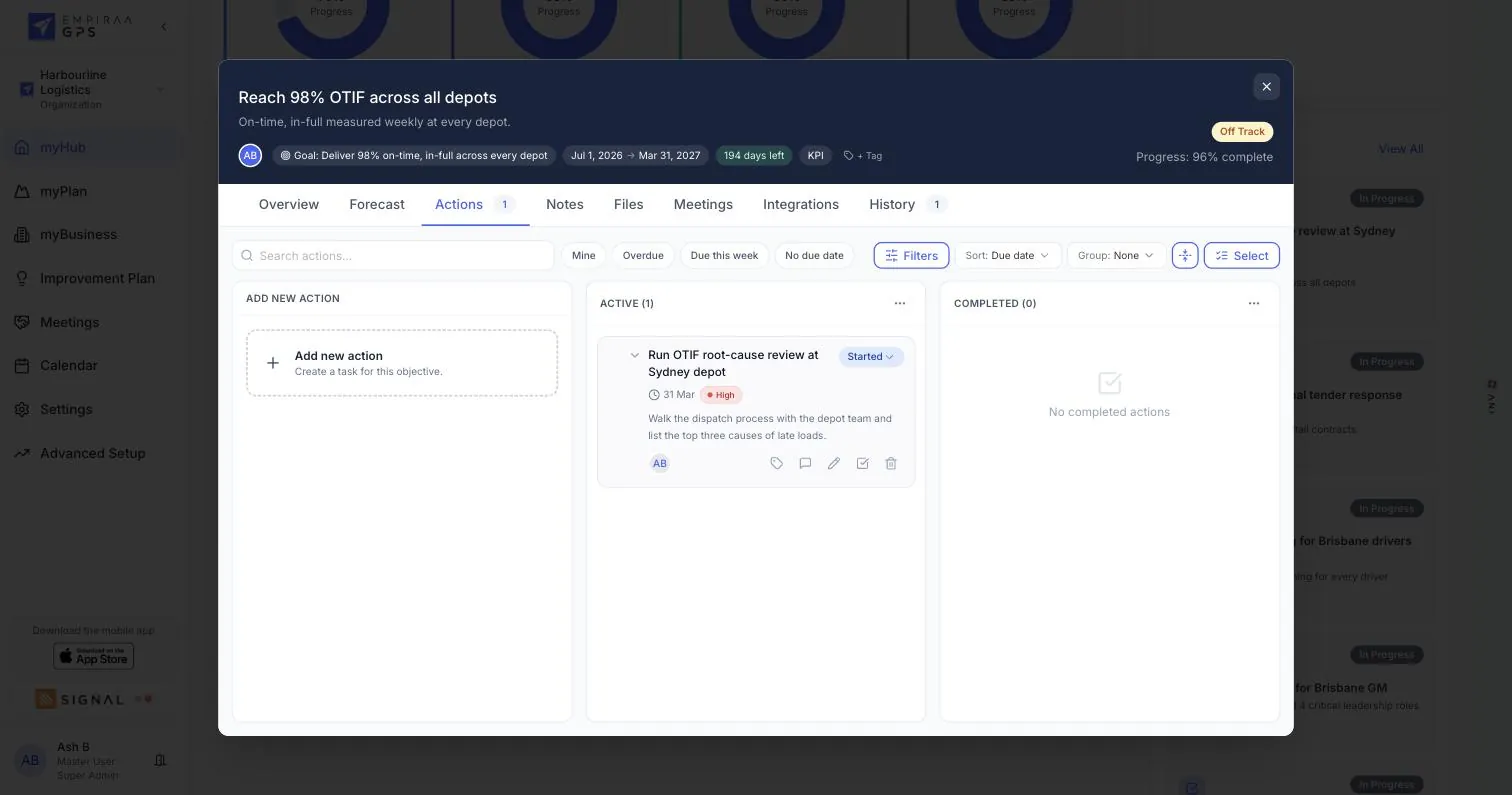
The goal it serves
Every objective is attached to one, so an action can be traced up to the strategy without a mapping document.
Off track, and by how much
Measured against where it should be by today, not against the deadline.
One action, with everything on it
Owner, due date, priority and status. An action with none of those is a note.
Completed, and how many
The column nobody fills in by hand, which is why it can be believed.
What it is
It started as a planning process, not a two by two.
The history is worth two minutes, because it explains exactly why SWOT feels like a waste of a morning.
SWOT descends from SOFT, which stood for satisfactory, opportunity, fault and threat, developed by Robert Franklin Stewart and his Theory and Practice of Planning group at Stanford Research Institute and published in 1965. Albert Humphrey, who is usually credited with SWOT, was in that group and later introduced the relabelled version, but he was not the originator.
The part that got lost matters more than the naming. Stewart’s emphasis was on a participatory planning process, with the creativity of the people in the room as the point of it, rather than on a grid. What survived into every business textbook is the grid.
Which is why SWOT has the reputation it has. Four lists produced in ninety minutes by a leadership team, with no weighting, no prioritisation and no consequence, is not a strategy tool, it is a warm-up exercise. The framework did not fail; the half of it that did the work was discarded.
The step that recovers it is usually called TOWS: instead of reading the four lists separately, you pair them. Which strength lets us take which opportunity. Which weakness leaves us exposed to which threat. Which opportunity is unreachable until a weakness is fixed. A pairing is a candidate strategy, where an item on a list is only an observation.
- Strengths and weaknesses are internal, opportunities and threats are external
- The grid was the part that survived; the process was the part that worked
- TOWS pairs the quadrants, which is where a strategy actually comes from
- An item with no owner and no date is an observation, not a plan
In the library
SWOT to Action is a ready-made plan, not a setting.
The ready-made plan is built for the step after the workshop: the handful of pairings that matter, each as an objective with an owner, a date and a measure that would show the position had changed.
3 goals · 6 objectives, loaded into a client’s workspace in one action
What the plan carries
Only the items you would act on
Three goals rather than four quadrants, because a plan with an objective under every heading has not made a choice. Most of what comes out of a SWOT workshop is context, and saying which parts are context is the value.
Pairings, not lists
A strength matched to an opportunity becomes one objective. A weakness that exposes you to a threat becomes another. Each pairing is a sentence a client can disagree with, which is the test of whether it is a strategy.
A measure per position
What number would move if this were working. Without one, a strength objective is a description of the company and cannot be marked as anything other than done.
How measures workAcross the year, not across the whiteboard
Every action from the session as a bar with a date, which is the part that normally evaporates in the week after the workshop.
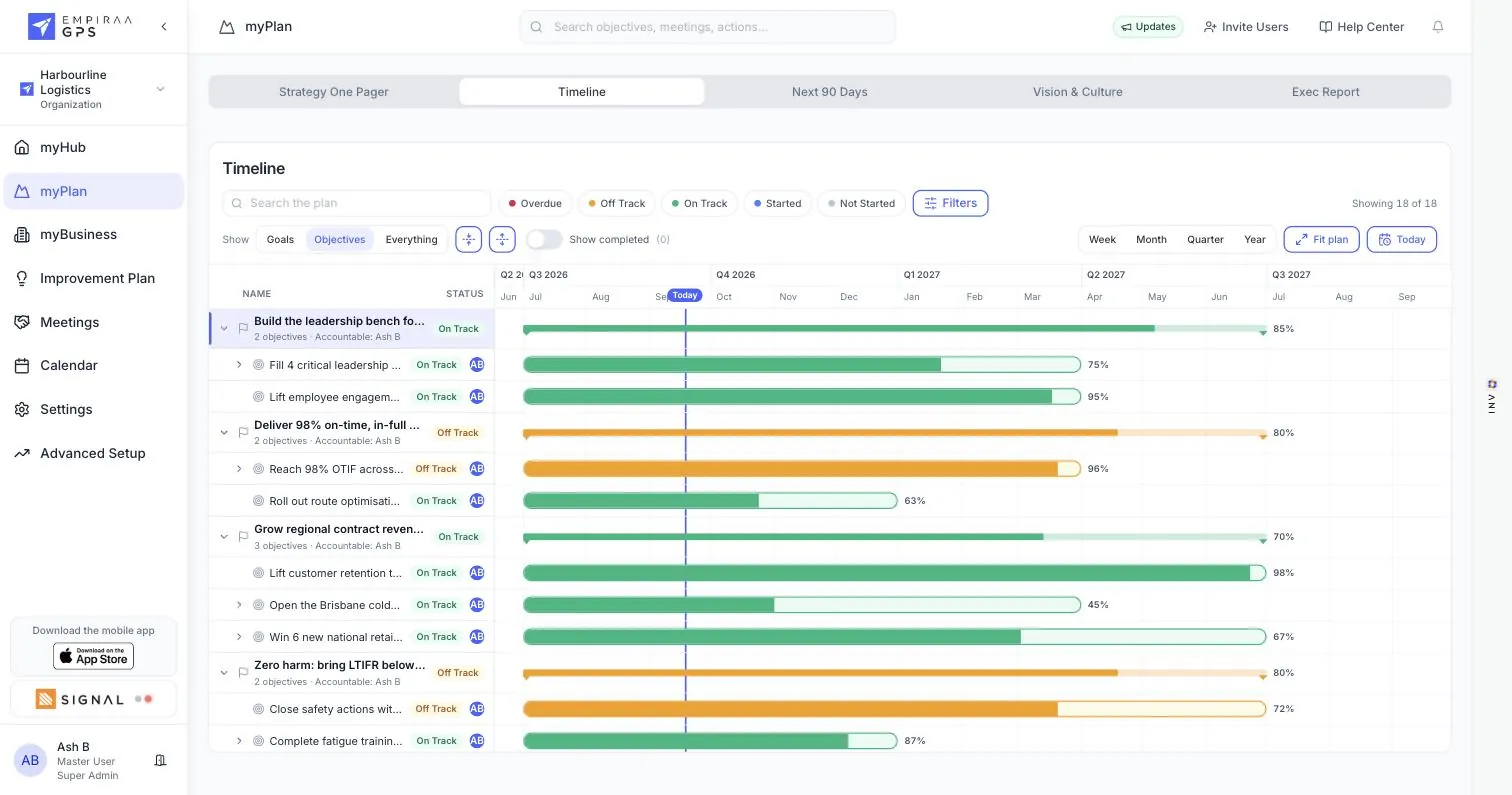
The today line
Every bar is read against it, so late work shows up as a gap rather than a status someone typed.
Filter to the problem
Overdue, off track, on track, started or not started, across every team.
Week to year
Zoom out for the board, in for the quarter, or fit the whole plan on one screen.
A goal and its objectives
Open a goal to see the measures under it and which one is dragging.
Delivering it
The workshop is the easy part.
Three steps, and the second is the one most engagements skip, which is also why most SWOT outputs are never seen again.
- One
Run the workshop as you always do
Applied into the client workspace as it happens if you want, so the four lists exist somewhere other than a whiteboard photo in somebody’s phone.
- Two
Pair them, and cut most of it
TOWS the grid, pick the three or four pairings worth a quarter, and say out loud that the rest is context. A client who leaves with eighteen actions leaves with none.
- Three
Give each survivor an owner and a measure
Then it is a plan. Progress against expected pace, visible between sessions, so a strategy that came out of a morning in a room is still running in week eight.
Where it does not fit
Three reasons SWOT gets dismissed, two of them fair.
If a client has done a SWOT before and found it useless, they are not wrong and it is better to agree than to defend the framework.
It has no weighting
Nothing in SWOT says which threat is existential and which is an irritation, so a list treats them as equals. You supply the judgement, and a client expecting the framework to prioritise for them is a client who will be disappointed by it.
Items land in the wrong quadrant constantly
Is a well-funded new competitor a threat, or is your thin balance sheet the weakness? Both, and arguing about which box it goes in is time that produces nothing. Pair them instead and the question stops mattering.
It is a snapshot, so it ages fast
A SWOT describes a company and a market on the week you did it. Six months on it is a historical document. Items held as objectives with progress on them age much better than items held in a grid.
The client in front of you
Is SWOT to Action the right call for this client?
Five questions about them, not about you. The answer is graded rather than yes or no, and it names what to compare against either way.
Yes
On these answers SWOT to Action is where I would start.
SWOT to Action is worth it here because the lightest diagnostic that a whole leadership team can take part in without being taught a model first.
Decided mostly by: growth has stalled and more of the same is not working
Also worth reading: Blue Ocean Strategy, because the four actions grid forces a client to choose what to stop, which is the move when more of the same has stopped working.
A starting point, not advice. You know this client and this tool does not, and the useful part is that whichever framework it names has a page with the plan already built.
Who reaches for it
The firms that arrive already selling this.
Each of these is a page in its own right, with the argument written for that profession rather than for a framework.
Strategy consultants
You wrote the plan. Somebody has to run it.
Read their argumentBusiness advisory
The rhythm has to work when you are not in the room.
Read their argumentOr read a framework that fits better
Porter's 5 Forces Plan
When the external half of the SWOT is the half that matters. Five Forces is structured where opportunities and threats is a blank page, and it is harder to be lazy in.
Read itMcKinsey 7S
When the internal half is the problem. Seven named elements beat two open lists for finding out where an organisation is arguing with itself.
Read itOGSM Framework
What comes after. Once the pairings are chosen, OGSM is how the year gets written down on one page a board will read.
Read itQuestions
SWOT to Action, answered.
Who invented SWOT analysis?
Not who is usually credited. SWOT descends from the SOFT approach, satisfactory, opportunity, fault and threat, developed by Robert Franklin Stewart and the Theory and Practice of Planning group at Stanford Research Institute and published in 1965. Albert Humphrey, the usual attribution, was a member of that group and later introduced the relabelled version, but Stewart was the primary architect.
Why does SWOT analysis have a bad reputation?
Because the half of it that did the work was discarded. Stewart’s emphasis was on a participatory planning process with the creativity of the room as the point; what survived into every textbook was the two by two grid. Four unweighted lists produced in ninety minutes with no consequence attached is a warm-up exercise, and treating it as a strategy tool is what gives it the reputation.
What is the TOWS matrix?
The step that turns SWOT into strategy by pairing the quadrants rather than reading them separately: which strength lets you take which opportunity, which weakness exposes you to which threat, which opportunity is unreachable until a weakness is fixed. A pairing is a candidate strategy, where an item on a list is only an observation.
How do you turn a SWOT analysis into an action plan?
Pair the quadrants, cut most of what comes out, and give each survivor an owner, a date and a measure. The cutting is the part clients resist and the part that matters: a leadership team leaving with eighteen actions leaves with none. SWOT to Action is a ready-made plan in Empiraa for exactly that step, with three goals and six objectives.
Is there SWOT software in Empiraa?
There is a ready-made SWOT to Action plan in the strategy library. It is not an analysis tool and does not draw a grid: it is the structure for the work after the workshop, so the pairings you chose have owners, dates and measures inside the client’s own workspace.
Can I pair it with another framework?
Yes, and it is the normal sequence. SWOT or 7S for the diagnosis, OGSM or the Balanced Scorecard for the year, both applied into the same client workspace. The plan structure is data, so two frameworks coexist rather than competing. Every framework in the library.
Bring one client and see.
Load the framework you already sell into a client's workspace under your own logo, and see whether it survives the eight weeks between your sessions.