

OGSM, delivered to your clients
One page a board will actually read, still true in month seven.
OGSM fits a whole strategy on a single sheet, which is why it survives contact with a board and why it is the framework to reach for when the client’s real problem is that nobody can state the strategy. Loaded as a plan, the page stops being a snapshot and starts carrying live numbers.
- Objectives, goals, strategies and measures as one structure
- Live numbers, not a quarterly retype
- A workspace per client, branded as you
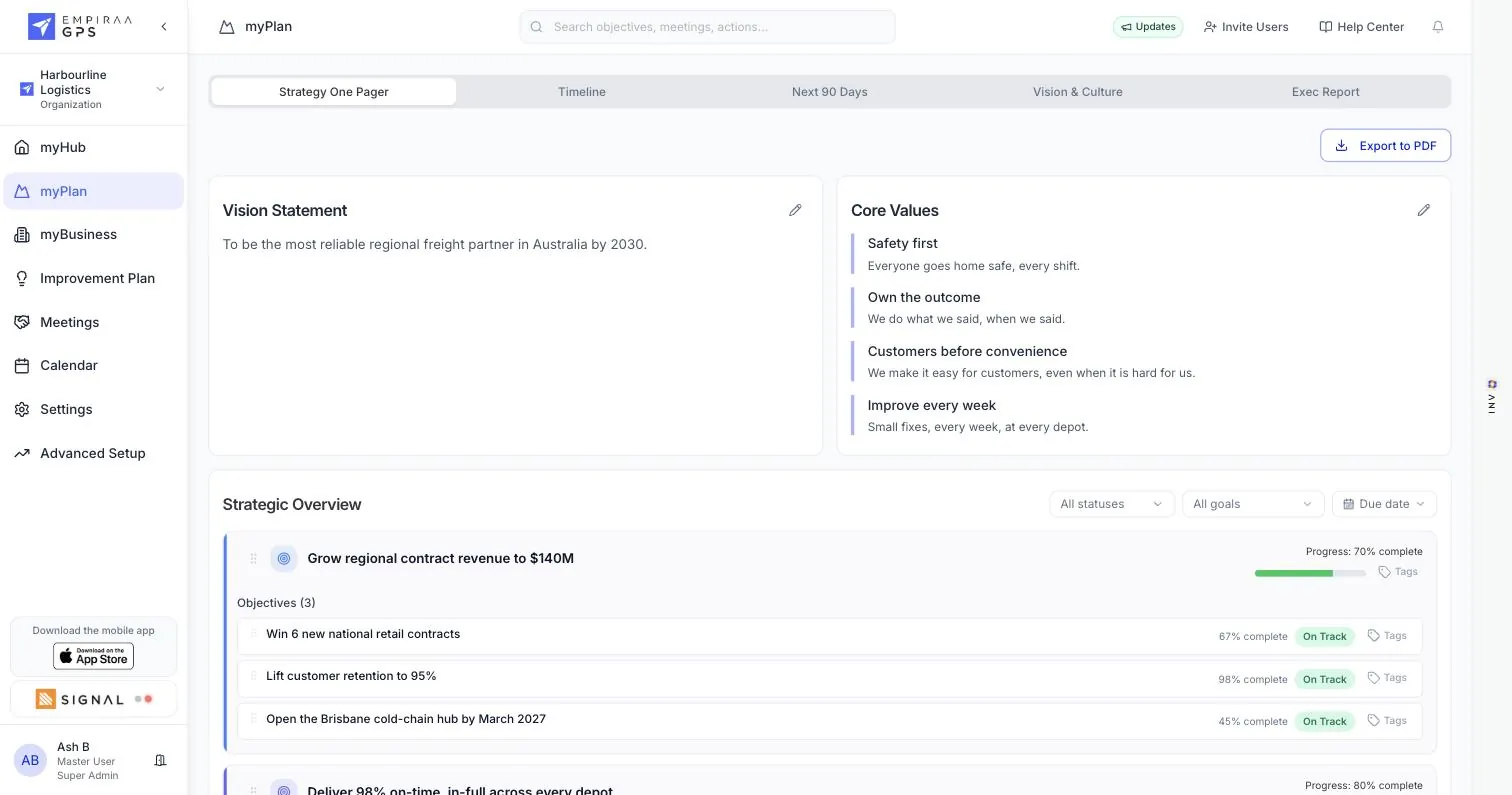
Vision
The one sentence everything else has to serve, in front of everyone who works on the plan.
Core values
How the business behaves, kept beside the numbers rather than on a poster.
Live progress on every goal
No one rebuilds this page for a meeting. It is right whenever you open it.
Export to PDF
The same page as a PDF for the offsite or the board pack.
What it is
Four letters, and two of them are numbers doing different jobs.
This is the part almost every explanation of OGSM gets wrong, and the part a client will ask you about in the first session.
OGSM is usually credited to Procter & Gamble and is often traced further back, to Japanese planning practice in the 1950s. Its verifiable origin is genuinely unclear, which is worth knowing if a client asks, and matters less than why it spread through consumer goods and then everywhere else: it holds a complete strategy on one page without becoming a list.
The objective is the aim in a sentence, written qualitatively and deliberately so. “Be the first choice for commercial maintenance in Victoria” is an objective. It is not measurable, and that is the point: it is the thing the numbers are for.
The goals are the numbers that would prove the objective had been achieved. Revenue, share, retention, whatever the objective actually means in figures. Two or three, not ten.
The strategies are the choices about how, and this is where OGSM is hardest and most useful. A strategy is a choice, which means it excludes something. “Grow in Victoria by taking share from the two incumbents in aged care” is a strategy. “Improve sales and marketing” is not a strategy, it is a wish, and a client who writes four of those has produced a document that cannot be wrong and therefore cannot be useful.
The measures are the numbers that show whether the strategies are working, and they are not the goals again. Goals are lagging: they tell you at the end. Measures are leading: they tell you in week six whether the strategy that was supposed to produce the goal is doing anything. Confusing the two is the most common way an OGSM turns into a scorecard that only reports the past.
- Objective: the aim in one qualitative sentence
- Goals: two or three numbers that would prove it happened
- Strategies: choices about how, each one excluding something
- Measures: leading numbers that show the strategies are working
In the library
OGSM Framework is a ready-made plan, not a setting.
The ready-made plan maps OGSM onto the plan structure directly: the objective as the goal, the numbers under it as its measures, and each strategy as an objective with its own owner and its own leading measure.
3 goals · 6 objectives, loaded into a client’s workspace in one action
What the plan carries
The objective, with its goals under it
The qualitative aim as a goal, carrying the two or three lagging numbers that would prove it. Progress is read against where it should be by now rather than against percent complete.
Each strategy as an owned objective
A strategy with no owner is a paragraph. Each one becomes an objective with a name on it, a date and a leading measure, which is also the fastest way to find out that two of the four strategies were wishes.
The one page, generated
The strategy one pager carries the objective, the values and every goal with live status, so the page the board reads is produced from the plan rather than rebuilt for the meeting.
How reporting worksThe M, doing its job
Each measure against where it should be by today rather than only against the target. That is the difference between a one-page plan and a one-page poster.
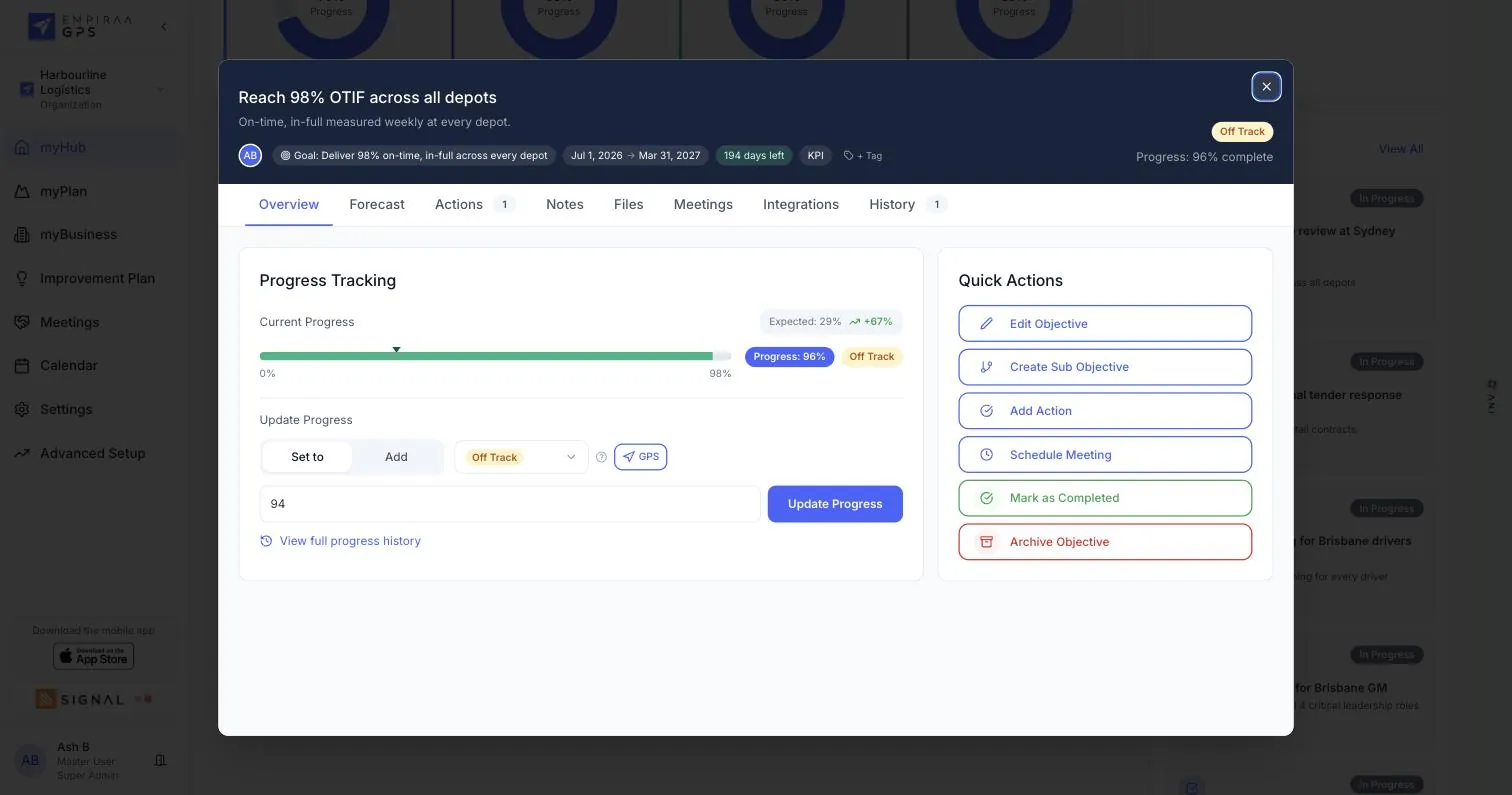
Expected, not just actual
GPS works out where this measure should be by today, and shows the gap.
Off track, early
Status comes from pace, so a measure turns amber weeks before the quarter closes.
Updating takes seconds
Set a new value or add to the last one, pick a status, and you are done.
Everything from here
Sub-objectives, actions, a meeting, or mark it complete.
Delivering it
The engagement is mostly the S, and the software is mostly the M.
Writing a good OGSM is judgement work and it is what the client is paying you for. Keeping it true for the rest of the year is not, and that is the part that usually does not happen.
- One
Write it in the session
Objective, goals, strategies, measures, applied into the client workspace as you go, so the wording is argued against a plan rather than a slide.
- Two
Give every strategy an owner and a leading measure
This is the step that separates an OGSM that works from one that is filed. A strategy nobody owns and nothing measures is indistinguishable from a strategy that was never chosen.
- Three
Read the measures, not the goals, in month two
The goals will not have moved yet, and a client reading them in month two concludes the strategy has failed. The measures are what tell you whether it is working, which is why they were on the page.
Where it does not fit
Two honest limits, and one that is not the software’s fault.
OGSM is a planning artefact. Knowing what it does not do is how you avoid selling it as more than that.
It is not an operating rhythm
OGSM tells you what the year is for. It does not tell anybody what to do on a Monday, and it has no meeting, no weekly number and no issues list. Clients who need the rhythm rather than the page are better served by EOS, and plenty of firms deliver an OGSM on top of one.
It gives no help choosing the strategies
The S is the hardest part of the framework and OGSM offers no method for it. That is not a flaw, it is scope, and it is why firms pair it with something diagnostic. McKinsey 7S or Porter’s Five Forces earlier in the engagement is usually where the strategies come from.
The client in front of you
Is OGSM Framework the right call for this client?
Five questions about them, not about you. The answer is graded rather than yes or no, and it names what to compare against either way.
Yes
On these answers OGSM Framework is where I would start.
OGSM Framework is worth it here because a whole strategy on one page, which is what a business needs when the real problem is that nobody can state it.
Decided mostly by: nobody in the business can state the strategy
Also worth reading: EOS (Traction), because an operating system rather than a goal format, which is what a client needs when the plan is fine and nothing happens on a Tuesday.
A starting point, not advice. You know this client and this tool does not, and the useful part is that whichever framework it names has a page with the plan already built.
Who reaches for it
The firms that arrive already selling this.
Each of these is a page in its own right, with the argument written for that profession rather than for a framework.
Strategy consultants
You wrote the plan. Somebody has to run it.
Read their argumentAccountants
You have the actuals. There is nothing to hang them on.
Read their argumentOr read a framework that fits better
Balanced Scorecard
When the objective is clear and the gap is that financial results are being read without the customer, process and people measures behind them.
Read itMcKinsey 7S
Earlier in the engagement, when nobody yet knows which strategies to choose. It is a diagnostic and OGSM is the document that comes after it.
Read itEOS (Traction)
When the client can state the strategy perfectly well and nothing happens on a Tuesday. That is a rhythm problem, not a planning one.
Read itQuestions
OGSM Framework, answered.
Is there OGSM software in Empiraa?
Yes. OGSM is a ready-made plan in the strategy library, carrying three goals and six objectives, and applying it gives a client a plan already shaped as an objective with its goals, its strategies as owned objectives and the leading measures under them. It is one of fifteen named frameworks in the library.
What is the difference between goals and measures in OGSM?
Goals are lagging numbers that would prove the objective happened, such as revenue or retention. Measures are leading numbers that show whether the strategies are working, such as qualified conversations in the target segment. Goals tell you at the end, measures tell you in week six. Treating them as the same thing twice is the most common way an OGSM becomes a report about the past.
What makes a strategy in OGSM, as opposed to a wish?
A strategy excludes something. "Grow in Victoria by taking share from the two incumbents in aged care" is a strategy because it rules other things out. "Improve sales and marketing" cannot be wrong, so it cannot be useful. A quick test: if the opposite of your strategy is obviously stupid, it is not a choice.
Does OGSM fit on one page in the software?
The strategy one pager carries the objective, the values and every goal with its objectives and live progress, generated from the plan rather than assembled for the meeting. It is not laid out as the classic four-quadrant OGSM grid, so if that specific layout is your client deliverable you will keep producing it where you produce it now.
Can I change it into my own version?
Yes, and most firms do. Open it in the plan builder in myPortal, rename the goals, cut what never fits your clients, add what you always add, and save it as one of your own templates for the whole book. Every framework in the library.
Do I earn anything on clients I bring?
30% recurring for the first twelve months on each client, and your own Empiraa Signal workspace free for as long as you hold three or more clients. The partner program.
Bring one client and see.
Load the framework you already sell into a client's workspace under your own logo, and see whether it survives the eight weeks between your sessions.