

For venture funds and platform teams
No governance rights. Forty founders. Good luck mandating anything.
You cannot require reporting across a seed portfolio, so updates arrive when there is good news and the quietest companies are the ones that need you. The only reporting that survives contact with a founder is reporting they were going to keep anyway. Give them a planning tool they actually want, branded as yours, and read it.
- Branded as your fund
- The same shape across the portfolio
- Founder updates written from the plan
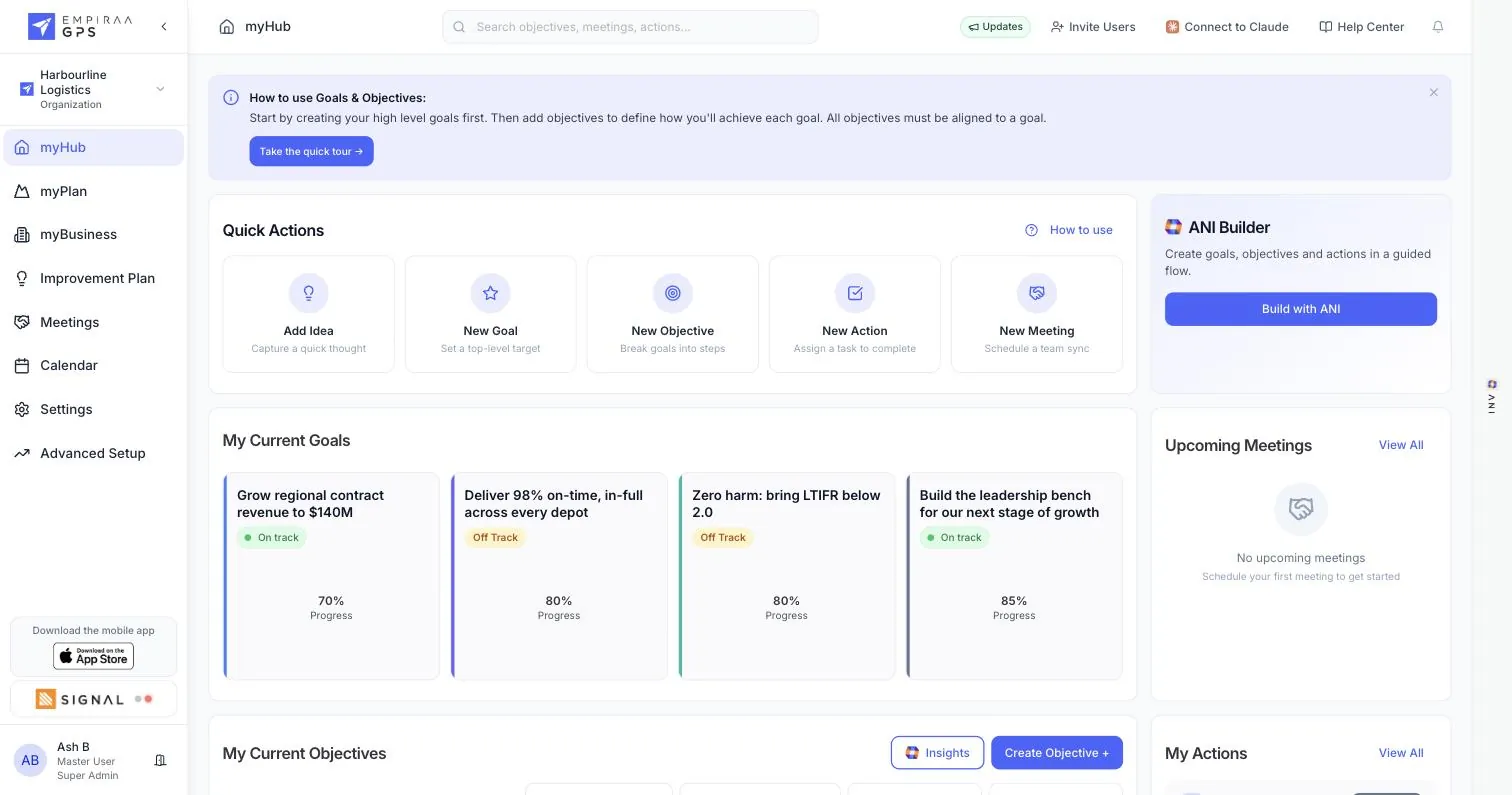
Your goals, with live progress
On track and off track at a glance, without asking anyone for an update.
Add anything in one click
An idea, a goal, an objective, an action or a meeting, from wherever you are.
Build with ANI
The guided flow that turns a thought into goals, objectives and actions.
What is coming up
The meetings and actions due, beside the plan they move.
What they are paying you for
Money, and help. The next round judges you on the help.
Capital is the commodity. What a founder tells the next founder is whether you were useful: whether the platform team answered fast, whether the introductions landed, whether anybody noticed the company was struggling before the founder had to say so.
That reputation is built almost entirely in the companies you are not currently worried about, which are exactly the companies you have the least information on. It is a distribution problem dressed as a relationship problem.
Where it stops working
The update that arrives because things went well.
A founder writes when there is something to say, and something to say usually means good news. The company going sideways writes less, then stops, and by the time the silence is loud enough to notice the runway conversation is already late.
Meanwhile the platform team answers the same five questions forty times, each in its own thread, none of it accumulating. You wrote a playbook. Nobody has read it, because reading a playbook is not a thing a founder does at 11pm.
- Reporting cannot be mandated, so the data is voluntary and therefore biased
- The companies that need you most are the quietest
- Platform knowledge is delivered one conversation at a time and never compounds
- No pattern across a cohort, because there is no common shape to compare
What is different
Reporting stops being a request and becomes a by-product.
Four things. The last one is the only version of founder reporting that has ever survived contact with a founder.
- Give the company a planning tool it wants anyway, branded as yours, and progress becomes something you can read instead of something you have to ask for
- The same structure across the portfolio means a pattern is visible: which cohort is hitting its milestones and which one went quiet in the same month
- The plans the platform team would have walked each founder through are already in the library, so the answer to the fifth identical question is a plan pushed into their workspace
- A founder’s quarterly update writes itself out of the plan they are already keeping, which is the only version of founder reporting that ever survives contact with a founder
Platform value is mostly a distribution problem. Forty founders will not read your playbook. They will open their own plan.
How an engagement runs
Offer it, do not require it.
A fund that mandates this gets a plan updated the day before a board meeting. A fund that funds it and makes it useful gets a plan that is current because the company uses it.
- At investment
Offer it as part of the platform
Their own workspace, branded as your fund, at no cost to them. Framed as something the fund provides rather than something the fund requires, because the second framing produces a different and much less useful artefact.
- First ninety days
Push the playbook in as a plan
The advice your platform team gives every company anyway, applied as a ready-made plan: launching a business, a growth flywheel, the goals every seed company should be able to state. The fifth identical question becomes a plan pushed into their workspace.
- Ongoing
Read the portfolio, and notice the quiet
One screen, the same shape in every company, ordered by who needs attention. A company that stopped updating in March is visible in March, which is the only month in which that information is worth anything.
The fifth identical question, answered once
ANI reads the workspace it is in, so a founder gets a straight answer about their own plan without a call. The platform team stops being a helpdesk for the same five questions.
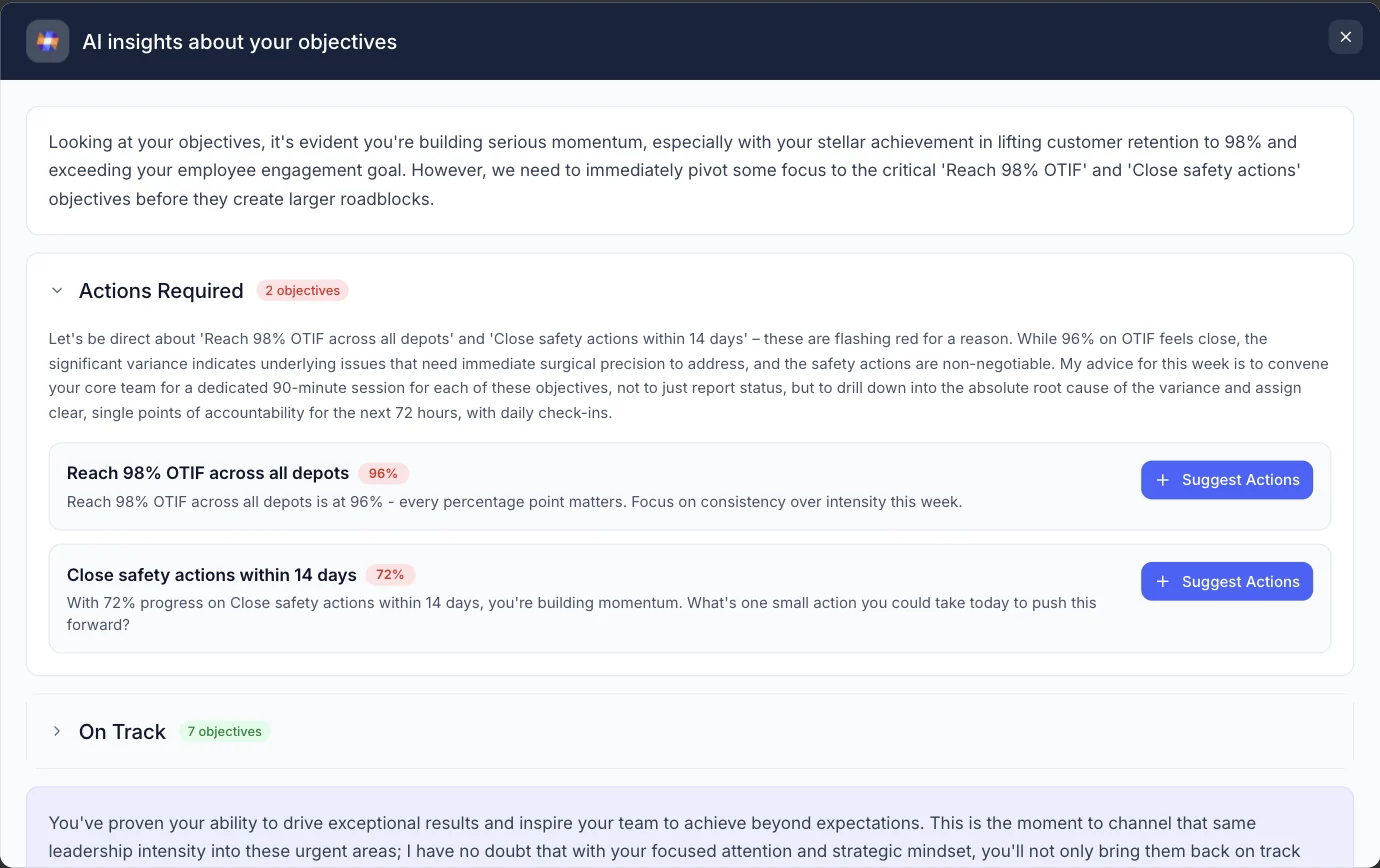
The read in plain English
What is going well, what is slipping, and what it means for the plan.
Ranked, not listed
The objectives that need action come first, with the reason each one is there.
And what to do about it
Ask for next steps on any objective and ANI drafts them for you to accept or change.
The frameworks you already sell
Loaded as plans, not adopted as a way of working.
The method is what you charge for. If the software arrives with its own, it is competing with you inside your own client. These are the ones this profession reaches for first.
SMART Goals
The plainest structure in the library, and the one to reach for with a client who has never written a plan down. Specific, measured, owned and dated, with nothing else to learn first.
Read the pageGrowth Flywheel
Acquisition, retention and referral as one reinforcing loop rather than three departments. The plan that suits a client whose growth has to compound rather than be bought.
Read the pageOKR Framework
Objectives with key results under them, each one measured rather than described. The client updates the number, so progress is a fact instead of a status colour somebody chose.
Read the pageBlue Ocean Strategy
Value innovation as a structured plan rather than a workshop feeling. What to raise, what to cut, what to create, each with a measure on it.
Read the pageThe milestones in the update
Which of these would a founder still be tracking in March?
Put in three milestones from a founder’s last update. You have no governance rights, so the only ones that survive are the ones the founder keeps because they are useful to the founder.
nothing measures it, so progress is an opinion.
nobody owns it, so nobody is asked about it; nothing measures it, so progress is an opinion; no date, so it is never late and never done.
1 of 3
Only 1 of these could be run by something other than you.
One is close and missing a field, which is the easiest kind to fix and the kind that quietly never gets fixed.
One is a statement of intent. Worth having in the document, impossible for anybody to act on.
A milestone a founder can see moving in their own workspace gets updated without being chased. That is the whole of platform value as a distribution problem: forty founders will not read your playbook, but they will open their own plan.
What this does not do
Three things to be clear-eyed about.
A venture fund has no leverage, and any page that pretends otherwise is written by somebody who has not worked with founders.
A mandate produces compliance theatre
Require this and you will get a plan updated the night before a board meeting, which is worse than no plan because it looks like information. It only works offered, funded, and genuinely useful to the company. If a founder does not want it, that is the end of it.
It is not a cap table, a data room or fund admin
No ownership, no SAFEs, no valuations, no LP reporting, no fund accounting. It holds what the company is trying to do and whether it is happening. Everything about the fund stays where it is.
It does not aggregate financials across the portfolio
You will not get a consolidated portfolio revenue number out of this. Progress against plan is comparable across companies; their P&Ls are not, and nothing here tries to normalise them.
If that is not quite you
Venture capital is one of ten. These are the ones next to it.
Closely related work, bought for different reasons. If one of these describes your week better, read that page instead.
Private equity
You own the business, you hold a board seat, you can mandate how a company reports, and the hold period has to end in a number.
Read that pageStrategy consultants
You are hired to work out what the business should do, you deliver that as a plan and a set of choices, and the engagement is scoped to end at approval.
Read that pageBusiness advisory
You are hired for a rhythm rather than a document, you are in the room every quarter, and you are judged on whether the cadence survived the gap between visits.
Read that pagePricing
Plans for your client workspaces.
Compare Professional Services plans by client workspace capacity.
Questions
Venture capital, answered.
How do VC funds monitor portfolio companies without governance rights?
Mostly badly, because the only lever is goodwill. The approach that works is to make the reporting a by-product of something the company wanted anyway: give the company a planning tool, fund it, brand it as yours, and read the plan they are already keeping. What does not work is a mandated template, which produces a document written for you rather than a picture of the business.
Do founders have to use it?
No, and requiring it defeats the purpose. A plan updated the night before a board meeting looks like information and is not. Offered as part of the platform, funded by the fund, and actually useful to the company is the only version that stays current, and a founder who declines is simply a founder who declines.
Who pays for it?
Usually the fund, as part of the platform offering, which is also what makes it an offer rather than an imposition. Empiraa GPS for a portfolio is agreed against the number of companies. Some funds pass it to the company after a round; that is a conversation rather than a rule. Pricing, and what you earn.
Can it write the founder update?
It can generate a report from the plan the company already keeps, with goals, measures, progress against expected progress and what is behind. Six report types and different lengths. A founder editing a generated update is a founder who sends one; a founder starting from an empty template at 11pm is a founder who sends one late. How reporting works.
Does it carry our fund’s branding?
Yes. Your logo, four interface colours and your typeface, set once and pushed into every company workspace. For a platform offering that matters: the founder is opening something their investor gave them rather than a subscription they were told to buy.
Which plans suit an early stage company?
Launching a Business, of which there are ten in the library. A growth flywheel where growth has to compound rather than be bought. SMART goals for a company that has never written a plan down, which is more of them than anybody admits. OKRs once there is a team to align rather than five people in one room. The fifteen frameworks.
Can companies see each other?
No. Each company is a separate workspace with its own users. The portfolio view is the fund’s alone, and no company can tell which others are in it.
What does the fund earn on companies it brings?
30% recurring for the first twelve months each company is with us, and your own Empiraa Signal workspace free for as long as you hold three or more. For most funds the share offsets part of what the platform offering costs them. The partner terms.
Bring one client and see.
Fifteen minutes with one real client in mind, ideally the one you are slightly worried about.