

EOS, delivered to your clients
EOS runs in week eight, or it does not run at all.
The session works. The five weeks after it are the problem: the scorecard goes stale, the accountability chart is a PDF from the last offsite, and the Rocks are in a spreadsheet only the operations person opens. Load EOS as a plan in the client’s own workspace, under your logo, and the rhythm is still running when you walk back in.
- A workspace per client, branded as you
- The accountability chart, live
- Not affiliated with EOS Worldwide
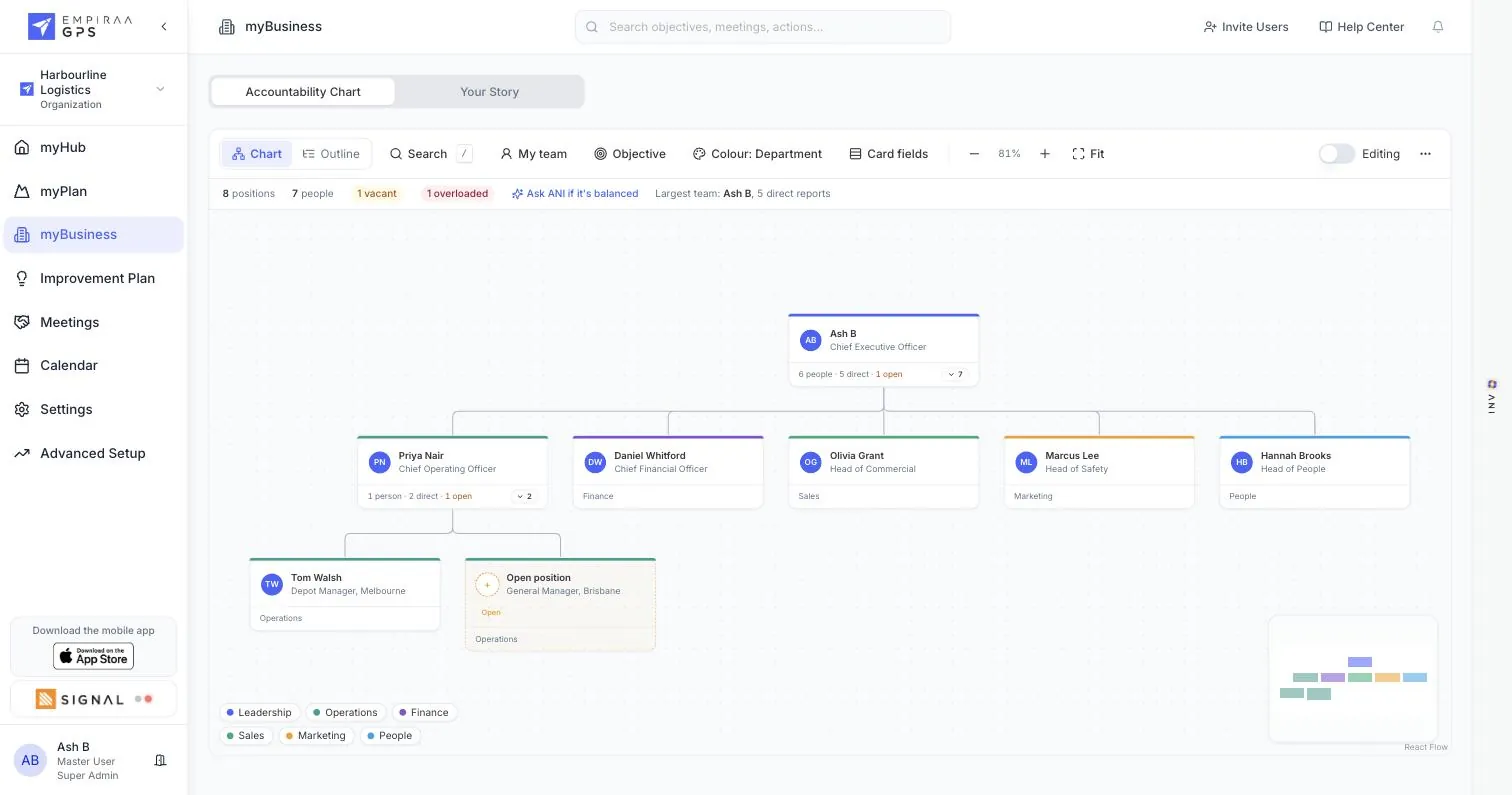
Vacant and overloaded, flagged
GPS counts the seats and the load, and tells you where the plan is exposed.
An open position
The roles you have not filled sit on the chart, so the gap is visible before it bites.
Objectives on the seat
Every card carries what that seat owns, so accountability is a fact rather than an assumption.
Ask ANI if it is balanced
A second opinion on whether the work is spread properly.
What it is
EOS is an operating system, not a goal-setting method.
That distinction is the whole reason it works, and the reason software built for goals tends to hold only half of it.
EOS®, the Entrepreneurial Operating System, was set out by Gino Wickman in Traction in 2007 and is delivered by implementers rather than sold as a book to be followed. It organises a business around six components: vision, people, data, issues, process and traction. The first two are about whether everybody wants the same thing and whether the right people are in the right seats. The last four are about whether anything actually happens.
The tools are the part your clients recognise. The accountability chart sets out the seats the business needs and who sits in each one, which is a different question from an org chart of who reports to whom. The scorecard is a handful of weekly numbers with an owner and a target each. Rocks are the three to seven priorities for the next ninety days, one owner apiece, and the discipline is that there are only ever a few. The Level 10 Meeting is a fixed ninety minutes every week that ends in decisions, with issues identified, discussed and solved rather than described.
What makes EOS hard to sustain is not the tools, it is the cadence. Ninety days is short enough that a Rock cannot be quietly abandoned, and a week is short enough that a number going the wrong way is a conversation rather than a surprise. Both of those only work if the artefacts are alive between your sessions, which is the gap this page is about.
Empiraa is not affiliated with, endorsed by, certified by or licensed by EOS Worldwide. EOS and Traction are their registered marks, and EOS Worldwide are clear that EOS is a proper noun rather than a generic term for an operating system. Supporting a framework means the plan structure is in the library and the software runs it. If you are a Certified or Professional EOS Implementer, that credential is yours and nothing here is a substitute for it.
- Six components: vision, people, data, issues, process, traction
- Rocks: three to seven priorities a quarter, one owner each
- The accountability chart: the seats the business needs, and who is in them
- The Level 10 Meeting: ninety fixed minutes that end in decisions
In the library
EOS (Traction) is a ready-made plan, not a setting.
Applying it gives the client a plan already shaped like EOS, so the first session is spent on their business rather than on setting up a structure everybody in the room already knows.
3 goals · 6 objectives, loaded into a client’s workspace in one action
What the plan carries
Rocks as objectives with owners
Each Rock is an objective with one owner, a due date inside the quarter and a measure, tracked against where it should be by now rather than against percent done.
The accountability chart, live
Seats, who is in them, and which seats are still open. It flags a leader carrying more than the rest of the team, which is the conversation you were going to have to open carefully anyway.
How the chart worksThe weekly meeting, with its agenda
Build the Level 10 agenda once as a template and reuse it across every client. Check-ins come in before the call, an issue can be raised from one, and what is agreed becomes an action with a name on it before anybody leaves.
How meetings runThe rocks, as the quarter
High, medium, low and none, argued once in the room instead of every week. An empty column is an answer the leadership team has given out loud.
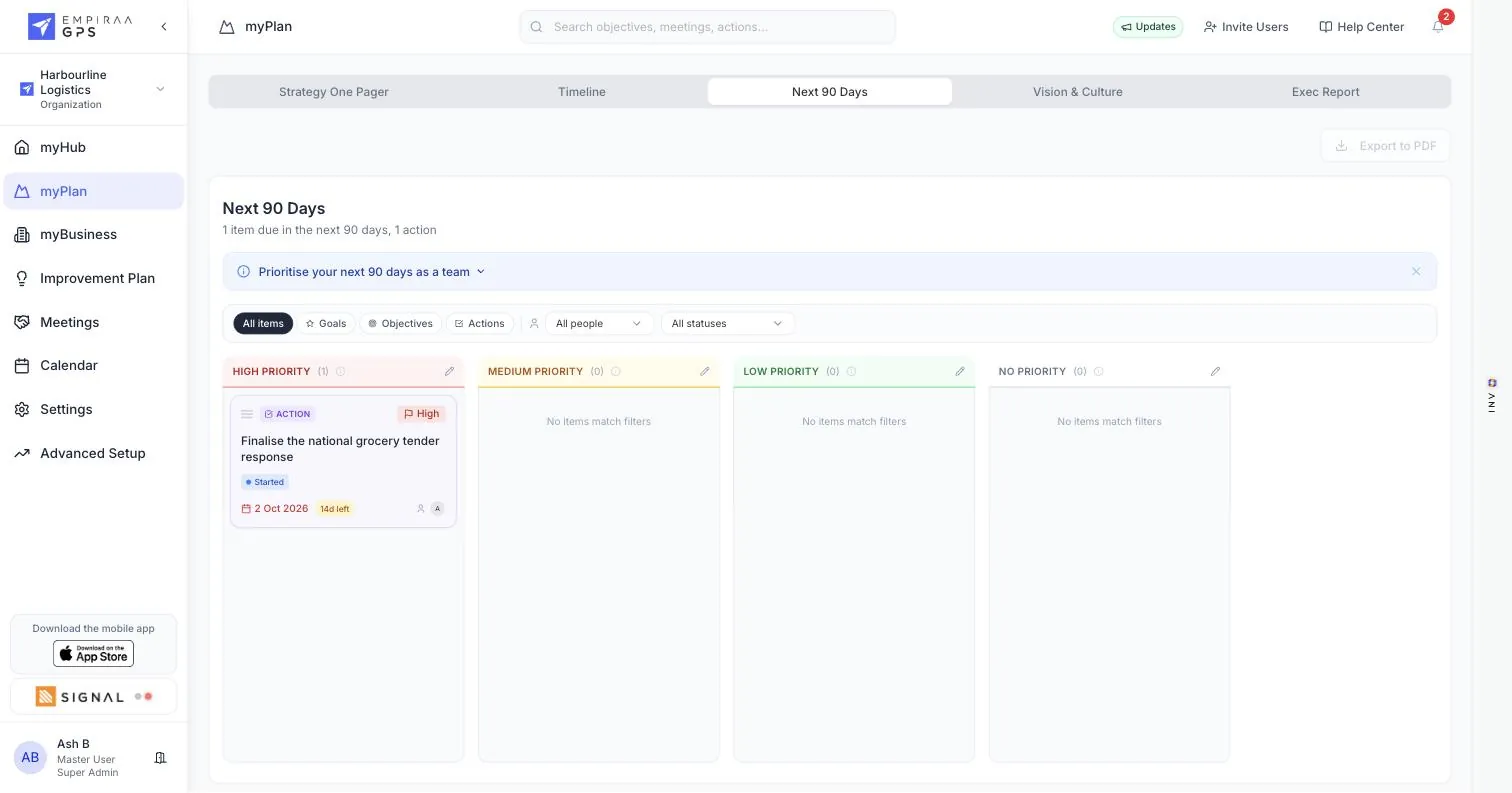
What is actually due
Everything landing in the next 90 days, pulled from the plan rather than typed up again.
Drag it into priority
High, medium, low or none. The argument happens here, once, instead of every week.
Empty columns are an answer
If nothing is medium priority, the team has said so out loud.
Delivering it
Three steps, and the second is the one that keeps the client.
The point of doing it this way is not speed. It is that what you set up in the session is the thing the client opens on a Monday.
- In the session
Apply EOS into their workspace
One action from myPortal. The Rocks, the structure and the chart are there before the offsite finishes, so the room is looking at their own plan rather than at a whiteboard that has to be typed up later.
- Between sessions
Watch it without asking
Rocks against pace, check-ins arriving, issues raised. When a Rock stops moving in week three you know in week three, which is the only part of the quarter where it can still be saved.
- At the quarterly
Open on what is behind
The status round is already done, because the plan has been keeping it. The ninety minutes goes on the two Rocks that did not land and why, which is the work they hired you for.
Where it does not fit
Three places this is not a perfect fit, said plainly.
If you run EOS for a living you know it better than we do, and finding these out on a demo call wastes fifteen minutes for both of us. Read them, and book if they are survivable.
The scorecard is not drawn as a thirteen-week grid
Empiraa GPS measures each objective against where it should be by now, with current and target values. If the thirteen-column weekly grid is the centre of your Level 10 and your clients read it left to right, look at this in the demo before you decide. Several implementers run it happily; some want the grid.
The V/TO is not a form
GPS has a strategy one pager carrying the vision statement, core values and every goal with live progress, which covers the bottom half. The core focus, ten-year target and marketing strategy at the top of a V/TO are not fields you fill in. Most implementers keep the V/TO where it is and use this for traction.
No software makes a Level 10 happen
The meeting holding to ninety minutes, the issues actually being solved rather than aired, somebody saying the uncomfortable thing: that is you, and a tool that claimed otherwise would be selling you something. This makes the artefacts survive the gap. It does not run the room.
The client in front of you
Is EOS (Traction) the right call for this client?
Five questions about them, not about you. The answer is graded rather than yes or no, and it names what to compare against either way.
Yes
On these answers EOS (Traction) is where I would start.
EOS (Traction) is worth it here because an operating system rather than a goal format, which is what a client needs when the plan is fine and nothing happens on a Tuesday.
Decided mostly by: the plan exists and nothing happens
Also worth reading: MBO (Management by Objectives), because individual objectives authored by the people who own them, which is the answer when everyone is busy and nobody is accountable.
A starting point, not advice. You know this client and this tool does not, and the useful part is that whichever framework it names has a page with the plan already built.
Who reaches for it
The firms that arrive already selling this.
Each of these is a page in its own right, with the argument written for that profession rather than for a framework.
Business advisory
The rhythm has to work when you are not in the room.
Read their argumentStrategy consultants
You wrote the plan. Somebody has to run it.
Read their argumentOr read a framework that fits better
Hoshin Kanri
EOS is described as suiting privately held entrepreneurial companies of roughly ten to two hundred and fifty people. When the client is bigger, or listed, or spread across several sites, the problem becomes deployment and this is the better read.
Read itOKR Framework
For a client who wants measured outcomes rather than a ninety-day priority list, and who has no appetite for a whole operating system.
Read itContinuous Improvement Plan
If what the client actually needs is somewhere for issues to be raised, voted on and tracked to done, rather than the full six components.
Read itQuestions
EOS (Traction), answered.
Is there EOS software in Empiraa?
Yes. EOS (Traction) is a ready-made plan in the strategy library, and applying it gives a client a plan already shaped around Rocks, an accountability chart and a weekly meeting. It is one of fifteen named frameworks rather than the only thing the software does.
How does this compare to Ninety?
Ninety is built around EOS and is very good at it. That is also its constraint: software built for one methodology cannot run another, which matters for a firm whose clients are not all on the same one. Empiraa GPS is framework-agnostic, so one client can run EOS and the next can run OKRs in the same practice, and myPortal adds the layer Ninety has no equivalent of: your whole client book on one screen, your branding in every workspace, and capacity across your consultants. Empiraa GPS compared with Ninety.
Is Empiraa certified by EOS Worldwide?
No. Empiraa is not affiliated with, endorsed by, certified by or licensed by EOS Worldwide, and EOS and Traction are their registered marks. The framework is supported, which means the plan structure is in the library and the software runs it. Your implementer credential is yours.
Does it have an accountability chart?
Yes, and it is called that. It sets out seats by function with the person in each, marks the ones still open, and flags a leader carrying more objectives than the rest of the team. It is live rather than a document, so it is accurate at the next session without anybody redrawing it. How the accountability chart works.
Can I run the Level 10 Meeting in it?
You can run the structure: build the agenda once as a template in myPortal and reuse it across every client, take check-ins before the call, raise an issue from a check-in, and leave with actions that have names and dates on them. What it will not do is hold the room to ninety minutes or make anybody solve an issue rather than describe it. That is the implementer.
Can I run EOS for one client and something else for another?
Yes, and this is the reason most firms move off single-methodology software. The plan structure is data, so one client runs EOS, the next runs OKRs, the third runs your own version of either, and all of them sit in the same client book in myPortal with the same branding on them. Every framework in the library.
Does my client have to learn EOS to use the software?
No, and this is usually the argument for loading it rather than teaching it. What the client sees is their goals, their Rocks, their owners and their weekly meeting. The vocabulary comes from you in the session. Nobody has to read a book to open a plan with their name on three things in it.
Do I get a margin on clients I bring?
30% recurring for the first twelve months on each client, and once you have three clients on board your own Empiraa Signal workspace is free for as long as you hold three or more. The partner program.
Bring one client and see.
Load the framework you already sell into a client's workspace under your own logo, and see whether it survives the eight weeks between your sessions.
EOS and Traction are registered marks of EOS Worldwide. Empiraa is not affiliated with, endorsed by, certified by or licensed by EOS Worldwide or Gino Wickman. The other fourteen frameworks.