

For strategy consultants
You wrote the plan. Somebody still has to run it.
The engagement ends the week the plan is signed off, which is the week before anything has to happen. Put it in the client’s own workspace under your logo, with an owner and a date on every objective, and the document you delivered becomes the thing being executed rather than a reference for it.
- A branded workspace per client
- Your framework, not ours
- Progress visible between sessions
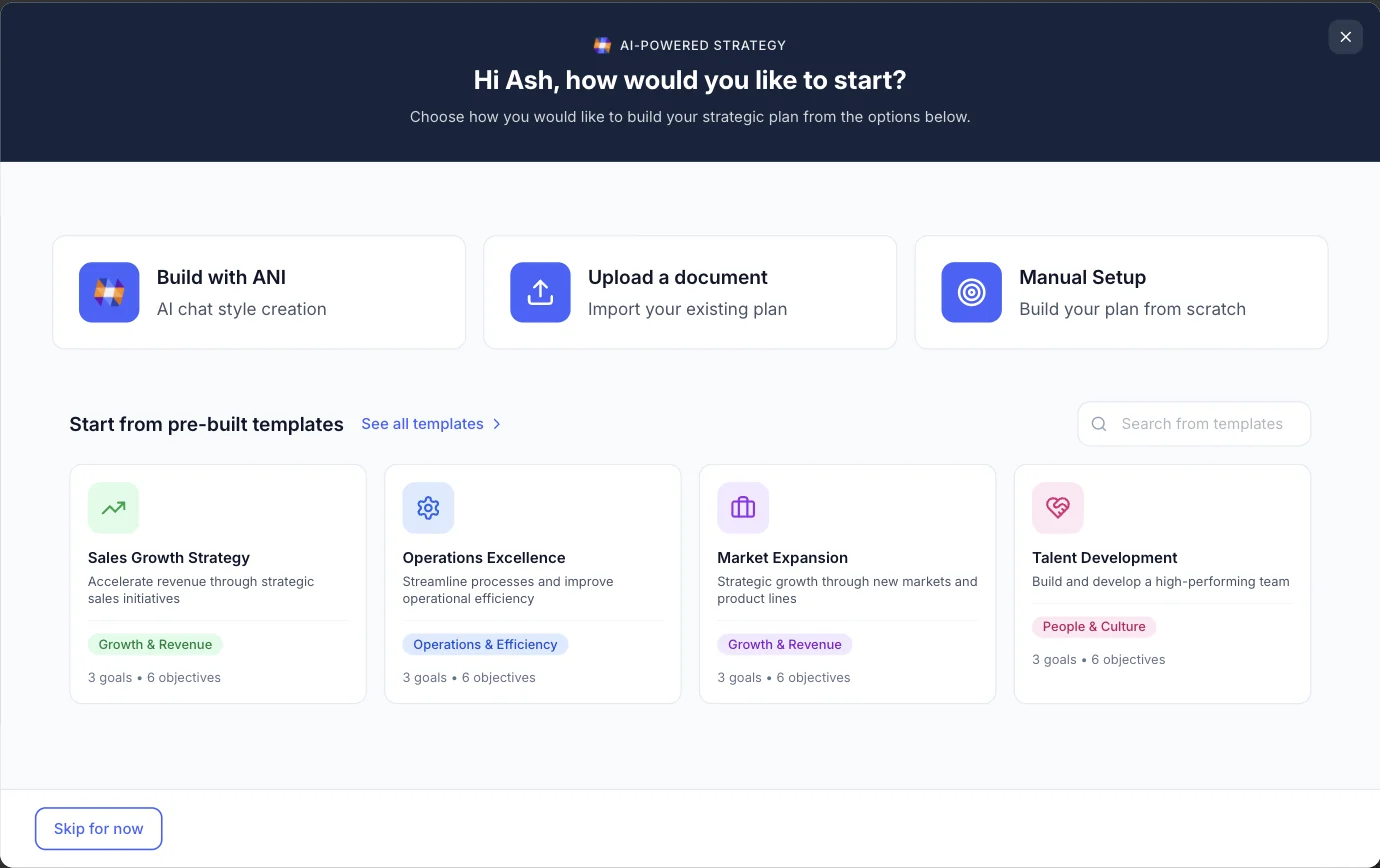
Build it with ANI
Answer a few questions and ANI drafts the goals, objectives and actions for you to edit.
Upload what you already have
Drop in the strategy document or deck you wrote last year. GPS turns it into a working plan.
Or start from a template
Templates come with goals and objectives already drafted for common plans.
What they are paying you for
Judgement, made legible enough to be acted on.
A client is not paying for a document. They are paying for somebody who has seen forty businesses to say which three things matter in theirs, in what order, and what they should stop doing. The deck is the receipt.
Which means the deliverable is only worth what happens to it. A diagnosis nobody acts on is indistinguishable, twelve months later, from a diagnosis that was wrong, and the client cannot tell the difference. That is the risk in every engagement you have ever run and it sits almost entirely outside your control.
Where it stops working
The hour at the start of every quarterly.
You come back for the review and spend the first hour reconstructing what moved, from people who are reconstructing it too. Somebody has a spreadsheet from six weeks ago. Somebody else says their part is basically done. Nothing in that hour is the work you were hired for, and the client is paying full rate for it.
By the time you have a picture, the quarter it describes is over. The two objectives that died in week five died quietly, in the gap where nobody was looking, and the honest version of the review is that you found out too late to do anything about either.
- The plan is a document, so it goes stale the day it is circulated
- Progress arrives as a recollection rather than a number
- An objective that stops moving in week five surfaces in week twelve
- The client concludes the plan was wrong, because that is the only explanation they can see
What is different
The plan stops being a document and starts being the system of record.
Four things, and the second one is what changes the shape of your engagement rather than just its admin.
- The plan goes into the client’s own workspace with an owner and a date on every objective, so the document you delivered is the thing being executed rather than a reference for it
- You see progress between sessions without asking for it, so the quarterly opens on the two goals that are behind instead of on a status round
- The report the client takes to their board is generated from the plan, so your work is what the board reads
- When the plan stops being the right plan, you find that out in week five rather than week twelve
The difference between a consultant who is called back and one who is not is usually whether the plan got executed, which is the part nobody paid you to be there for.
How an engagement runs
The same engagement, with the eight weeks in the middle visible.
Nothing here asks you to change how you diagnose or what you recommend. It changes what happens after you leave the room.
- In the room
The plan goes in as you build it
Applied from your own template or from a framework in the library, so the leadership team is arguing about their plan on a screen rather than about a whiteboard that has to be typed up later.
- Week one
Owners and measures, not just objectives
Every objective gets a name and a number. The name is the part clients resist and the part that decides whether anything happens, and it is much harder to leave blank in a field than in a paragraph.
- Weeks two to eleven
Watch it without asking
Progress against expected pace, not against percent done. When something stalls you see it while it can still be saved, and a two minute message in week five is worth more than an hour in week twelve.
- The quarterly
Open on what is behind
The status round is already done because the plan has been keeping it. Ninety minutes on the two goals that did not land and why, which is the conversation they are actually paying for.
The board reads your work, not a summary of it
The report is generated from the plan you delivered, with variance against expected progress already in it. You edit rather than assemble, and the thing the board discusses is your plan rather than somebody’s recollection of it.
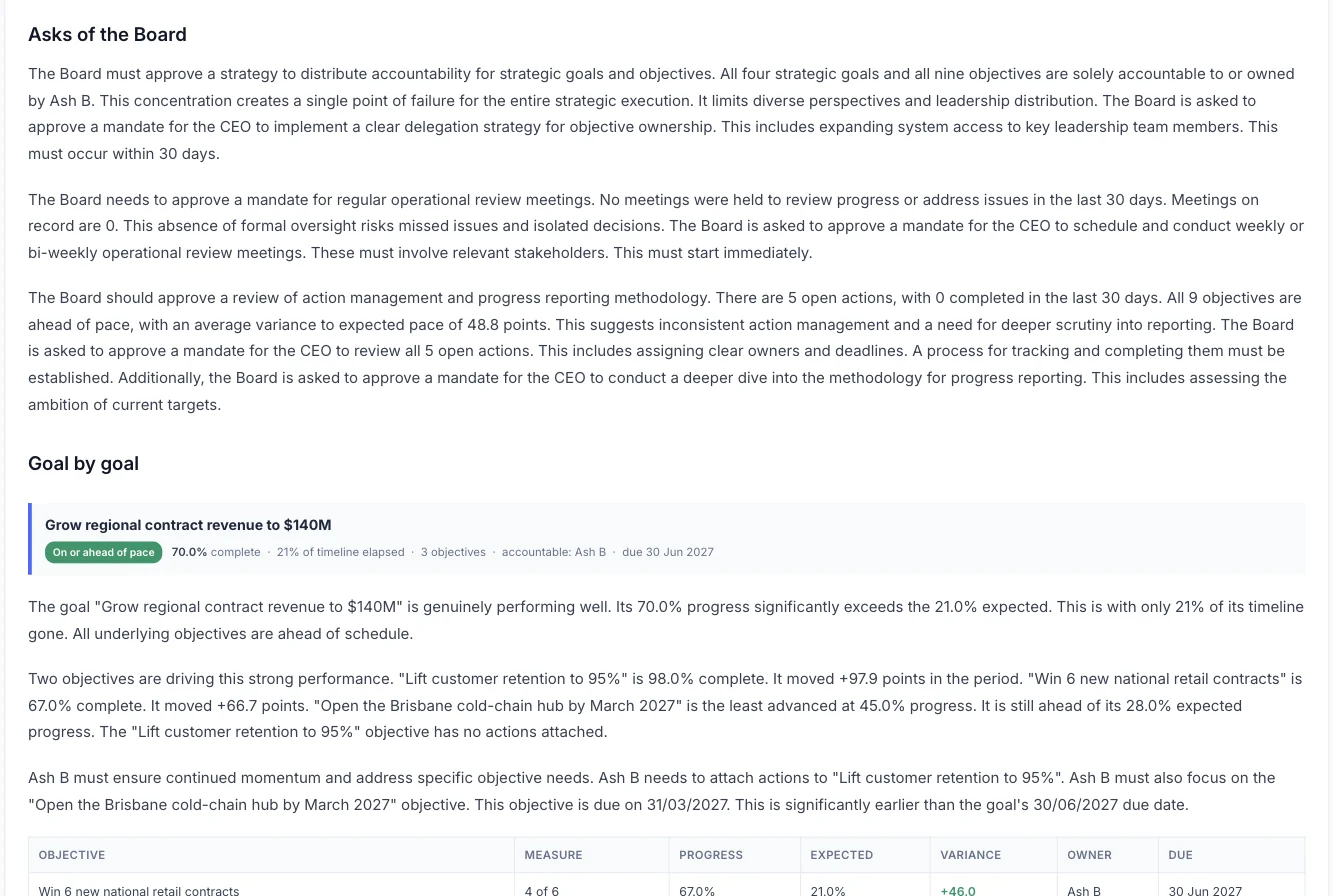
The asks, up front
What the board is being asked to decide, before the detail.
Goal by goal
Each goal reviewed against pace, so the good news and the bad news get equal billing.
Progress, expected, variance, owner
One table per goal, with a name against every number.
The frameworks you already sell
Loaded as plans, not adopted as a way of working.
The method is what you charge for. If the software arrives with its own, it is competing with you inside your own client. These are the ones this profession reaches for first.
Hoshin Kanri
The deployment side of strategy: each level of the business carries the objective above it, so a plan agreed by the leadership team reaches the people who have to do it.
Read the pageOGSM Framework
Objectives, goals, strategies and measures on one page. The framework that survives contact with a board because it fits on a single sheet and still carries numbers.
Read the pageBalanced Scorecard
Four perspectives loaded as four goals, so financial results sit beside the customer, process and people measures that produced them. The version an accountant can hang actuals on.
Read the pagePorter's 5 Forces Plan
Competitive position turned into a plan: what the rivalry, the buyers, the suppliers, the substitutes and the new entrants each require you to do about them.
Read the pageThe plan you delivered
How many of its goals could be executed without you?
Put in three goals from the last plan you handed over. The test is not whether the thinking was right, because it was. It is whether anything in the document was holding them once the engagement closed.
no date, so it is never late and never done.
nobody owns it, so nobody is asked about it; nothing measures it, so progress is an opinion; no date, so it is never late and never done.
1 of 3
Only 1 of these could be run by something other than you.
One is close and missing a field, which is the easiest kind to fix and the kind that quietly never gets fixed.
One is a statement of intent. Worth having in the document, impossible for anybody to act on.
The engagement ends the week the plan is approved, which is the week before anything has to happen. A goal with an owner, a number and a date is a row somebody is asked about on a Monday. A goal without them is the reason you spend the first hour of the quarterly reconstructing what moved.
What this does not do
Three things this will not do for you.
The first two are the ones firms are disappointed by, and they are disappointed by every tool for the same reasons.
It will not write the strategy
ANI will draft a plan, suggest actions and tell you which objectives need attention. It cannot decide that this client should walk away from a third of their revenue. That judgement is the engagement, and nothing here reduces how much of it you have to supply.
It will not create an owner who does not exist
An objective with a name against it still needs a person who believes the objective is theirs. If nobody inside the client owns the work, the field is filled and the work is not, and you will see that as a plan full of names and no movement. Worth knowing, because that pattern is diagnostic.
It is not a consulting delivery tool
No proposals, no engagement letters, no WIP, no utilisation reporting for the firm. It holds the client’s plan and the rhythm around it. Whatever you run the practice on keeps running the practice.
If that is not quite you
Strategy consultants is one of ten. These are the ones next to it.
Closely related work, bought for different reasons. If one of these describes your week better, read that page instead.
Business advisory
You are hired for a rhythm rather than a document, you are in the room every quarter, and you are judged on whether the cadence survived the gap between visits.
Read that pageAccountants
You already hold the client’s numbers, and the advisory work sitting on top of them is the thing you are trying to make repeatable and properly priced.
Read that pagePrivate equity
You own the business, you hold a board seat, you can mandate how a company reports, and the hold period has to end in a number.
Read that pageWork it out with your own numbers
The same delivery work, priced two ways.
Project revenue is flat and starts from nothing each January. Retained revenue compounds. You know that already, so this is the arithmetic with your fees in it rather than the argument.
Project work only
A$324K
over three years, and January starts at nothing every year
With a retainer after each
A$801K
2.5 times the same delivery work
By month 36, retainers are
67%
of your monthly revenue
Clients paying monthly
9
at a steady win rate
Month 36 revenue
A$27K
against A$9K on projects alone
Month
Every partner already knows retained revenue compounds and project revenue does not. The hard part is never the arithmetic, it is giving the client a reason to pay in month four when the report was delivered in month two. That is an evidence problem rather than a pricing one, and it is the only thing this software is actually for: when the plan is live, something visible happens every month, and a monthly fee stops needing to be justified. Whether that is worth what a retainer is worth to you is a judgement we are not going to make on your behalf.
See the month by month figures
| Month | Projects only | With retainers |
|---|---|---|
| 1 | A$9,000 | A$9,000 |
| 2 | A$9,000 | A$10,000 |
| 3 | A$9,000 | A$11,000 |
| 4 | A$9,000 | A$12,000 |
| 5 | A$9,000 | A$13,000 |
| 6 | A$9,000 | A$14,000 |
| 7 | A$9,000 | A$15,000 |
| 8 | A$9,000 | A$16,000 |
| 9 | A$9,000 | A$17,000 |
| 10 | A$9,000 | A$18,000 |
| 11 | A$9,000 | A$19,000 |
| 12 | A$9,000 | A$20,000 |
| 13 | A$9,000 | A$21,000 |
| 14 | A$9,000 | A$22,000 |
| 15 | A$9,000 | A$23,000 |
| 16 | A$9,000 | A$24,000 |
| 17 | A$9,000 | A$25,000 |
| 18 | A$9,000 | A$26,000 |
| 19 | A$9,000 | A$27,000 |
| 20 | A$9,000 | A$27,000 |
| 21 | A$9,000 | A$27,000 |
| 22 | A$9,000 | A$27,000 |
| 23 | A$9,000 | A$27,000 |
| 24 | A$9,000 | A$27,000 |
| 25 | A$9,000 | A$27,000 |
| 26 | A$9,000 | A$27,000 |
| 27 | A$9,000 | A$27,000 |
| 28 | A$9,000 | A$27,000 |
| 29 | A$9,000 | A$27,000 |
| 30 | A$9,000 | A$27,000 |
| 31 | A$9,000 | A$27,000 |
| 32 | A$9,000 | A$27,000 |
| 33 | A$9,000 | A$27,000 |
| 34 | A$9,000 | A$27,000 |
| 35 | A$9,000 | A$27,000 |
| 36 | A$9,000 | A$27,000 |
Pricing
Plans for your client workspaces.
Compare Professional Services plans by client workspace capacity.
Questions
Strategy consultants, answered.
What software do consultants use to run plans with their clients?
Most use a document and a spreadsheet, which is why the plan goes stale. The alternative is a workspace per client: Empiraa GPS through myPortal gives a consulting firm a separate branded workspace for each client, with the plan carrying owners, dates and measures, and one screen showing every client’s progress so you know which one has gone quiet before they tell you. See the practice view.
Does the client workspace carry my branding or Empiraa’s?
Yours. Your logo in the sidebar, four interface colours and your typeface, set once in myPortal and pushed into every client workspace in one action. A client signing in on a Tuesday is opening your system, which matters because a client who sees somebody else’s software has been introduced to your replacement.
What happens when the engagement ends?
The client keeps their workspace and their plan, and you keep the share. The partner terms follow the client’s subscription rather than your engagement, so a three month piece of work earns for the first twelve months they are with us. For a firm doing project rather than retainer work, that is the part of this worth reading twice. The partner terms.
Can different clients run different frameworks?
Yes, and this is the reason most firms move off single-methodology software. The plan structure is data, so one client runs Hoshin Kanri, the next runs OKRs, the third runs your own version of either, and all three sit in the same client book with your branding on them. The fifteen frameworks.
Does my client have to learn a methodology?
No. What the client sees is their goals, their owners, their measures and their meeting. The vocabulary comes from you in the session. Nobody has to read a book to open a plan that has their name on three things.
Can my clients see each other?
No. Each client is a separate sub-account with its own workspace and users. The book view is yours alone, and a client has no indication of how many other clients you have or who they are.
Does it replace my project management tool?
No. Deliverables with dependencies, files moving through review, a Gantt of your own work: that is project management and it belongs where you already do it. This holds the client’s plan and the rhythm around it, which is usually the part with nowhere to live.
What does it cost, and what do I earn?
Empiraa GPS for a practice is agreed against the size of your book, because a five client firm and a fifty client firm are not buying the same thing. You earn 30% recurring for the first twelve months on each client you bring, and your own Empiraa Signal workspace is free for as long as you hold three or more. Pricing, and what you earn.
Bring one client and see.
Fifteen minutes with one real client in mind, ideally the one you are slightly worried about.