

MBO, delivered to your clients
Drucker wrote management by objectives and self-control. The second half is the mechanism.
Almost every implementation kept the objectives and dropped the self-control, which is how a management philosophy became an annual appraisal form. If the manager did not set the objective themselves and cannot see their own result, you do not have MBO. You have assignment.
- Individual objectives tied to the organisation’s
- Owners set their own measures
- A branded workspace per client
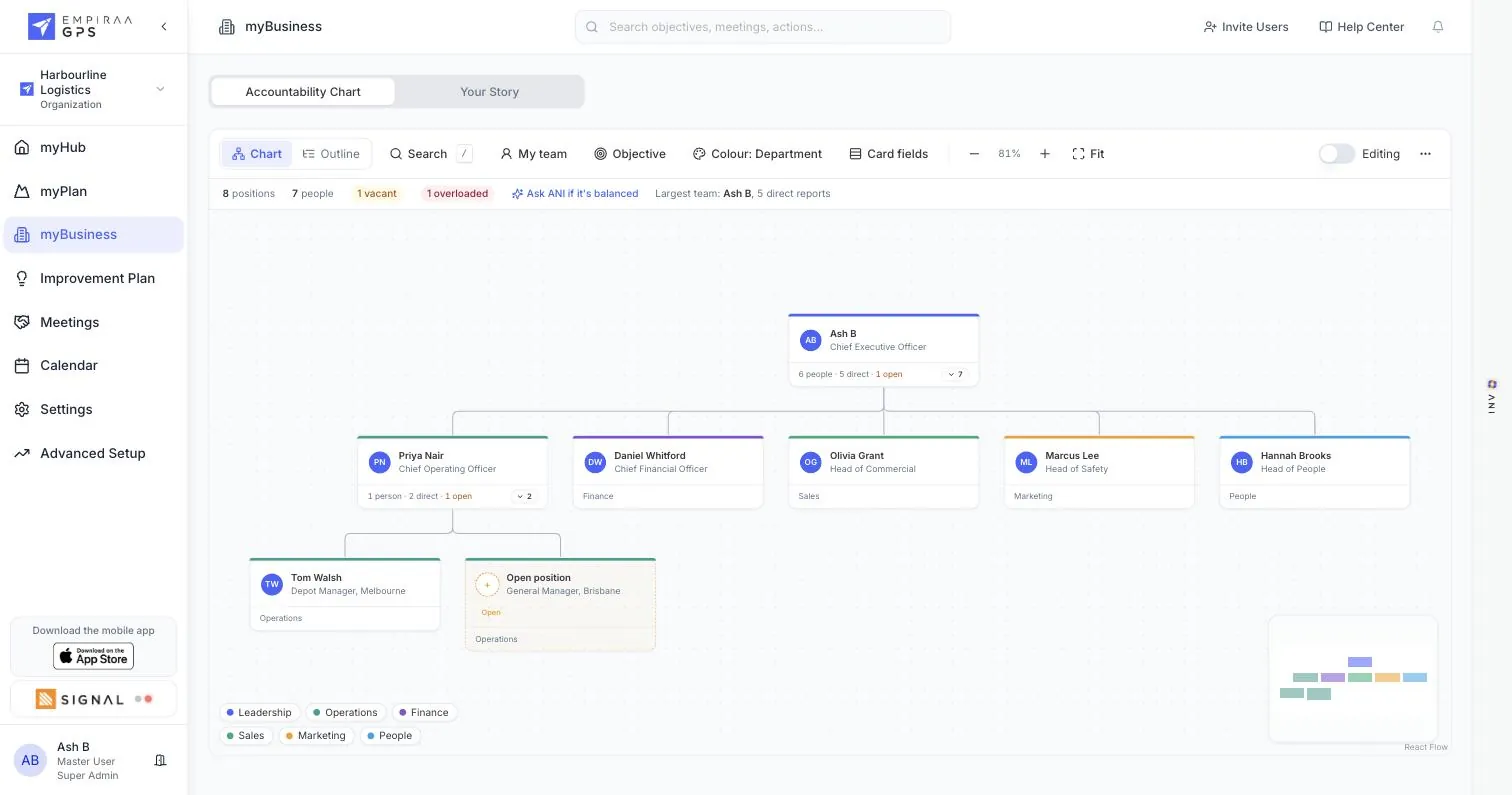
Vacant and overloaded, flagged
GPS counts the seats and the load, and tells you where the plan is exposed.
An open position
The roles you have not filled sit on the chart, so the gap is visible before it bites.
Objectives on the seat
Every card carries what that seat owns, so accountability is a fact rather than an assumption.
Ask ANI if it is balanced
A second opinion on whether the work is spread properly.
What it is
It was never meant to be an appraisal form.
Drucker set MBO out in The Practice of Management in 1954, and the full phrase is the part that gets cut.
The idea is that an organisation works better when each manager knows what the business is trying to do and sets their own objectives in service of it, rather than being handed a target. The alignment is deliberate and top down. The authorship is not.
Drucker’s phrase was management by objectives and self-control. The self-control half is the mechanism: a manager who set the objective and can see their own result does not need somebody standing over them, because they already know whether they are winning. Supervision becomes unnecessary rather than automated.
What most organisations built instead was objectives assigned downward, reviewed once a year, tied to pay. That is not MBO with a few compromises, it is the opposite arrangement wearing the name: the objective is somebody else’s, the result is visible to the reviewer rather than the doer, and the cadence is far too slow for anybody to correct anything.
It is also the direct ancestor of OKRs. Andy Grove ran a version of MBO at Intel, and what came out of it, by way of John Doerr, is the framework most of your clients will name if you ask what they use. Knowing that lineage is useful in a room: OKRs are not a rejection of MBO, they are an attempt to fix its cadence.
- Objectives aligned to the organisation’s, but authored by the manager who owns them
- The result visible to the person doing the work, not only to their reviewer
- A cadence fast enough to correct something, which annual review is not
- The ancestor of OKRs, by way of Andy Grove at Intel
In the library
MBO (Management by Objectives) is a ready-made plan, not a setting.
The ready-made plan is shaped for the version Drucker described: organisation goals at the top, individual objectives under them with the owner who wrote them, and the measure visible to that owner rather than filed for a review.
3 goals · 6 objectives, loaded into a client’s workspace in one action
What the plan carries
Individual objectives under organisation goals
A manager’s year and the company’s year in one document rather than two, so alignment is structural instead of asserted in a kickoff meeting.
The owner sets and updates the measure
Current value against target, updated by the person accountable. That is the self-control half, and it is the difference between an objective somebody owns and an objective somebody was given.
Reviewed on a rhythm, not annually
Build the review agenda once as a template and reuse it across the book. Monthly is fast enough to act; the annual cycle MBO became is not.
How meetings runThe individual objective, measured
Current against target and against expected pace, on the objective a named person owns. MBO without the measure is a job description.
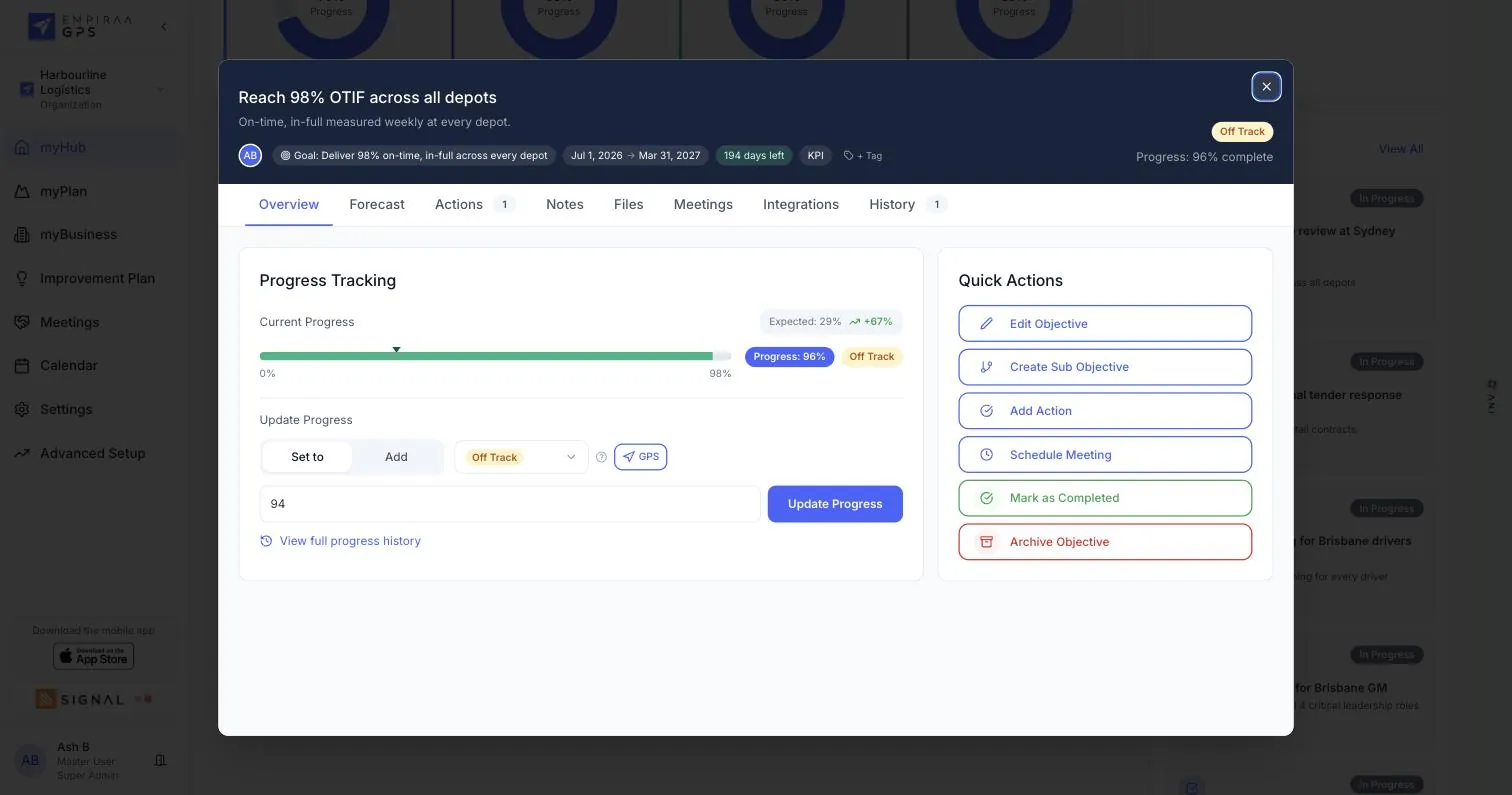
Expected, not just actual
GPS works out where this measure should be by today, and shows the gap.
Off track, early
Status comes from pace, so a measure turns amber weeks before the quarter closes.
Updating takes seconds
Set a new value or add to the last one, pick a status, and you are done.
Everything from here
Sub-objectives, actions, a meeting, or mark it complete.
Delivering it
The whole engagement is whether the manager wrote it.
This is unusually easy to implement badly, and the failure looks exactly like success until about month four.
- One
Set the organisation goals with the leadership team
Few, and clear enough that a manager two levels down can work out what their part of it is without being told.
- Two
Have each manager write their own
Not approve one. Write one. It takes longer, it produces awkward conversations about what is actually achievable, and those conversations are the value of the exercise rather than friction in it.
- Three
Give them their own result, then leave them alone
The manager sees their own progress against pace. If the only person who can see it is their reviewer, you have rebuilt the appraisal form and the client will feel it within a quarter.
Where it does not fit
Three limits, and the first one is Deming’s.
MBO has the most famous critic of any framework in this library, and the criticism is fair enough that it is worth having ready.
Deming argued for eliminating it
His 14 Points call for eliminating management by objective and management by numbers, on the grounds that a numerical target with no method for reaching it is pressure rather than management, and produces distortion. The honest answer is that this attacks the version without self-control, which is the version almost everybody built.
It drives local optimisation
Give every manager their own objective and you will get managers hitting their own objective at each other’s expense. Nothing in MBO prevents it. A framework with explicit deployment, such as Hoshin Kanri, handles it better.
Tie it to pay and it stops being true
The moment an objective determines a bonus, the objective gets negotiated rather than set, and every number in the plan becomes a number somebody had an interest in choosing. That is a client decision rather than a software one, and it is worth raising before the plan is written.
The client in front of you
Is MBO (Management by Objectives) the right call for this client?
Five questions about them, not about you. The answer is graded rather than yes or no, and it names what to compare against either way.
Yes
On these answers MBO (Management by Objectives) is where I would start.
MBO (Management by Objectives) is worth it here because individual objectives authored by the people who own them, which is the answer when everyone is busy and nobody is accountable.
Decided mostly by: everyone is busy and nobody owns anything
Also worth reading: EOS (Traction), because an operating system rather than a goal format, which is what a client needs when the plan is fine and nothing happens on a Tuesday.
A starting point, not advice. You know this client and this tool does not, and the useful part is that whichever framework it names has a page with the plan already built.
Who reaches for it
The firms that arrive already selling this.
Each of these is a page in its own right, with the argument written for that profession rather than for a framework.
Business advisory
The rhythm has to work when you are not in the room.
Read their argumentStrategy consultants
You wrote the plan. Somebody has to run it.
Read their argumentOr read a framework that fits better
OKR Framework
The descendant, with the cadence fixed. Quarterly rather than annual, key results true or false at the end, and an explicit expectation of missing some.
Read itHoshin Kanri
When local optimisation is the risk. Hoshin negotiates objectives down through levels with catchball, which is the problem MBO leaves open.
Read itSMART Goals
When the client does not need individual objectives across a hierarchy and just needs a handful of company goals written properly.
Read itQuestions
MBO (Management by Objectives), answered.
What is management by objectives?
A management approach Peter Drucker set out in The Practice of Management in 1954, in which each manager sets their own objectives in alignment with the organisation’s and can see their own results. The full phrase is management by objectives and self-control, and the second half is the mechanism: a manager who authored the objective and can see the result needs less supervision, not more.
What is the difference between MBO and OKRs?
OKRs are descended from MBO by way of Andy Grove at Intel and John Doerr. The differences are cadence and expectation: OKRs run quarterly rather than annually, key results are true or false at the end of the period, and missing some is expected rather than a failure. MBO as usually implemented was annual, tied to appraisal and tied to pay, which is what OKRs were reacting against. OKRs in Empiraa GPS.
Why did MBO fall out of favour?
Because almost every implementation dropped the self-control half. Objectives were assigned downward, reviewed once a year and tied to pay, which turned a management philosophy into an appraisal form. Deming attacked it directly, calling in his 14 Points for eliminating management by objective and by numbers, on the grounds that a target without a method is pressure rather than management.
Is MBO worth using with a client today?
Where the client needs individual objectives tied to the organisation’s, and where managers will genuinely author their own, yes. Where objectives will be assigned and reviewed annually, no, and OKRs or an operating framework will serve them better. The test is simple: if the manager did not write it, it is not MBO.
Is there MBO software in Empiraa?
MBO is a ready-made plan in the strategy library, with three goals and six objectives, shaped as organisation goals with individual objectives under them, each carrying the owner who wrote it and a measure that owner updates. The review cadence runs as meetings rather than as an annual form. Every framework in the library.
Bring one client and see.
Load the framework you already sell into a client's workspace under your own logo, and see whether it survives the eight weeks between your sessions.