

For go-to-market consultants
You deliver a system. They need five purchase orders to run it.
An ideal customer profile, territories, coverage, sequences, stage definitions and a forecast. Running it takes a prospect database, enrichment, a sequencer, a booking link, proposal software and a CRM. So half of it is implemented, and the engagement gets judged on the half that was.
- ICP, territories and coverage in one product
- Unlimited users on every plan
- Hand over something running
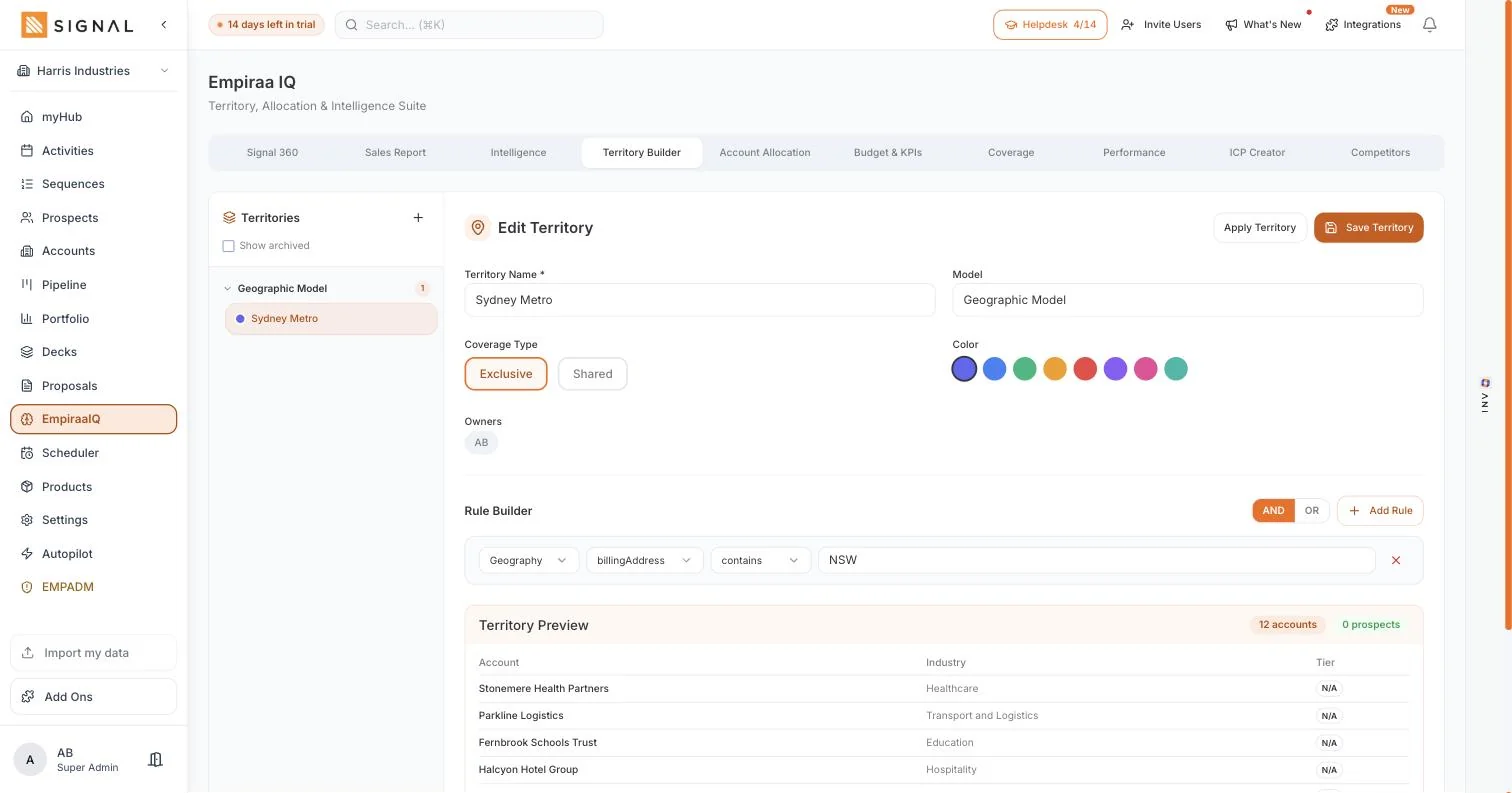
Name the patch
By geography, by industry, by size, or by whatever your business actually splits on.
Exclusive or shared
One owner, or a team that works it together. The rule decides, so it does not drift.
A rule, not a spreadsheet
Accounts join the territory when they match. New ones land in the right patch without anyone sorting them.
It shows you who it caught
Preview the accounts the rule matches before you apply it, so nobody loses a customer overnight.
What they are paying you for
A motion, designed before there is a team to run it.
Who to sell to and why them, how the market divides, who covers what, what the first three touches say, when a deal is genuinely qualified, and how the number gets forecast. It is the most leveraged work in sales consulting because every later decision inherits it.
It is also the most fragile, because none of it exists until somebody operates it. A go-to-market design is a set of instructions for a machine the client has not bought yet.
Where it stops working
The procurement conversation nobody budgeted for.
The design is signed off. Then the implementation list arrives: Apollo or ZoomInfo for the data, Clay for enrichment, a sequencer, Calendly, proposal software, and a CRM to hold it together. Six line items, six security reviews, and a number the client did not expect when they approved your fee.
So they buy two of the six. The ICP becomes a slide the team refers to while searching manually. Territories become a tab. Coverage is never measured because nothing measures it. Then the results are attributed to the design rather than to the two thirds of it that never shipped, and you have been blamed for a stack decision that was never yours to make.
- Six subscriptions to operate one design
- The ICP becomes a reference document rather than the thing that finds accounts
- Territories and coverage live in a spreadsheet and stop being maintained
- The engagement is judged on the third of the system that got funded
What is different
The system you designed is the system that ships.
Four things. The first one is the difference between an ICP that works and an ICP that is quoted.
- The ideal customer profile you defined becomes the thing that finds the accounts, rather than a slide the client refers to while searching manually
- Territories and account allocation are built in the product, so coverage is a picture of who owns what rather than a tab in the handover pack
- Sequences, the booking link, the quote and the pipeline are in the same system, so the system you designed is the system that ships
- You hand over something running, with the stages, the sequences and the reporting already configured, which is a different deliverable from a document about them
The gap between a go-to-market system on paper and one in production is usually five purchase orders wide. This removes them.
How an engagement runs
Design it, build it, hand it over running.
The judgement is yours. What changes is that the handover is a configured system rather than a specification for one.
- One
Define the ICP where it does the work
Described once in plain words, and it becomes the thing that finds matching companies with the decision-makers on them, rather than a slide somebody consults while searching by hand.
- Two
Build the territories and the allocation
Who owns which accounts, assigned in the product, with coverage measurable afterwards. The half of a go-to-market design that usually goes missing first.
- Three
Configure the motion
Sequences, the booking link, stage definitions and the quote, in the same system as the pipeline, so the first three touches you wrote are the ones that actually get sent.
- Four
Hand over, and keep a seat
Unlimited users on every plan, so you can stay in it at no cost to the client and see whether the motion held. Most consultants never find that out.
You hand over something running
The sequences, the stages and the reporting are configured when you leave, so the system you designed is the system that ships rather than the half of it the client could afford to buy.
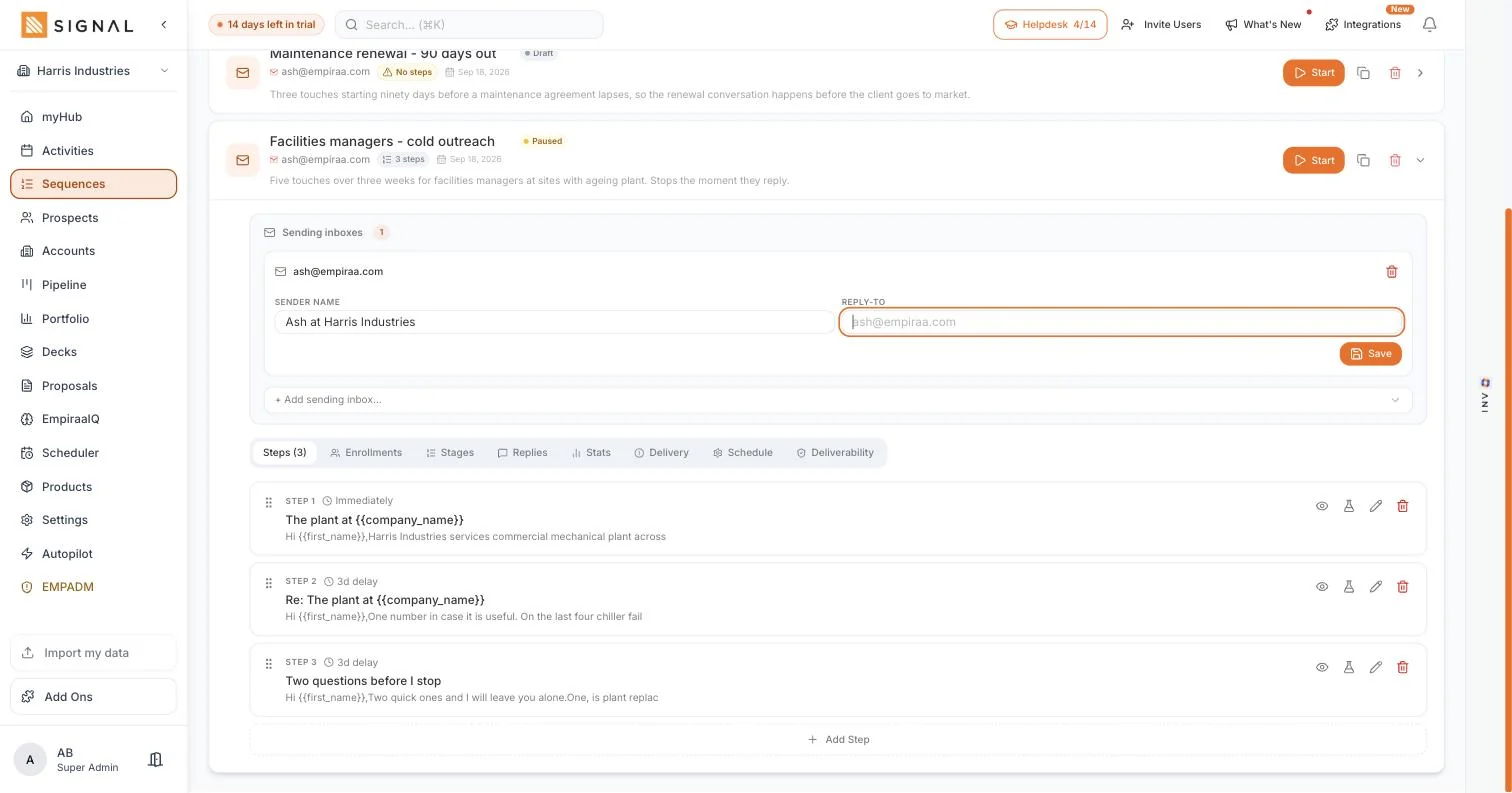
Sent from your own inbox
Your address, your signature, your sending reputation. Not a shared relay the spam filters already know.
The first email
Goes out the moment someone is enrolled, with their name and company filled in.
Then a nudge, three days later
Set the gap in days and hours. The sequence keeps its place whatever your week does.
It stops when they reply
A reply takes them out of the sequence, so nobody gets chased after they have already answered.
In the product
Empiraa IQ, which is the list you normally sell as a service.
The product calls it a territory, allocation and intelligence suite. These are its tabs, and a go-to-market consultant will recognise all of them as deliverables.
Six of them
ICP Creator
The ideal customer profile as a working definition rather than a document, feeding the search that finds the accounts.
Territory Builder
The carve-up built in the product, so the territories you designed are the ones being worked.
How territories workAccount Allocation
Who owns which accounts, assigned and visible, which is the part of a design that usually evaporates at handover.
Coverage
Whether the accounts that matter are actually being touched. The question a coverage model exists to answer and almost never gets asked again.
How coverage worksSignal 360
Open pipeline, stale deals, win rate, value at risk and overdue activity on one screen, grounded in the workspace’s own data.
Competitors
Who you are up against on a deal, tracked where the deal is, so the battlecard you wrote gets read at the moment it matters.
The system you handed over
How much of it was running when you left?
Put in three parts of the go-to-market system from your last engagement. The test is whether each one was configured in something, or described in the handover pack.
nothing logs it, so the cadence is reported rather than run.
no owner, so the deal sits between two people; nothing to clear, so the stage means whatever the rep hopes; nothing logs it, so the cadence is reported rather than run.
1 of 3
Only 1 of these could be run by something other than you.
One is close and missing a field, which is the easiest kind to fix and the kind that quietly never gets fixed.
One is a statement of intent. Worth having in the document, impossible for anybody to act on.
A part of the system that exists as a rule, a sequence or a stage is running when you leave. One that exists as a slide needs the client to buy five more tools to implement, and the engagement gets judged on the half that shipped.
What this does not do
Three limits, and the first one is about you rather than the software.
A better tool executes a design faster, which is only good news if the design is right.
A wrong ICP finds the wrong companies faster
If the segment is wrong or the positioning does not land, better prospecting produces more conversations with people who were never going to buy. The tool amplifies the design. It does not audit it, and neither does anything else.
It is not a revenue operations stack
No data warehouse, no multi-touch attribution, no reverse ETL, no integration platform. For a growing client that is usually a relief, because those things are the reason the six subscriptions existed. For an enterprise RevOps engagement it is a real constraint and worth saying early.
Coverage is measured on what is in the product
It reports coverage against the accounts and territories held here. It cannot see activity happening in a system you did not put in it, so a client running half their outbound elsewhere will get half a picture, which is the usual argument for not running half of it elsewhere.
If that is not quite you
GTM specialists is one of ten. These are the ones next to it.
Closely related work, bought for different reasons. If one of these describes your week better, read that page instead.
Sales consultants
You design the process itself, the stage definitions and the forecast, and then have to implement it inside whatever the client already bought.
Read that pageSales coaches
You change how individual reps behave, one session at a time, and what you need is to see the week between sessions rather than to redesign the process.
Read that pagePricing
The same Signal plans. Built around your work.
Use the standard Signal plans, with unlimited users. There is no separate Professional Services price table.
Questions
GTM specialists, answered.
What does a go-to-market consultant actually need from software?
The parts of the design that only exist once something operates them: an ICP that finds accounts rather than describing them, territories and account allocation, coverage against the accounts that matter, sequences, stage definitions and a derived forecast. Empiraa IQ carries that set in one product, which is the alternative to specifying six subscriptions.
Does the ICP actually drive prospecting?
Yes, and that is the difference worth understanding. You describe the ideal customer in plain words and it becomes the search that returns matching companies with decision-makers on them, monthly, with a daily run that emails the new ones. An ICP that finds accounts is a different artefact from an ICP that gets quoted in a kickoff deck.
Can I build territories and see coverage?
Yes. Territory Builder and Account Allocation set who owns what, and Coverage reports whether the accounts that matter are being touched. Those are three of the tabs in Empiraa IQ, which the product itself describes as a territory, allocation and intelligence suite. How territories work.
How many tools does this replace for the client?
Empiraa Signal is a CRM and more: it is also the B2B prospect database people buy Apollo or ZoomInfo for, the enrichment they buy Clay for, the sequencer they buy Smartlead or Instantly for, the booking link they buy Calendly for, and the proposal tool. For a go-to-market engagement that is the difference between one purchase order and six. What Empiraa Signal replaces.
Do I keep access after handover?
You can, at no cost to the client, because every plan has unlimited users. Most consultants lose visibility the day the invoice is paid and never learn whether the motion held, which is bad for the client and worse for your next proposal.
Is this suitable for an enterprise RevOps engagement?
Often not, and it is better to say so. There is no data warehouse, no multi-touch attribution and no integration platform, so a client with an existing RevOps stack and enterprise reporting requirements is a poor fit. Where it fits well is a growing business that needs the whole motion to work without six subscriptions and a systems integrator.
What do I earn on clients I bring?
30% recurring for the first twelve months they are with us, and your own Empiraa Signal workspace free for as long as you hold three or more clients. Running your own pipeline in it is also the fastest way to know the product well enough to configure it for somebody else. The partner terms.
Bring one client and see.
14 days free, no credit card, and you can have a client’s pipeline in it in an afternoon.