

For sales consultants
You designed the process. Then it bent to fit their CRM.
The stages cannot carry the exit criteria you wrote, the activity you need logged is three clicks deep so nobody logs it, and the forecast is a field somebody sets by feel. Six months later the client says the process did not stick, and they are describing a tool decision that was never yours.
- Your stages, your exit criteria
- Unlimited users on every plan
- Hand over something running
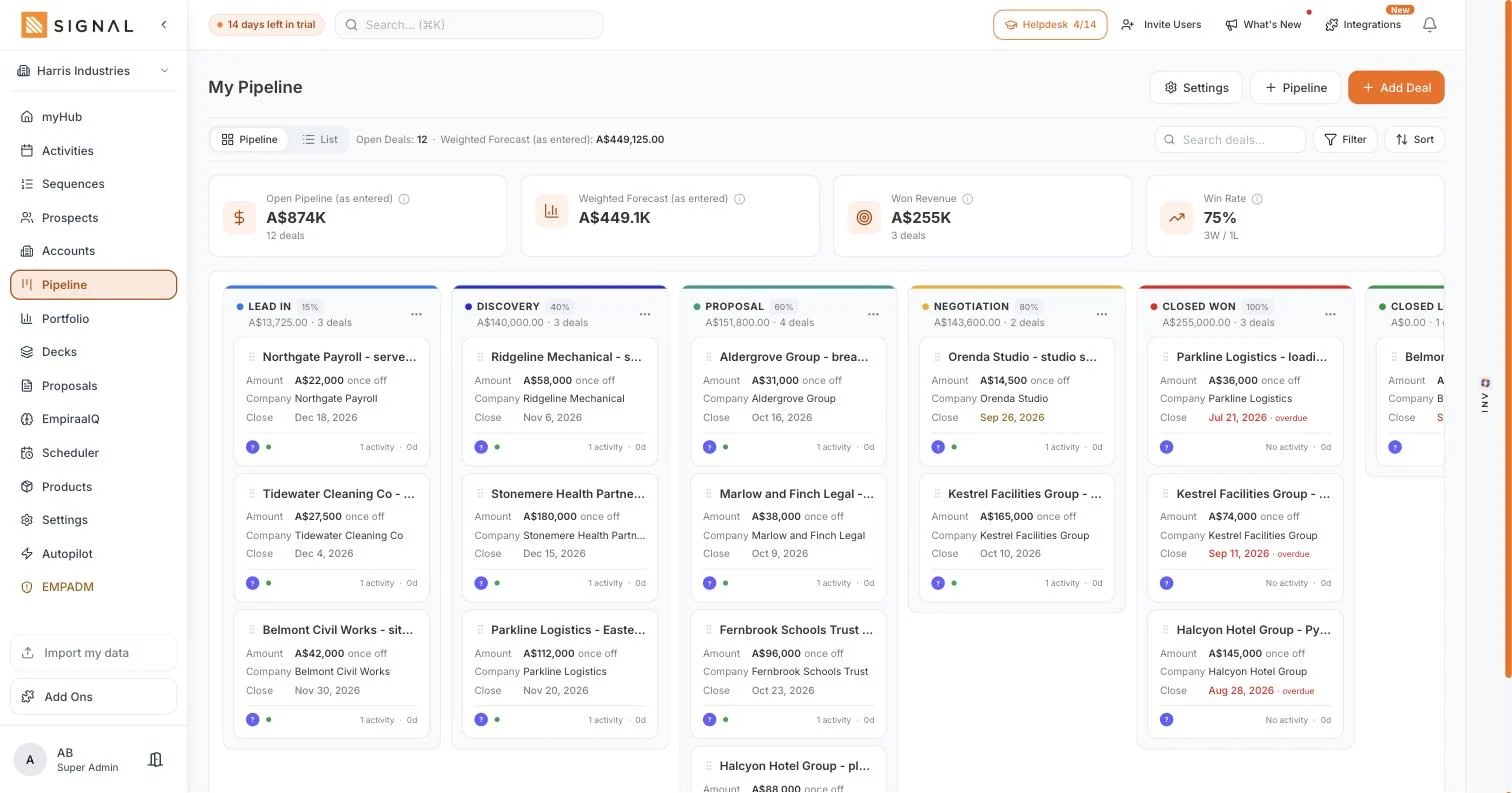
What is genuinely open
The total everyone quotes. It is the one that flatters you, which is why it is not the only one here.
And what it is worth weighted
Each deal at its stage probability. This is the number to take into a forecast conversation.
A stage is a probability, not a folder
Moving a card changes the forecast, so nobody can park a dead deal in Proposal to look busy.
Every card shows its last touch
Amount, company, close date and how long since anything happened. Stalled deals stop hiding.
Win rate, from real closes
Counted from deals you actually won and lost, not from the ones you remember.
What they are paying you for
A sales process that holds after you leave.
Stage definitions that mean something, exit criteria a deal has to actually clear, pipeline hygiene so the number is real, a forecast that is not a feeling, and a management cadence that survives a busy month. The work is judgement about how this particular business should sell.
The deliverable, though, is behaviour, and behaviour needs somewhere to live. A process described in a document is a process that depends on everybody remembering it, which is a bet against human nature you have probably lost before.
Where it stops working
Implementing your process in somebody else’s tool.
You designed it, then you went to configure it, and the CRM could not do half of it. Stages that will not hold exit criteria. Required fields that make reps enter fiction. Activity logging that lives somewhere other than the deal, so it does not happen. A forecast field nobody can derive, so it becomes a number a manager types.
So the process bends until it fits the tool, and what ships is the half that could be configured. When the client judges the engagement they judge the half, and the tool decision that shaped it was made before you arrived.
- Stages cannot carry the exit criteria, so they become labels
- Activity logging sits away from the deal, so it does not happen
- The forecast is typed rather than derived
- The quote and the proposal live outside the deal, so the last stage is a handoff
What is different
The process is configured rather than described.
Four things. The first is the one that decides whether the rest of your design survives.
- Pipelines and stages are yours to define, so the exit criteria you wrote are the ones the deal has to clear
- Activity is logged where the deal is rather than in a separate system, which is the difference between a cadence that holds and one that is reported on
- The forecast reads from the pipeline, weighted by stage, so what the client reports and what is actually there are the same number
- The quote and the proposal are in the deal, so the stage after "negotiation" is not a handoff into somebody else’s software
A process that had to fit around the tool was never your process. It was the tool’s, with your name on the document.
How an engagement runs
Design, configure, hand over.
The judgement is yours and unchanged. What changes is that the handover is a working system rather than a document about one.
- One
Define the stages and the exit criteria
Built as pipelines in the product, so a deal moving stage means something specific rather than somebody dragging a card because it feels closer.
- Two
Put the activity where the deal is
Logged against the deal rather than in a parallel system, and sequences log themselves. The cadence you designed is the cadence that runs, including on the days it would have been skipped.
- Three
Make the forecast derived, not typed
Weighted from the pipeline by stage, with the gap to target expressed as deals needed. A number the client can argue with is a number that gets corrected rather than inflated.
- Four
Hand over a running system
Stages, sequences, quote templates and reporting already configured, with a seat for you afterwards at no cost to them because every plan has unlimited users. Your engagement ends without your visibility ending.
What they report and what is there are the same number
The forecast reads from the pipeline, weighted by stage, against the budget. No field set by mood, which is usually where the process you designed quietly stopped being the process.
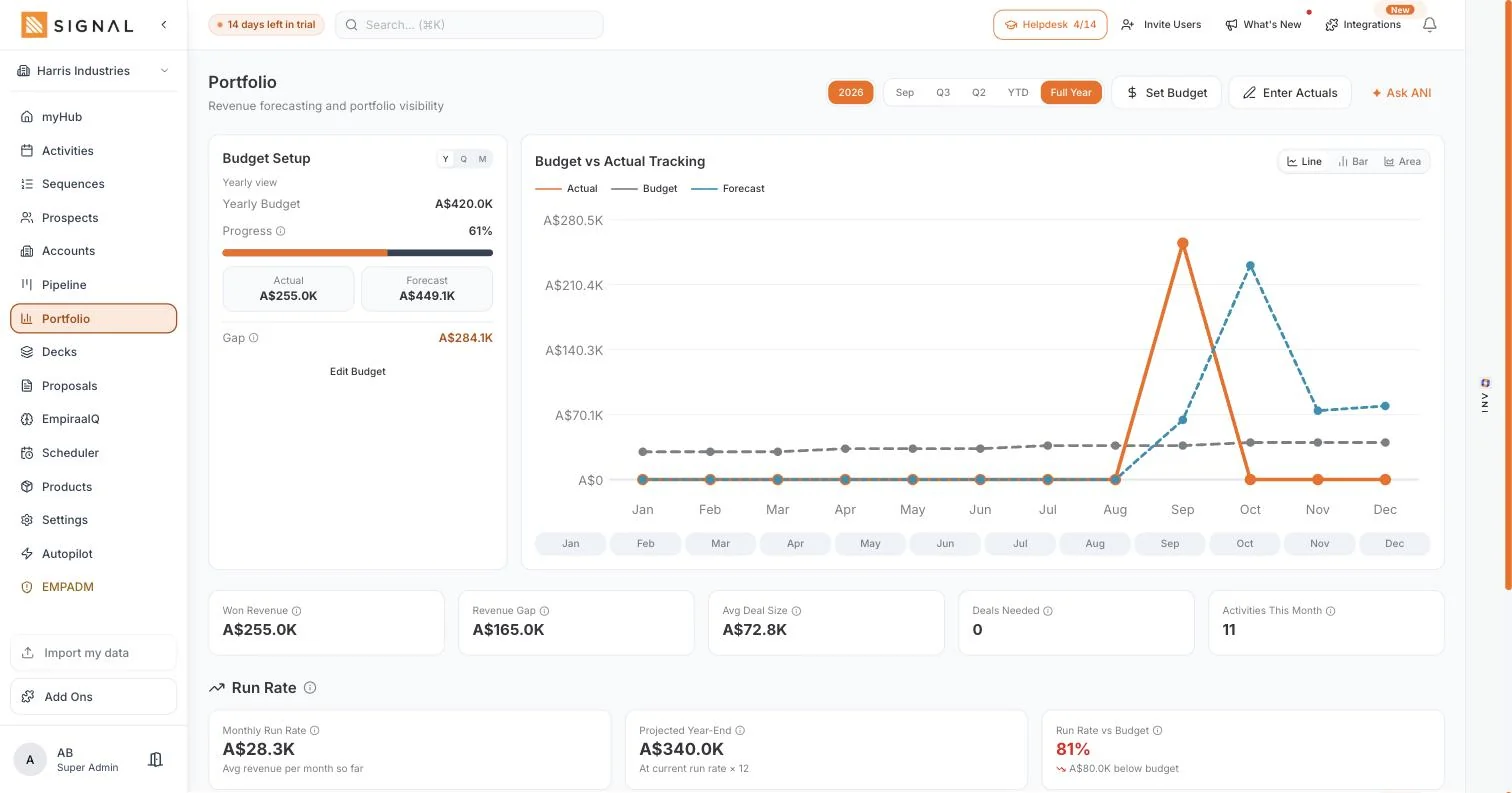
The number you committed to
Set it once, by quarter or by month. Everything on this page is measured against it.
Actual against forecast
What you have won, and what the weighted pipeline says you will win. Two different conversations.
And the gap, in money
Not a percentage. The dollars you are short, which is the number that changes what you do on Monday.
Month by month, all year
Budget, actual and forecast on one chart, so a bad quarter shows up while you can still fix it.
In the product
The parts of the process you can actually build.
Each of these is a thing you would normally specify in a document and hope somebody configured correctly.
Four things
Pipelines and stages
Multiple pipelines, your stages, your exit criteria, so the process is the product rather than a description of it.
How pipelines workSequences from the rep’s own inbox
Multi-step outreach that stops when somebody replies, with deliverability per sequence so a sending problem shows up before it costs a quarter.
How sequences workForecasting and targets
Weighted pipeline against budget, run rate, and the gap as deals needed rather than revenue missing. The version a rep can do something about.
How forecasting worksQuotes and proposals in the deal
The proposal and the quote sit on the deal they belong to, so the stage after negotiation is not a handoff into a different subscription.
How proposals workThe process you designed
How much of it could the tool actually enforce?
Put in three stages from the process you last implemented. The question is whether the exit criteria you wrote were things a system could check, or things a sales manager had to remember to ask.
nothing to clear, so the stage means whatever the rep hopes.
no owner, so the deal sits between two people; nothing to clear, so the stage means whatever the rep hopes; nothing logs it, so the cadence is reported rather than run.
1 of 3
Only 1 of these could be run by something other than you.
One is close and missing a field, which is the easiest kind to fix and the kind that quietly never gets fixed.
One is a statement of intent. Worth having in the document, impossible for anybody to act on.
A stage whose exit criteria are fields the deal has to carry is a process. One whose criteria live in the document you handed over is a suggestion, and six months later the client tells you the process did not stick.
What this does not do
Three things to be straight with the client about.
The first one is the real cost of this approach and it is better raised by you in week one than discovered in week three.
Moving off an incumbent CRM is work
Records import, but history, custom fields, integrations and whatever somebody built in a spreadsheet five years ago all have to be decided about. It is a project with a cost, and a client who thinks it is an afternoon will blame you in a fortnight. Scope it out loud.
It cannot make a team adopt a process
Configuration removes the excuses. It does not supply the management will to hold people to exit criteria when a quarter is tight. If the client’s sales leader will not enforce it, the process fails in a well-configured system instead of a badly configured one.
It is not a revenue operations stack
No data warehouse, no attribution modelling, no territory carve-up analytics beyond what is in the product, no integration platform. For a mid-sized client that is usually a relief. For an enterprise RevOps engagement it is a genuine constraint.
If that is not quite you
Sales consultants is one of ten. These are the ones next to it.
Closely related work, bought for different reasons. If one of these describes your week better, read that page instead.
Sales coaches
You change how individual reps behave, one session at a time, and what you need is to see the week between sessions rather than to redesign the process.
Read that pageGTM specialists
You build the whole route to market, from who to target through to what runs on a Tuesday, and you hand it over as something already running.
Read that pagePricing
The same Signal plans. Built around your work.
Use the standard Signal plans, with unlimited users. There is no separate Professional Services price table.
Questions
Sales consultants, answered.
Can I define my own pipeline stages and exit criteria?
Yes, and multiple pipelines if different parts of the business sell differently. That is the point of building the process in the product rather than describing it: a stage means what you decided it means, so a deal moving forward has cleared something specific rather than somebody dragging a card. How pipelines work.
Do I keep access after the engagement ends?
You can, at no cost to the client, because every plan has unlimited users. That matters more than it sounds: the usual pattern is that a consultant loses visibility the day the invoice is paid, so nobody ever finds out whether the process held. Keeping a seat turns a project into a relationship.
What does it cost the client?
Empiraa Signal is published, from A$99 a month including GST, per workspace with unlimited users, and 14 days free to start. For most clients the useful comparison is not against one CRM, it is against the CRM plus the prospecting tool plus the sequencer plus the booking link plus the proposal software. Pricing, and what you earn.
How bad is the migration from their existing CRM?
Records import. The work is in the decisions: which history matters, which custom fields survive, what the integrations were doing, and what somebody built in a spreadsheet that nobody documented. It is a project with a real cost and it should be scoped in the proposal rather than absorbed.
Is the forecast derived or entered?
Derived. Weighted pipeline by stage against budget, with run rate and the gap expressed as deals needed. You can still override, but the default is a number the client can interrogate, which is the difference between a forecast that gets corrected and one that gets inflated. How forecasting works.
What do I earn on clients I bring?
30% recurring for the first twelve months they are with us, and your own Empiraa Signal workspace free for as long as you hold three or more clients. Your own pipeline, on the system you are recommending, which is also the fastest way to know it properly. The partner terms.
Bring one client and see.
14 days free, no credit card, and you can have a client’s pipeline in it in an afternoon.