

Buyer guide
OKR software. And why most rollouts fail anyway.
OKR software manages Objectives and Key Results with named owners, a check-in rhythm and progress that updates from the systems your teams already work in. Choosing one is the easy part. The reason most OKR programmes are quietly abandoned by their third or fourth quarter has almost nothing to do with which tool was bought, and this page is mostly about that.
- Set up with your plan
- Unlimited users
- 30-day pilot
Before you choose a tool
The software is rarely what went wrong.
Three failure patterns account for most abandoned OKR programmes, and no vendor on your shortlist will fix any of them.
Why OKR rollouts die
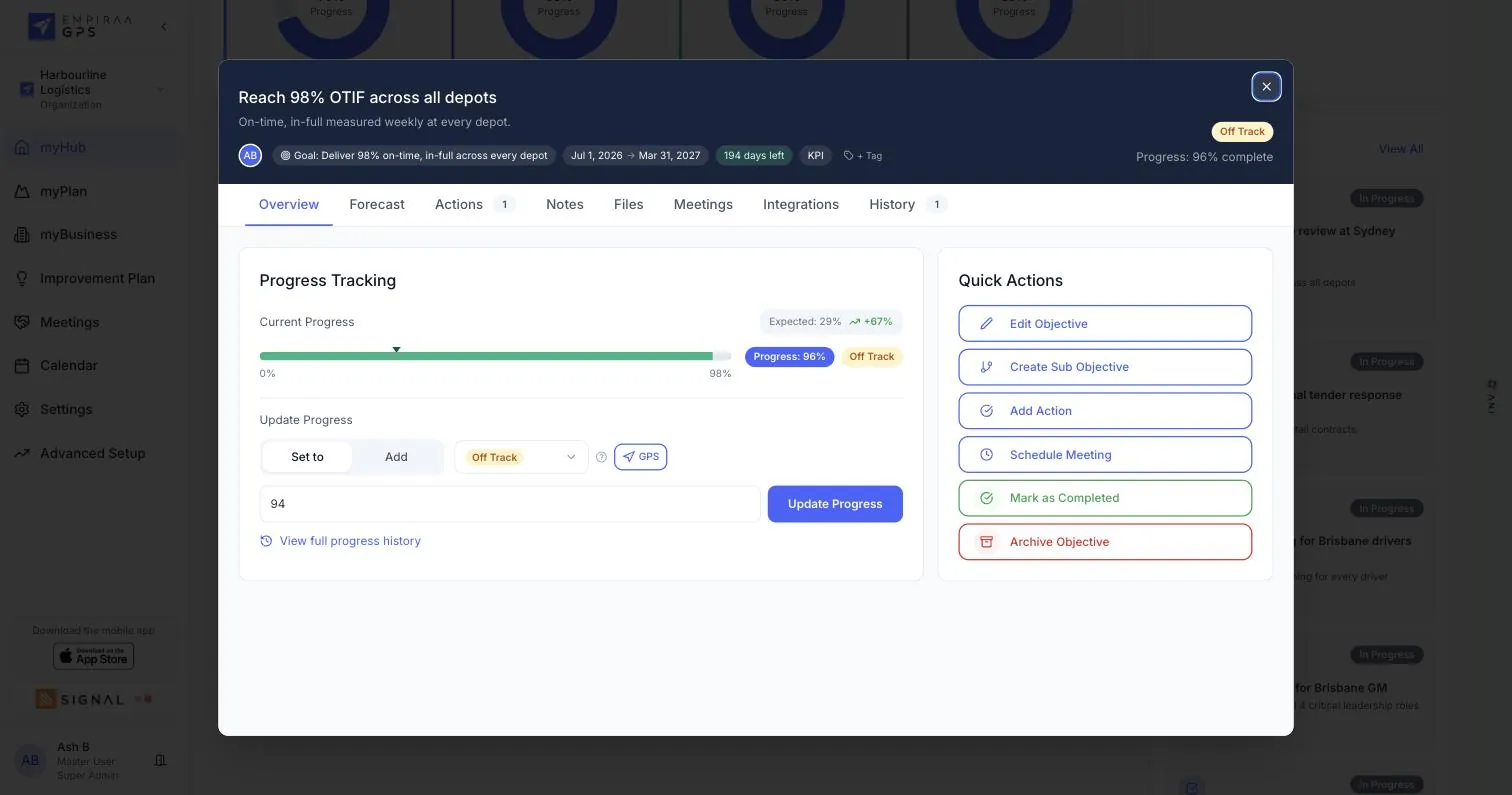
KPIs submitted as Objectives
Every team is asked for OKRs, including teams whose job is to keep something running steadily. With no change to commit to, they write their existing measures into the template. The next quarter the same list returns with the numbers nudged, and the exercise becomes paperwork.
Too many to be priorities
An organisation with thirty Objectives does not have priorities, it has a list. The method only works when the number is small enough that dropping one is a real decision, and software with unlimited objectives makes it very easy to avoid that decision.
Nobody agreed what a score means
Some organisations set ambitious targets where 0.7 is a success; others expect 1.0. Both work. Leaving it unsaid does not: people quietly set targets they know they will hit, and the ambition the method exists to create disappears while the reporting still looks healthy.
Choosing
What actually separates OKR tools.
The buying criteria
Can teams that should not run OKRs opt out?
This is the single most useful question to ask a vendor, and most OKR-only platforms cannot answer it well, because the model assumes OKRs everywhere.
A platform that also supports KPIs and quarterly priorities lets the teams running business as usual report in a shape that fits, while the teams driving change run proper Objectives. That removes the first and most common failure pattern before it starts, rather than managing it.
- OKR-only platform: every team submits Objectives, whatever their work looks like
- Framework-agnostic platform: OKRs where they fit, KPIs and priorities where they do not
- Ask in the demo: what does a team with no change initiative submit?
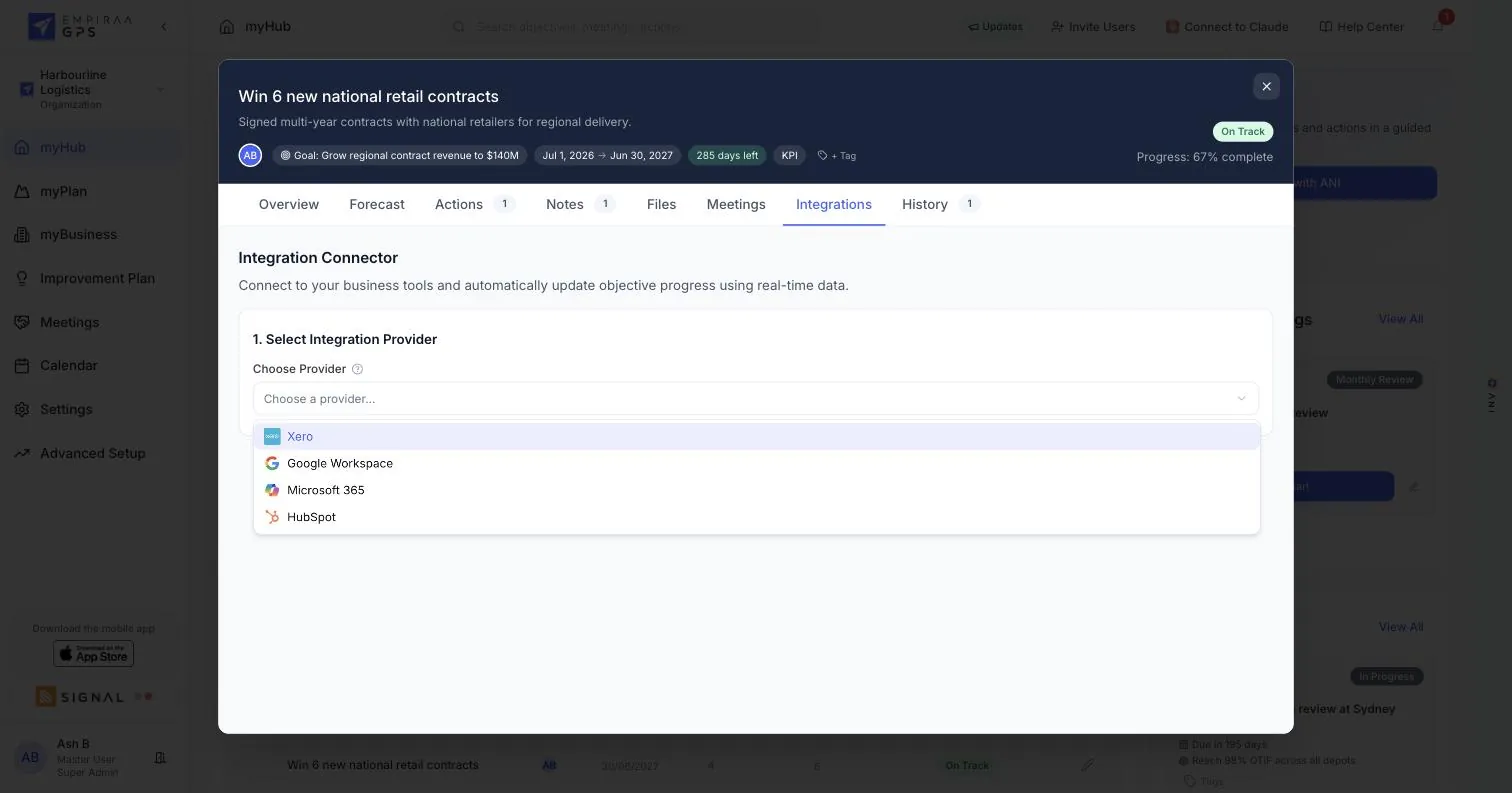
Where does key result progress come from?
A Key Result is a number that moves, so the question is who moves it. If the answer is that an owner remembers to type it in each fortnight, the data will be stale by the second quarter regardless of how good the reminders are. Progress that updates from the systems where the work happens is the difference between a live plan and a well-designed form.
Does it survive the champion leaving?
Most OKR rollouts have one person who cares about them. When that person changes role, the programme usually goes with them. Ask what the system does on its own: whether it chases check-ins, whether it flags a Key Result that has not moved, and whether leadership gets a view without somebody assembling it.
Check the shortlist is still current
Two names that appear on most OKR buyer guides are out of date. Microsoft retired Viva Goals on 31 December 2025 and stated it would not be replaced. WorkBoard acquired Quantive, announced on 28 May 2025, and quantive.com now redirects wholesale to workboard.com. Both were checked on 19 September 2026. A 2026 guide that still lists either as a live independent option has not been revisited, which tells you something about the rest of it.
The checklist
Six things to ask every vendor.
Including us. These separate the options faster than a feature matrix.
Questions for the demo
What does a steady-state team submit?
If the only answer is Objectives, expect the stale-list failure within three quarters. Look for KPIs or priorities as first-class alternatives in the same plan.
Which of my systems can update a Key Result?
Ask for the named integrations rather than "we have an API". The gap between those two answers is usually a quarter of engineering time.
Show me a board report generated live.
Not a screenshot prepared for the demo. Reporting from live data is where most of the value in this category sits, and it is the easiest thing to fake in a sales call.
How is it priced per person?
OKRs only work when the people delivering them can see them. Per-seat pricing is a tax on that, and a minimum user count is worth checking against your actual leadership headcount.
What happens to a stalled Key Result?
Ask whether anything notices on its own, or whether somebody has to look. That difference decides whether you find out in week three or week eleven.
Is the AI included or extra?
Several platforms in this category price their AI separately or include it only at the top tier. Get the answer in writing before comparing headline prices.
Honesty section
When a dedicated OKR tool is the better answer.
Empiraa GPS is a strategy execution platform that supports OKRs, not an OKR specialist, and for some organisations that is the wrong shape.
Choose something else if
One team, running OKRs only
A single team setting a handful of Objectives each quarter does not need a strategy execution platform. A focused OKR tool will be simpler to set up and better at the one job. GPS earns its place when the plan crosses several teams or sites.
You want OKRs enforced everywhere
Some organisations deliberately want one method, universally, with no opt-out, and there are platforms built precisely around that conviction. GPS is framework agnostic by design, which is the opposite choice. If uniformity is the point, buy the tool that enforces it.
OKRs live inside an engineering workflow
If your Objectives are tightly coupled to delivery work in a single system, a tool that lives natively inside that system may serve you better than a separate strategy layer above it.
Questions
Questions about OKR software.
What is OKR software?
Software that manages Objectives and Key Results: the Objective being a short qualitative statement of what you are trying to achieve, and the Key Results being the two to five measurable outcomes that would prove it. Good OKR software adds named owners, a check-in rhythm, progress that updates from connected systems, and reporting that leadership can read without somebody assembling it first.
Why do OKR software rollouts fail?
Most often because the organisation put its KPIs into OKR format. Every team is asked for Objectives, including teams whose job is to keep something running steadily, so they submit their existing measures in the required shape. The following quarter the same list returns with the numbers nudged, reviews teach nobody anything, and the programme is quietly dropped. That is a classification failure rather than a software one, and no vendor will fix it for you.
What should I look for in OKR software?
Six things: whether teams that should not run OKRs can report in another shape, which of your systems can update a Key Result automatically, whether reporting is generated live rather than assembled, how it is priced per person, whether anything notices a stalled Key Result on its own, and whether the AI is included or charged separately. Ask to see a board report generated during the demo rather than shown as a screenshot.
Is Viva Goals still available?
No. Microsoft retired Viva Goals on 31 December 2025 and stated in its own documentation that it would not be replaced, encouraging customers to explore third-party OKR tools. Any buyer guide still listing it as an option has not been updated. Checked 19 September 2026.
What happened to Quantive?
WorkBoard acquired Quantive, announced on 28 May 2025, and quantive.com now redirects wholesale to workboard.com. WorkBoard's own site presents WorkBoardAI as the platform those customers move to. If a shortlist you have been given includes Quantive as an independent option, it predates the acquisition. Checked 19 September 2026.
How much does OKR software cost?
Most of the enterprise options quote rather than publish, so a real comparison usually needs two or three quotes. The structural thing to check is the seat model, because OKRs only work when the people delivering them can see them, and per-seat pricing discourages exactly that. Ask what the bill looks like at twice your current head count, and whether there is a minimum user count.
Do we need OKR software, or will a spreadsheet do?
A spreadsheet genuinely works for one team with a handful of Objectives and a disciplined fortnightly check-in, and plenty of organisations should stay there. It stops working when the plan crosses teams: the sheet reflects whoever updated it last, nobody can tell which commitments are current, and a person spends the week before each review rebuilding the picture by hand. That week is the cost worth measuring.
Does Empiraa GPS do OKRs?
Yes, with owners, check-ins and progress that updates from connected systems. It also supports KPIs, quarterly priorities and custom frameworks in the same plan, which matters because it means the teams that should not be running OKRs do not have to pretend they are. GPS is built for organisations whose plan crosses several teams or sites; for a single team running OKRs and nothing else, a dedicated OKR tool is the simpler answer.

Question not answered here? Ask ANI and get a straight answer.
Run OKRs where they fit, and something else where they do not.
A 15-minute demo, with reporting generated live rather than screenshotted in advance.