

Answers
OKRs vs KPIs. One monitors, one changes.
A KPI is an ongoing measure of health: something you watch continuously and want to keep in a good range. An OKR is a time-boxed commitment to change something, with an Objective saying what and Key Results saying how you will know. Nearly every organisation needs both, and nearly every failed OKR programme is one that turned its KPIs into OKRs.
- Set up with your plan
- Unlimited users
- 30-day pilot
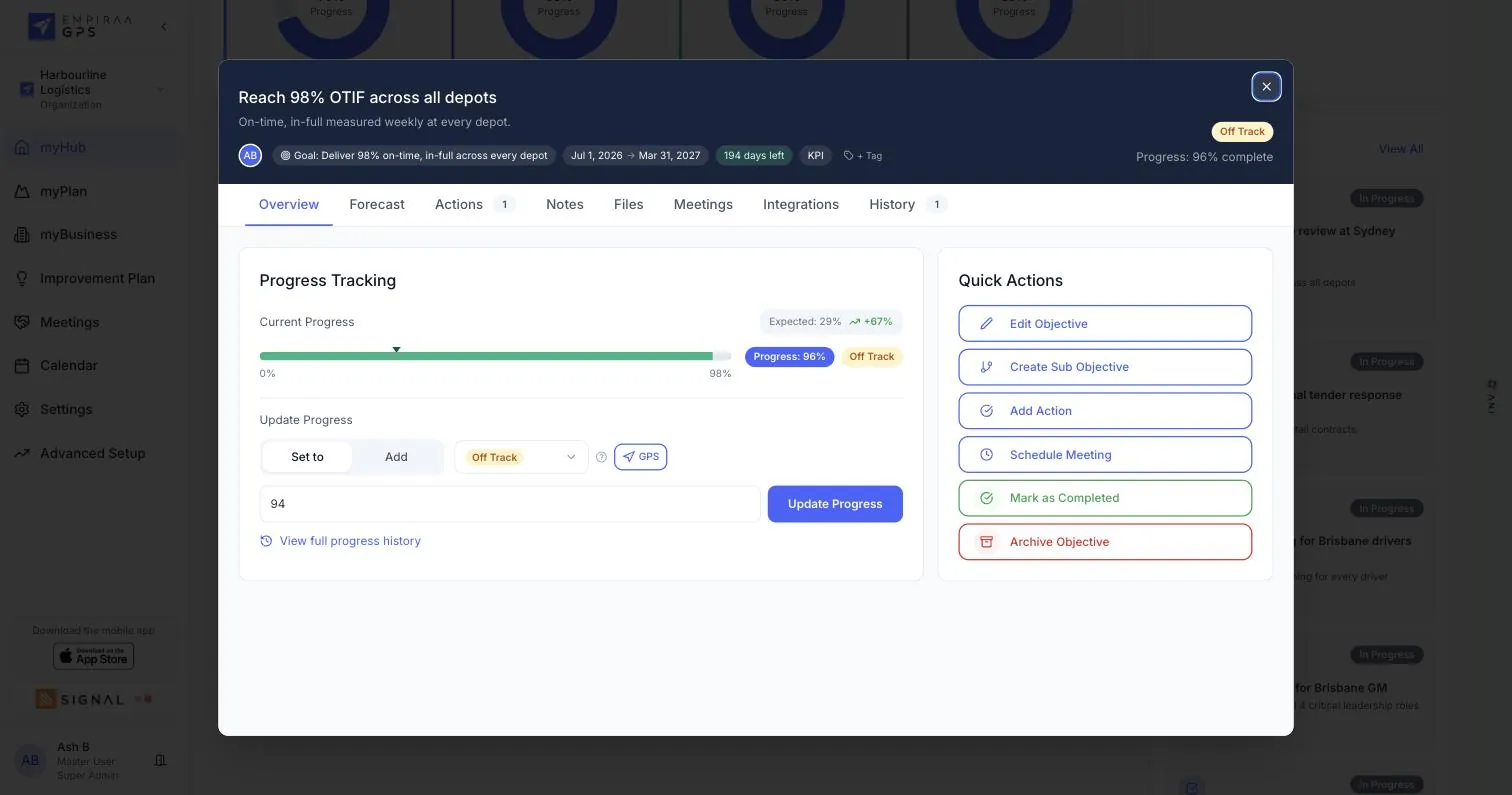
The confusion
They look the same on a slide.
Both are a name and a number with a target beside it. The difference is what you intend to do about it, and that does not show up in the formatting.
Why this keeps going wrong
The template makes everything look like an OKR
Once an organisation adopts OKRs, every team is asked to submit some. A team whose job is to keep a service running reliably has no change to commit to, so it writes its existing measures into the template and calls them Key Results.
The stale list nobody learns from
The following quarter the same Objectives come back with the numbers nudged. Reviews become status readouts, people stop preparing for them, and within three quarters the programme is quietly abandoned. Almost always this is a classification problem rather than a discipline problem.
The opposite mistake, less often noticed
A genuine change initiative left as a KPI on a dashboard has no owner, no deadline and no commitment attached. It gets watched for a year and never moves, because watching was all anyone signed up to.
How to tell them apart
One question settles almost every case.
The test
Ask what the honest target is
For any measure you are about to write down, ask what you would genuinely be happy with at the end of the period. If the honest answer is “about where it is now, ideally not worse”, it is a KPI. If the honest answer is a specific number that is materially different from today, and somebody is accountable for getting it there, it is a Key Result.
System uptime is a KPI. You want 99.9 per cent, you wanted it last quarter, and you will want it next quarter. Nothing about that is a commitment to change.
- Target is roughly today’s number: KPI
- Target is a deliberate move from today’s number, by a date: Key Result
- Nobody is accountable for moving it: KPI at best, decoration at worst
- It can be ticked off as done: that is an action, not either of them
The same metric can be either, in different quarters
This is what makes the distinction feel slippery, and it is worth stating plainly. Customer churn sitting at 4 per cent and monitored monthly is a KPI. A decision to get churn from 4 per cent to 2.5 per cent by the end of the half, with a named owner and work behind it, is a Key Result. It is the same number. What changed is whether the organisation has committed to moving it.
Key Results are outcomes, not the work
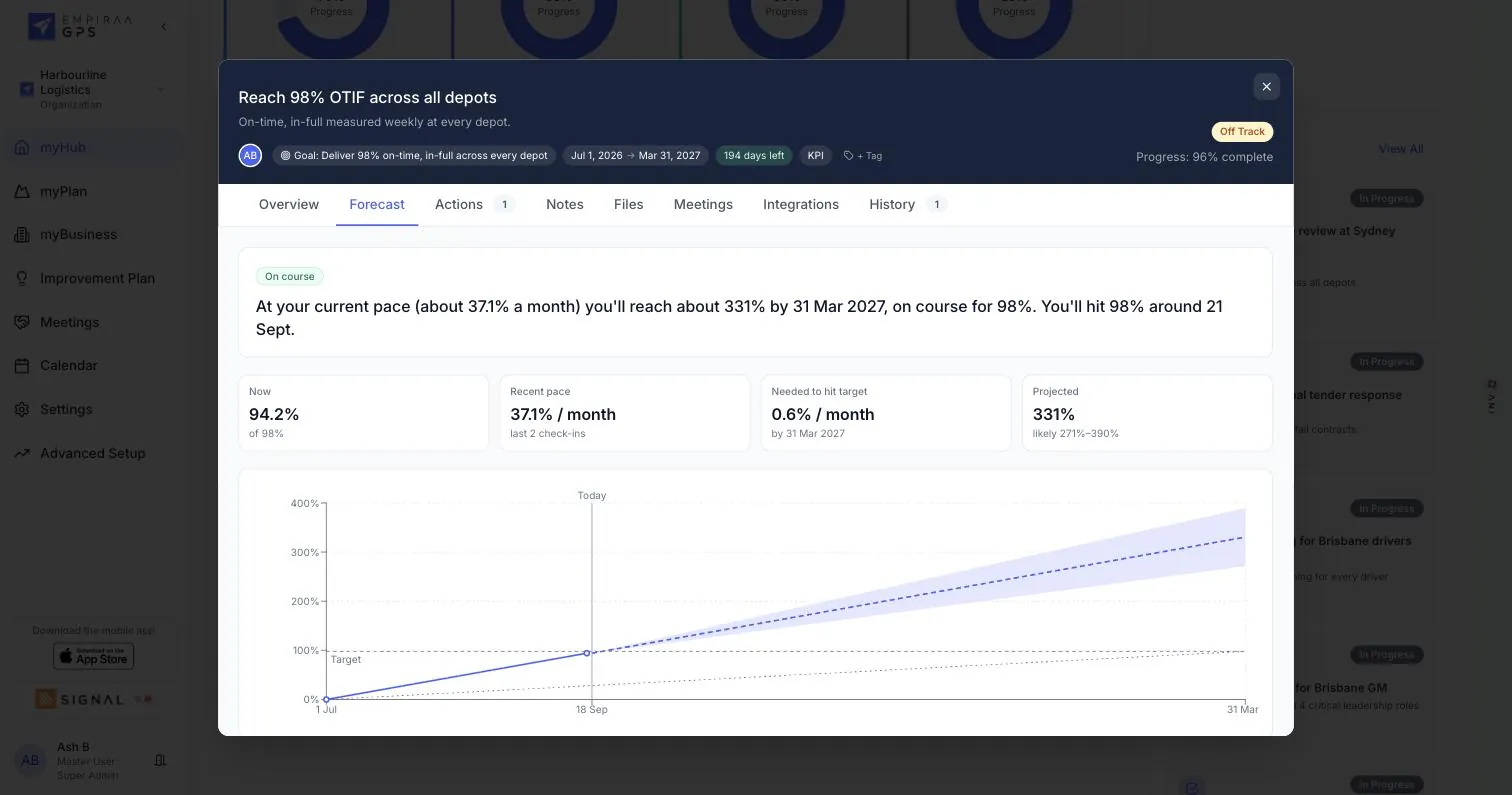
A Key Result is a number that moves. "Launch the new onboarding flow" is not a Key Result, it is an action that might move one. This matters because a list of actions dressed as Key Results lets a team score full marks for shipping things that changed nothing, which is the failure mode that makes executives lose faith in the method.
- Key Result: median time to first value from 11 days to 3
- Action: rewrite the onboarding email sequence
- The action sits underneath the Key Result, not in place of it
Both belong on the same page
The useful setup is not choosing one. It is a small number of OKRs for what is genuinely changing, sitting alongside the KPIs that tell you the business is still healthy while you change it. Organisations that run only OKRs lose sight of the base business. Organisations that run only KPIs never commit to anything.
Side by side
The differences that actually matter.
OKRs and KPIs compared
Purpose
A KPI monitors the health of something that already runs. An OKR commits the organisation to changing something within a set period.
Time
KPIs are continuous and have no end date. OKRs are time-boxed, usually to a quarter or a half, and are meant to be retired or replaced.
Ambition
A KPI target is usually the level you need to sustain. A Key Result target is deliberately a stretch from where you are, and some organisations set them so that hitting 70 per cent is a good outcome.
Ownership
A KPI often belongs to a function as a standing responsibility. A Key Result needs one named person accountable for moving it in this period.
What failure means
A KPI outside its range is a problem to fix. A missed Key Result may be an acceptable outcome of an ambitious target, provided the organisation said so in advance.
How many
An organisation can reasonably track dozens of KPIs on a dashboard. Three to five Objectives per team per quarter is the limit before the list stops being a set of priorities.
Putting it into practice
Sorting an existing list.
Most organisations already have a mixed list. Four steps turn it into something that works.
What to do
Apply the test to every line
Ask what the honest target is. Anything whose answer is "keep it where it is" moves to the KPI list, however it is currently written.
Cut the Objectives to a handful
Three to five per team. If dropping one does not feel like a real decision, there are still too many.
Move the tasks underneath
Anything that can be ticked off is an action. It belongs beneath a Key Result, not in the place of one.
Say what a score means
Decide in advance whether 70 per cent of an ambitious target is a success or a failure, and tell everyone. Leaving it unsaid is how teams quietly start setting targets they know they will hit.
Related
Keep exploring GPS.
Related pages

Questions
Common questions about OKRs and KPIs.
What is the difference between OKRs and KPIs?
A KPI is an ongoing measure of health that you watch continuously and want to keep in a good range. An OKR is a time-boxed commitment to change something, pairing an Objective, what you are trying to achieve, with Key Results, the measurable outcomes that prove it. The practical test is to ask what the honest target is: if it is roughly where the number sits today, it is a KPI; if it is a deliberate move to a different number by a date, with an owner, it is a Key Result.
Should we use OKRs or KPIs?
Almost always both. KPIs tell you the business is healthy. OKRs tell you what you are changing this quarter. Organisations that run only OKRs lose visibility of the base business, and organisations that run only KPIs never commit to changing anything. The mistake is not choosing wrongly, it is forcing everything into one category.
Can the same metric be both an OKR and a KPI?
Yes, at different times, and this is what makes the distinction feel slippery. Churn monitored monthly at 4 per cent is a KPI. A commitment to move churn from 4 per cent to 2.5 per cent by the end of the half, with a named owner, is a Key Result. Same metric. What changed is whether the organisation has committed to moving it.
Why do OKR programmes fail?
The most common reason is that organisations put their KPIs into OKR format. Every team is asked for Objectives, including teams whose job is to keep something running steadily, so they submit their existing measures. The following quarter the same list returns with the numbers nudged, reviews teach nobody anything, and the programme is quietly dropped. That is a classification failure rather than a discipline failure.
Is a task a Key Result?
No. A Key Result is a number that moves; a task is work that might move it. "Launch the new onboarding flow" is an action. "Reduce median time to first value from 11 days to 3" is a Key Result. Treating actions as Key Results lets a team score full marks for shipping things that changed nothing, which is usually the point at which leadership stops believing the scores.
How many OKRs and KPIs should we have?
Three to five Objectives per team per quarter, with two to five Key Results each. KPIs are different: an organisation can reasonably monitor dozens, because monitoring is cheap and does not compete for attention the way commitments do. The constraint on OKRs exists because a long list of priorities is not a list of priorities.
Do we need different software for OKRs and KPIs?
No, and using different systems for each tends to make the confusion worse, because it hides the relationship between what you are changing and what you are keeping steady. Empiraa GPS holds OKRs, KPIs, quarterly priorities and custom frameworks in the same plan, so teams that should not be running OKRs do not have to pretend they are.

Question not answered here? Ask ANI and get a straight answer.
Run both, in one plan.
See how Empiraa GPS holds OKRs, KPIs and quarterly priorities together, with progress from live data.