

Answers
How many clients can one advisor hold?
Every article that answers this gives you a number, and none of them can know yours. The answer is available hours divided by hours per engagement, and the second figure moves enormously with your review cadence and with how much of the between-meeting work the client does themselves. The arithmetic takes ten minutes. The honest version of it is usually a lower number than the one people are carrying.
- Set up with your plan
- Unlimited users
- 30-day pilot
Why the usual answer is useless
A number without your inputs is somebody else’s practice.
Three firms can hold wildly different client counts per advisor and all be running well. The variables are knowable, which is why the number is not worth borrowing.
What the number depends on
Cadence
A monthly rhythm is roughly three times the review work of a quarterly one, and it front-loads it: the preparation does not get cheaper with repetition the way people expect.
Who does the chasing
If the advisor assembles the numbers, writes the update and reminds the client what they committed to, each engagement costs double what the same engagement costs when the client answers a check-in themselves.
Whether the advisor also sells
A practice lead carrying business development has materially fewer client hours than a delivery-only advisor, and firms almost always count both the same way when they plan headcount.
The arithmetic
Two numbers, one division.
How it works
One: available hours, which is arithmetic
Start from the standard rather than from how hard everyone is working. Australia’s National Employment Standards set maximum weekly hours at 38 and annual leave at four weeks, which leaves 48 weeks and 1,824 hours before public holidays, which vary by state. Then take out everything that is not an engagement: your own planning, training, recruitment, business development and the administration of the practice itself.- 38 hours, 48 weeks, less your state’s public holidays
- Subtract practice time before dividing, not after
- Use the real figure, not the one in the capacity plan
Two: hours per engagement, which is the one nobody has
Most firms can tell you the length of the review and almost nothing else, so they price and plan off the meeting. The actual cost is the fortnight around it: chasing the numbers, re-reading last quarter, preparing the pack, writing the report, and the unbilled follow-ups in between. Add those and a quarterly engagement is frequently two to three times the figure the firm has been using.- Count preparation, the review, the write-up and the follow-ups
- Count the chasing, which is where the surprise lives
- Two quarters of real entries beats any estimate
Then divide, and look at the answer twice
Available hours over hours per engagement gives the ceiling. The useful number is usually below it, because the ceiling assumes every week is average and no client ever needs two conversations in one month. Most firms set the working number at eighty per cent of the ceiling and hold the rest for the clients who need more than their share, which is always some of them.And watch the thing that fails first
Capacity rarely announces itself as capacity. It shows up as reports going out late, check-ins unanswered for a fortnight, and the same two clients always being the ones rescheduled. Those are measurable before anyone complains, which makes them a better early signal than the client count itself.Where GPS changes the inputs
It does not raise the ceiling by magic. It moves two of the terms.
Both of the honest ways to hold more clients are about the second number, not the first.
What moves the number
You stop estimating
Time entries against client accounts turn hours per engagement from an opinion into a figure, usually within two quarters.
Capacity is visible before it breaks
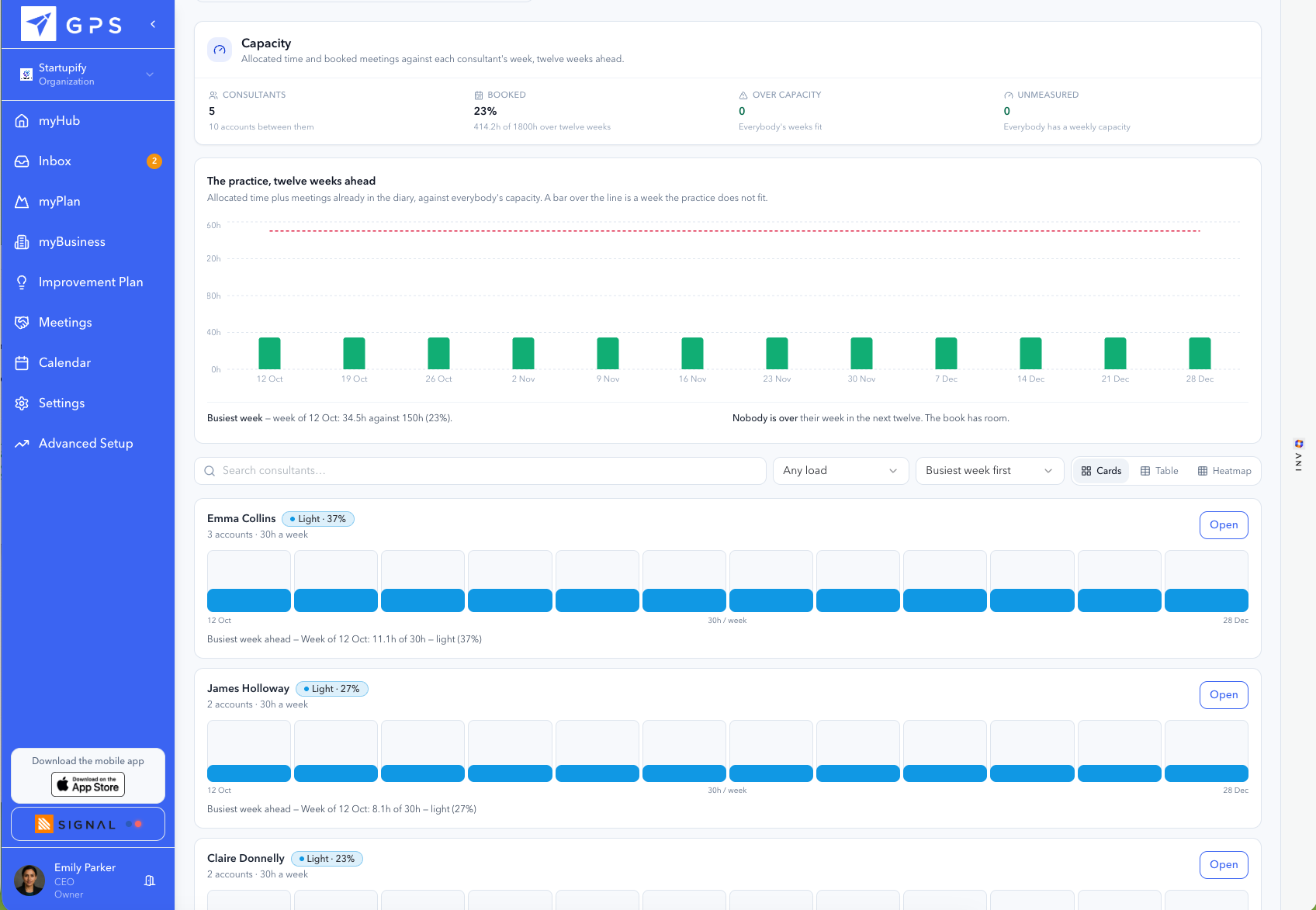
The capacity view shows who is carrying what now, rather than at the next partners’ meeting when something has already slipped.
The client does their own share
Check-ins the client answers themselves remove the chasing, which is the single largest hidden cost in the engagement.
The report assembles itself
Written from live plan data rather than rebuilt in a deck each quarter, which is hours per engagement per client.
Templates stop the re-invention
A standard engagement shape means the preparation is a review rather than a blank page every time.
Pricing follows the real count
GPS for Professional Services is priced by the client accounts you hold, so capacity and cost move together instead of pulling against each other.
Questions
Questions firms ask about advisor capacity
How many clients can one advisor hold?
There is no industry figure worth quoting, because the answer is available hours divided by hours per engagement and the second number moves by a factor of three with cadence and with how much between-meeting work the client does themselves. Work out both for your practice: the division takes ten minutes once you have real hours.
How do I work out available hours per advisor?
Start from 38 hours a week over 48 weeks, which is the National Employment Standards maximum weekly hours less four weeks of annual leave, then subtract your state’s public holidays. From that, take out planning, training, recruitment, business development and practice administration. What remains is what can be given to clients.
Why is the number always lower than people expect?
Because firms plan off the review and pay for the fortnight around it. Chasing numbers, re-reading the last quarter, preparing the pack, writing the report and the unbilled follow-ups frequently add up to two or three times the length of the meeting itself, and none of that is in the figure most firms are using.
Does a client portal let one advisor hold more clients?
It can, by removing the chasing rather than by speeding anyone up. When the client answers their own check-in and can see what changed without asking, the between-meeting work shrinks, and that is the term in the arithmetic with the most room in it. It does not change available hours at all.
Should we run at full capacity?
Most firms set the working number at about eighty per cent of the calculated ceiling, because the ceiling assumes an average week and no client needing two conversations in a month. The headroom is what absorbs the clients who need more than their share, and some always will.
What tells us an advisor is over capacity?
Reports going out late, check-ins left unanswered for a fortnight, and the same clients being rescheduled are all visible before anybody complains. Watching those is more useful than watching the client count, because they move first and they name which engagement is the problem.
Does Empiraa publish a benchmark for clients per advisor?
No, and deliberately. We hold timesheet data across firms with different cadences and different splits of the between-meeting work, so an average across them would be a worse answer than the arithmetic on this page applied to your own two quarters of entries.

Working out your own number? Ask ANI and get a straight answer.
Stop estimating hours per engagement.
Two quarters of real time entries against client accounts turns the capacity question into arithmetic. Start with a 30-day pilot.