

Answers
How long does it take to move a strategy out of a document?
Not as long as people fear, and for a reason that is worth understanding before you start. Moving the text is the easy part. What takes time is settling an owner, a measure and a date for each objective, which is exactly the decision a document allows you to defer. So the honest answer is one working session with the right people in the room, then one cycle before anybody trusts the thing.
- Set up with your plan
- Unlimited users
- 30-day pilot
Why estimates for this are always wrong
People budget for typing and spend the time deciding.
The plan in the document and the plan in a system are not the same document in two formats. One of them has to be specific.
Where the time actually goes
"Grow revenue" is not a goal yet
It has no owner, no measure and no date. A document can carry it for a year without complaint. A system asks all three questions on the way in, which is the point and also the delay.
Two people thought it meant different things
This is the common one. The sentence survived the planning day because it was broad enough for everyone to agree with. Being asked for a number is the first time the disagreement surfaces.
Nobody has the figure to hand
The measure is obvious and the current value is in a report somebody has to run. That is a day of waiting per measure if you let it be, and ten minutes if you decide to start from an honest estimate and correct it.
The three stages, and what each one costs
Only one of them is work you can speed up.
How it works
Stage one: the import, which is not the constraint
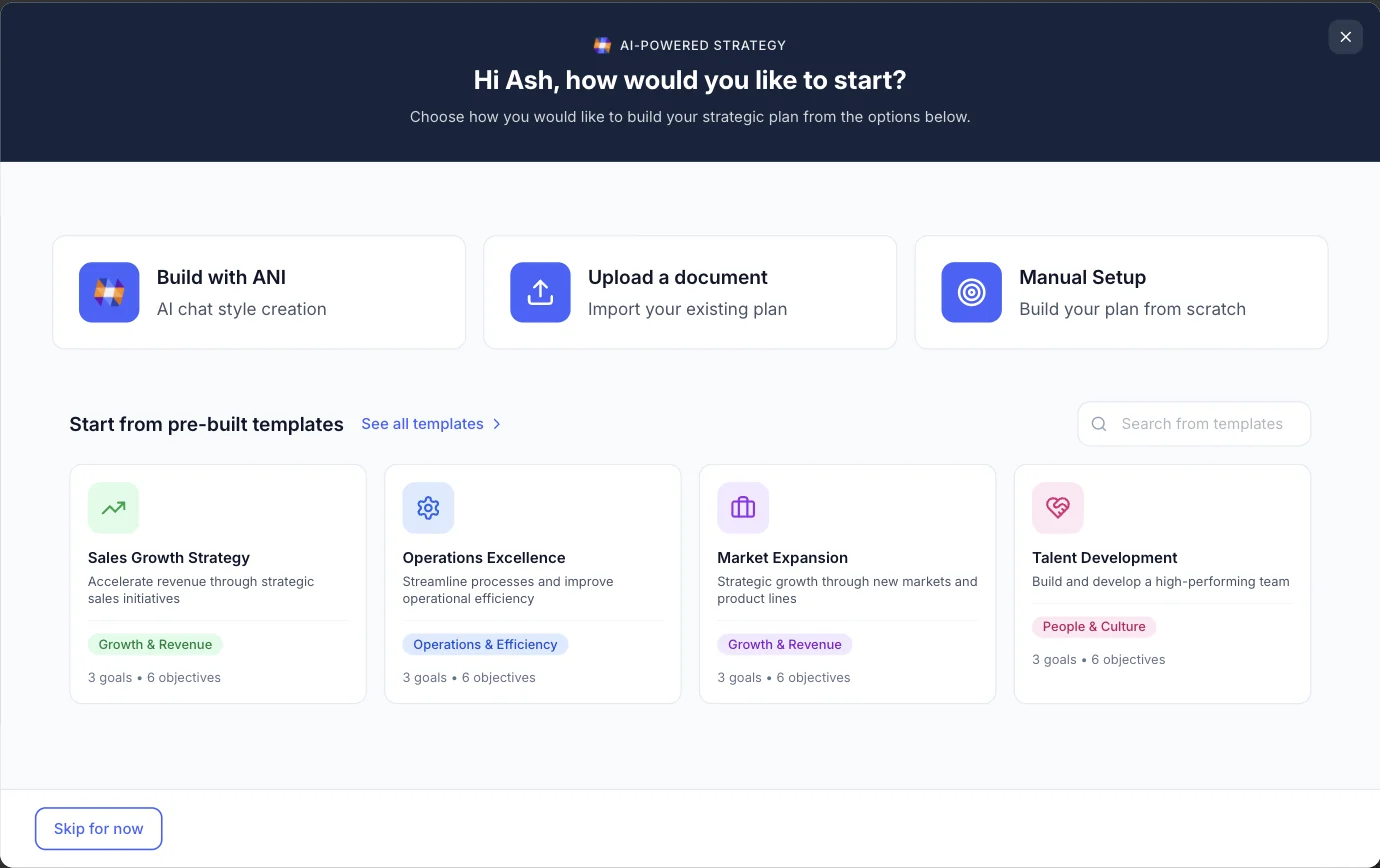
Upload the strategy you already have and DocuANI reads it and proposes the structure: the objectives it found, the measures implied and how they relate. You get something to react to rather than an empty screen, which is worth more than it sounds, because arguing with a draft is faster than authoring from nothing. Business plans include between three and twenty-five DocuANI uploads a month depending on tier, unlimited on the top one, and every Professional Services plan includes it.- Works from the document you have, not a template
- Produces a draft to correct, not a blank plan
- Included on every plan, metered by tier on Business
Stage two: the decisions, which is the real answer
Each objective needs one owner, one measure and one date. With the right people in a room that is a few minutes each, so a one-page plan is a single working session. Without them it is a fortnight of asynchronous messages per objective, and that is where every long migration story comes from. The variable is not the software and not the document. It is who is available to decide.- One owner, one measure, one date, per objective
- With the right room: one session for a one-page plan
- Without it: a fortnight per objective, in messages
Stage three: the first cycle, before anyone trusts it
A plan in a system is not believed until it has survived one round of people updating it and seeing that the updates showed up. That is one check-in cycle, so a week or a fortnight depending on your rhythm. You cannot compress it and it is not work, which makes it the easiest part of the timeline to plan around.And if you would rather hand it over
The migration service covers plans, KPIs, client lists and templates, from spreadsheets, decks or any other tool. It is free on annual billing and A$990 on monthly, including GST. It takes stage one off your hands entirely and makes stage two faster by arriving with the questions already written down, which is most of what you are buying.How to make it fast
Five choices that decide whether this takes a day or a quarter.
All five are yours rather than ours, which is the useful thing about them.
What to do first
Book the room before the upload
Ninety minutes with the people who can name an owner. The import without the room is a draft nobody finishes.
Start with one plan, not all of them
The organisation plan, this quarter. Divisions and prior years can follow once anybody believes the first one.
Estimate the current value, then correct it
A measure with a rough starting figure is usable this week. A measure waiting on a perfect baseline is not in the plan at all.
Let something be wrong
The draft will mis-read something. Fixing it in the system takes seconds and arguing about it in a document takes a meeting.
Do not re-plan while you migrate
The temptation is enormous and it is how a two-hour job becomes a strategy offsite. Move what you decided; change it next cycle.
Use the pilot as the deadline
The pilot runs 30 days with a card on file and nothing charged. That is a real date, which is the most useful thing about it.
Questions
Questions people ask about moving a plan in
How long does it take to move a strategy out of a document?
The import is not the constraint. Settling one owner, one measure and one date for each objective is, and with the right people in a room that is a few minutes each, so a one-page plan is a single working session. Then allow one check-in cycle before anybody trusts it. Long migrations are almost always decision latency rather than data entry.
Do I have to retype my strategy?
No. Upload the document and DocuANI reads it and proposes the objectives, measures and relationships it found, so you start by correcting a draft rather than authoring from an empty screen. Every plan includes it, metered by tier on GPS for Business and unlimited on the top tier.
What formats can it read?
The strategy documents organisations actually have, which in practice means a document or a deck. If what you hold is a spreadsheet of KPIs, or a plan spread across several tools, the migration service is the better route because it is built for exactly that.
What does the migration service cover, and what does it cost?
Plans, KPIs, client lists and templates, from spreadsheets, decks or any other tool. It is free on annual billing and A$990 on monthly, including GST. Onboarding is separate: also free on annual, and optional at A$1,490 on monthly.
Why does the import ask for things my document does not have?
Because a document can carry "grow revenue" for a year and a plan cannot. The missing owner, measure or date is not a gap the software created, it is a decision the document let you defer. Most people find this is the single most useful part of the exercise, even though it is also the slow part.
Can we move last year’s plan in as well?
You can, and it is usually worth doing second rather than first. A prior year gives you a baseline and some honest history, and it adds nothing to the question of whether this quarter is on track. Move the live plan, get one cycle through it, then bring the history in.
How long before people are actually using it?
One check-in cycle, so a week or a fortnight depending on your rhythm. A plan is believed once people have updated it and seen their updates appear in the next meeting, and that is not something you can shorten by working harder at it.

Working out your own timeline? Ask ANI and get a straight answer.
Upload what you already have.
Start free, let DocuANI draft the structure from your own document, and book the ninety minutes that turns it into a plan.