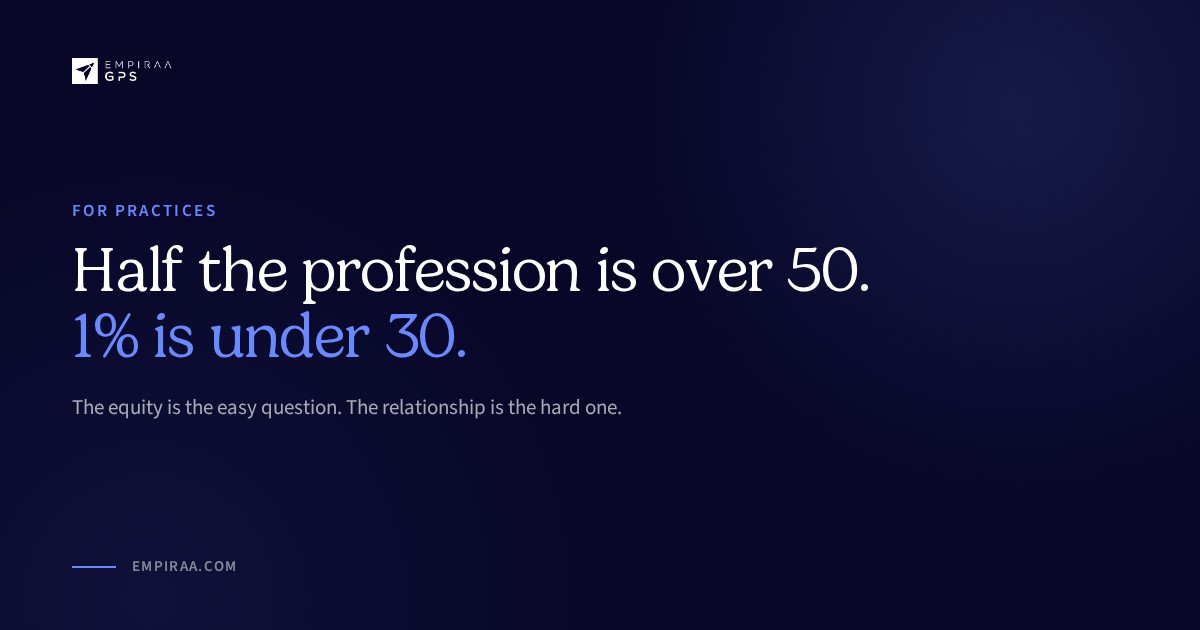
Not the people you expect, and not without a discount. Half of Australian tax practitioners are over 50 and 1% are under 30, so the usual assumption that a younger partner is waiting underneath is not available to most firms.
The Tax Practitioners Board figures, cited by The Tax Institute, put half the profession over 50 and 1% under 30. Membership over 45 at The Tax Institute rose from 64% in 2022 to 70% in 2025. Total staff at the AFR Top 100 fell about 6% in 2025.
The succession conversation that follows from those numbers is usually about equity: internal buyout, external sale, merge up. That is the financial question and it is well covered.
There is a second question underneath it that gets much less attention, and it determines what the equity is worth.
What actually leaves when a partner leaves
Take a client the departing partner has held for fifteen years. What transfers cleanly?
| Held in | Transfers | Why |
|---|---|---|
| The ledger and workpapers | Yes | It exists in a system because compliance requires it |
| Lodgement history and deadlines | Yes | Same reason |
| The engagement letter and the fee | Yes | It is a document |
| Why they bought the second site in 2021 | No | It was a conversation |
| What they tried in 2023 and abandoned | No | Nobody wrote it down |
| That the son-in-law makes the real decisions | No | Everyone knew, nobody recorded it |
| What was agreed at the last three meetings | Rarely | Notes in a doc, if at all |
| What they are actually trying to build | No | This is the whole relationship |
The bottom half of that table is the advisory relationship. It is the part clients pay a premium for, the part a buyer is notionally purchasing, and the part that is almost never written anywhere a successor can read.
So the handover transfers the obligations and not the understanding, and the new advisor spends two years rebuilding context the client has already paid to establish once. Some clients wait that out. Some do not, and the churn shows up in the earnout.
Why "we document everything" is usually not true
Practices are good at documentation. The documentation is just pointed at the wrong thing.
Workpapers record what was done. Almost nothing records what was decided, by whom, and why the alternative was rejected. A file note saying "discussed expansion, client to consider" is a record that a conversation occurred, not a record of its content.
This is not a discipline failure. It is that there has never been an obvious place to put it. The ledger has a place for every number and no place for "the owner wants out in five years and has not told his business partner".
What a transferable client record looks like
The test is simple: could a competent advisor who has never met this client pick up the file and be useful in the first meeting?
That needs five things, none of which are numbers:
- What the client is trying to achieve, in their words, with a date on it.
- The objectives underneath that, and which are moving.
- Open actions, with owners, including the ones sitting with the client.
- Meeting history, with what was agreed rather than what was discussed.
- The hours and the fee, so the successor knows what the relationship costs to serve before they promise anything.
A practice that holds those five things per client has a book that survives a handover. One that holds them in three partners' heads has a book with a discount attached that nobody has quantified.
The version that also works while nobody is leaving
This is the part worth arguing, because succession is a bad reason to change how you work. It is years away, it is unpleasant to plan, and anything you only do for succession gets deprioritised in March.
The same record earns its keep immediately. A client who can see their plan, their actions and their progress between meetings questions the fee less, which is the argument in what your client sees between meetings. A second person who can read the engagement can cover leave without a briefing. A partner holding forty relationships in memory is at capacity well before one holding forty in a system, which is the question behind how many clients can one advisor hold.
Succession is then a side effect rather than a project.
Where this lives
Empiraa GPS gives each client a workspace that holds exactly those five things: the goals and objectives agreed with them, actions with owners and dates, meeting agendas and what was decided, documents requested and outstanding, and the hours and billing behind it. The client signs in to their own view of it under your branding, so the record is one both sides can see rather than an internal file.
That changes where the relationship lives. A successor inherits a workspace instead of an introduction.
The question for this quarter
Not "what is my exit plan". Pick your three most valuable clients and ask whether anybody else in the practice could take the next meeting.
If the answer is no for all three, the book is worth less than the fee multiple suggests, and the fix takes about a year. Better to find that out while the choice is still yours.
Related reading: 93% of firms say they offer advisory, so why does compliance still pay the bills, and tracking client time without turning it into surveillance.
See the client workspace in myPortal, or start with the strategy library if the problem is that the plans do not exist yet.