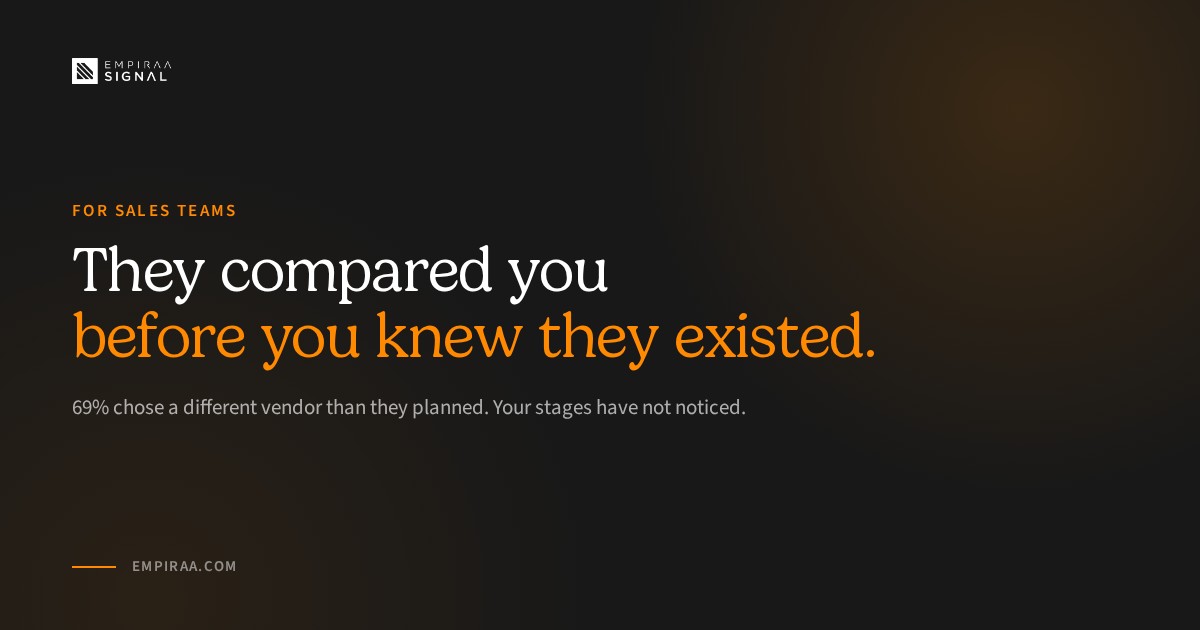
It compresses the early stages and moves the first conversation later, so a stage model built for an uninformed buyer now reports deals as early when they are nearly decided.
The research is not in doubt. G2 surveyed 1,076 B2B software buyers in March 2026 and found 51% now start software research with an AI chatbot more often than with Google, up from 29% a year earlier. 69% chose a different vendor than they had planned based on what the chatbot told them. 33% bought from a vendor they had never heard of.
Everyone selling answer-engine optimisation has written about the first half of that. The half nobody is writing about is what it does to the pipeline on Monday.
The buyer who arrives is not the buyer your stages describe
Most B2B pipeline models were designed around a buyer who found you, learned what the category was, worked out what they needed, and then compared options. The early stages reflect that: awareness, discovery, qualification.
A buyer who has spent forty minutes with a chatbot has already done all three. They know the category, they have a requirements list, and they have an opinion about you relative to two competitors they can name. Then they fill in a form and land in your pipeline at stage one.
| What the stage says | What is actually true | What the rep does |
|---|---|---|
| Discovery | They have compared three vendors and have a preference | Runs a discovery call that tells them nothing new |
| Qualification | They qualified themselves last Tuesday | Asks budget and timeline questions that feel like a toll gate |
| Evaluation | This is where they were when they arrived | The stage finally matches, three weeks late |
| Negotiation | Often reachable in week one | Nobody tries, because the model says it is too early |
The deal is not slow. The model is. And because the stage is wrong, the forecast built on the stage is wrong too, which is the broader argument in the proposal is the forecast.
The ten-second fix that most teams are not doing
Ask: who else have you looked at, and what did you conclude?
Two years ago that question got a vague answer, because the buyer genuinely had not looked closely. Now it gets a specific one, often with the competitor's pricing attached and a reason they are still talking to you.
That answer tells you where the deal really is, which objection has already formed, and whether you are the preference or the comparison. None of that is available from a stage.
It also surfaces the thing worth knowing at a company level: 64% of buyers in the G2 research said they encounter inaccurate AI recommendations often or very often. A meaningful share of your deals now begin with a buyer holding a confident, wrong belief about your product, and the only way to learn which beliefs are circulating is to ask the people in front of you and write the answers down somewhere.
What to actually change
Shorten the front of the pipeline. If your first three stages describe learning that now happens before contact, they are reporting delay that does not exist. Two early stages instead of four is usually closer to the truth.
Record the competitor named at first contact. Not at close, when it is retrospective and the rep is reconstructing. At first contact, as a field, so that in six months you can see which comparisons you win and which you lose before anyone speaks to you.
Treat the first call as a correction, not a discovery. The useful opening is not "tell me about your business". It is "here is what people usually get wrong about us, tell me if you have heard any of it".
Watch cycle length rather than stage count. With fewer, later stages, the honest measure of whether this is helping you is time from first contact to proposal sent.
Where the data lives
Most of this is a configuration question rather than a product question, and worth saying plainly: you can do all four of those in any competent CRM, today, without buying anything.
What makes it easier in Empiraa Signal is that the prospecting, the sequences, the meeting and the proposal are all on the same record, so the first-contact competitor field and the eventual outcome sit together without anybody joining two systems to find out. Accounts and contacts hold the comparison context, and Targets and coverage is where a shorter cycle shows up as a coverage change rather than as a surprise at quarter end.
What not to do about it
Do not rebuild your stages around AI. The buyer changed, not the sale. The jobs are the same: find out what they actually need, show them whether you do it, agree a price.
What has changed is how much of that the buyer completes before you are in the room, and a pipeline that does not know this is reporting a fiction with great precision.
Related reading: the warmest pipeline you have is already sitting in your CRM, and the proposal is the forecast.
See how Signal prices, or what a growing team's stack costs when the tools are bought separately.