
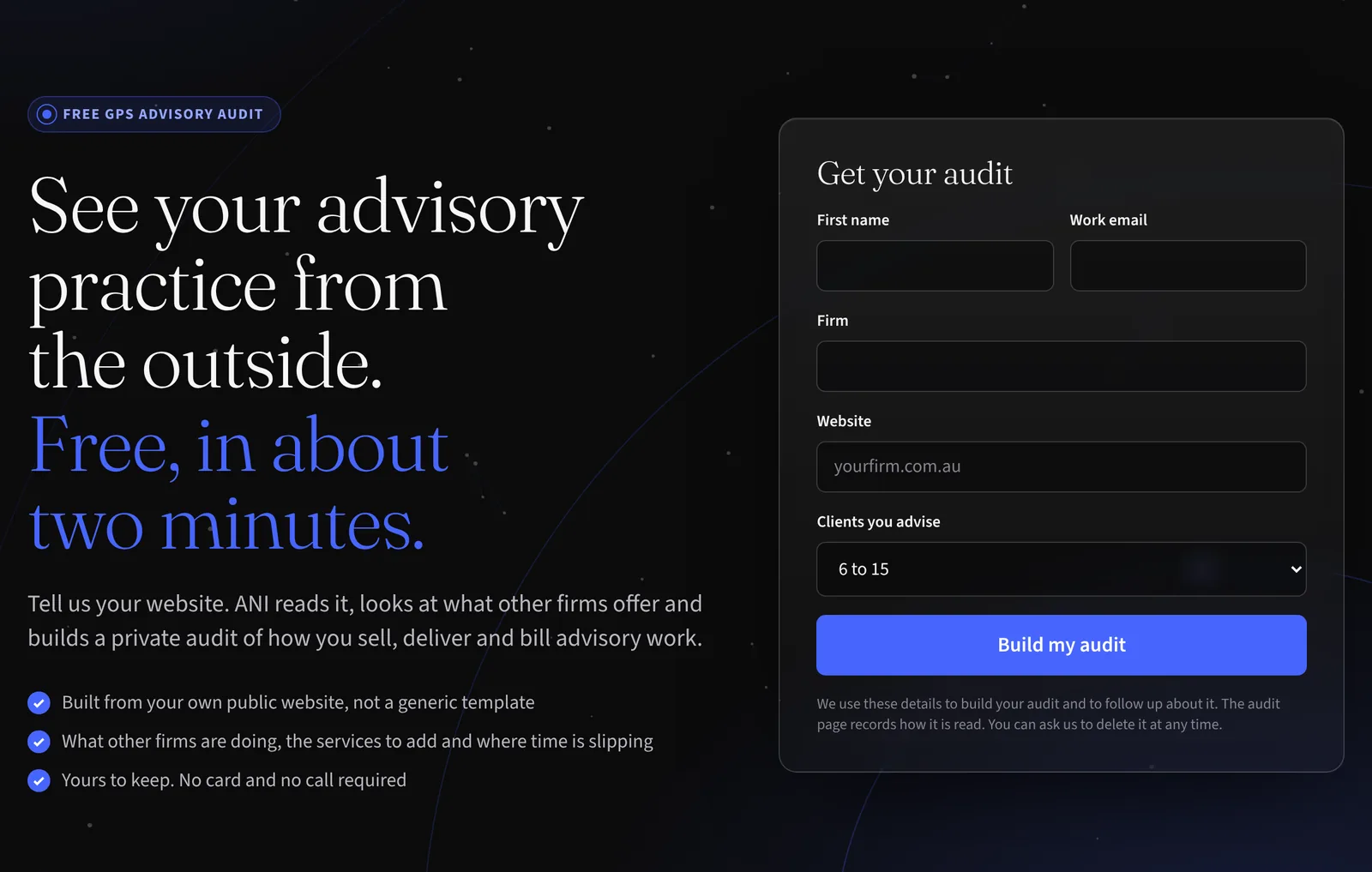
A free, private read of how your firm sells, delivers and bills advisory work, built from your own website. It shows the advisory services you could add, where fees and time are likely slipping, and how to grow advisory from the clients you already have. Asking for one takes about two minutes.
Almost every firm now says it offers advisory. Wolters Kluwer's Future Ready Accountant research puts the figure at 93%, up from 83% a year earlier. Yet for most practices, compliance still pays the bills.
The gap between those two facts is rarely a skills problem. The advice is good, and clients ask for it. The problem is that advisory has no shape a client can buy, no record a client can see and no timesheet that catches the hours. It happens in the margins of compliance work, and it is given away. Why that happens is worth a read on its own.
You are also the last person who can see it clearly. You know what your firm does. A prospective client only knows what your website tells them, and on most firm websites that is a list of services that is mostly compliance, with one line that says "business advisory".
So we built a way to see your own firm from the outside. Get your free advisory audit, or open the sample audit first and see exactly what you would get.
What the advisory audit is
The Empiraa GPS advisory audit is a private report about your firm, written by ANI, the AI strategist built into Empiraa GPS. Empiraa GPS is a strategy and client delivery platform that helps advisors and consultants manage client plans, demonstrate progress and grow recurring revenue. The audit shows what that would look like in your firm, before you sign up for anything.
It takes three steps, and none of them is a sales call:
- Tell us your website. Five fields: your name, work email, firm, website and roughly how many clients you advise.
- ANI builds the audit. It reads your public website, looks at what comparable firms publish about their advisory services, and checks every claim against what it found.
- Read it on your own link. A private page, hidden from search engines, that you can share with your partners. If something is wrong, tell us and the audit gets updated.
It does not touch your systems, your clients or your data. Everything in it comes from what is already public, and that is the point: it is the view a client gets before they ever pick up the phone.
Ten sections, all about your firm
Most people read it in about five minutes. It opens with the short version, then works through ten sections.
| Section | What it tells you |
|---|---|
| The firm | What your website tells a client, and how much of it is advisory |
| What other firms do | What firms like yours are doing with advisory, and where you stand on each |
| Services to add | Advisory services you could add for the clients you already have, and how GPS delivers each one |
| Gaps and fixes | Where advisory fees and time are likely slipping, and what closes each gap |
| Growing advisory | How to grow the advisory line from your existing clients, in order |
| Activities | The weekly habits that grow advisory work, and how each runs in GPS |
| A week in GPS | Client work due, time ready to bill, and the real cost and margin by client |
| Claude + GPS | What your advisors could simply ask for, and the hours that gives back |
| The numbers | A calculator you set with your own clients, fees and rates |
| Get started | A 30-day pilot with every feature and no credit card |
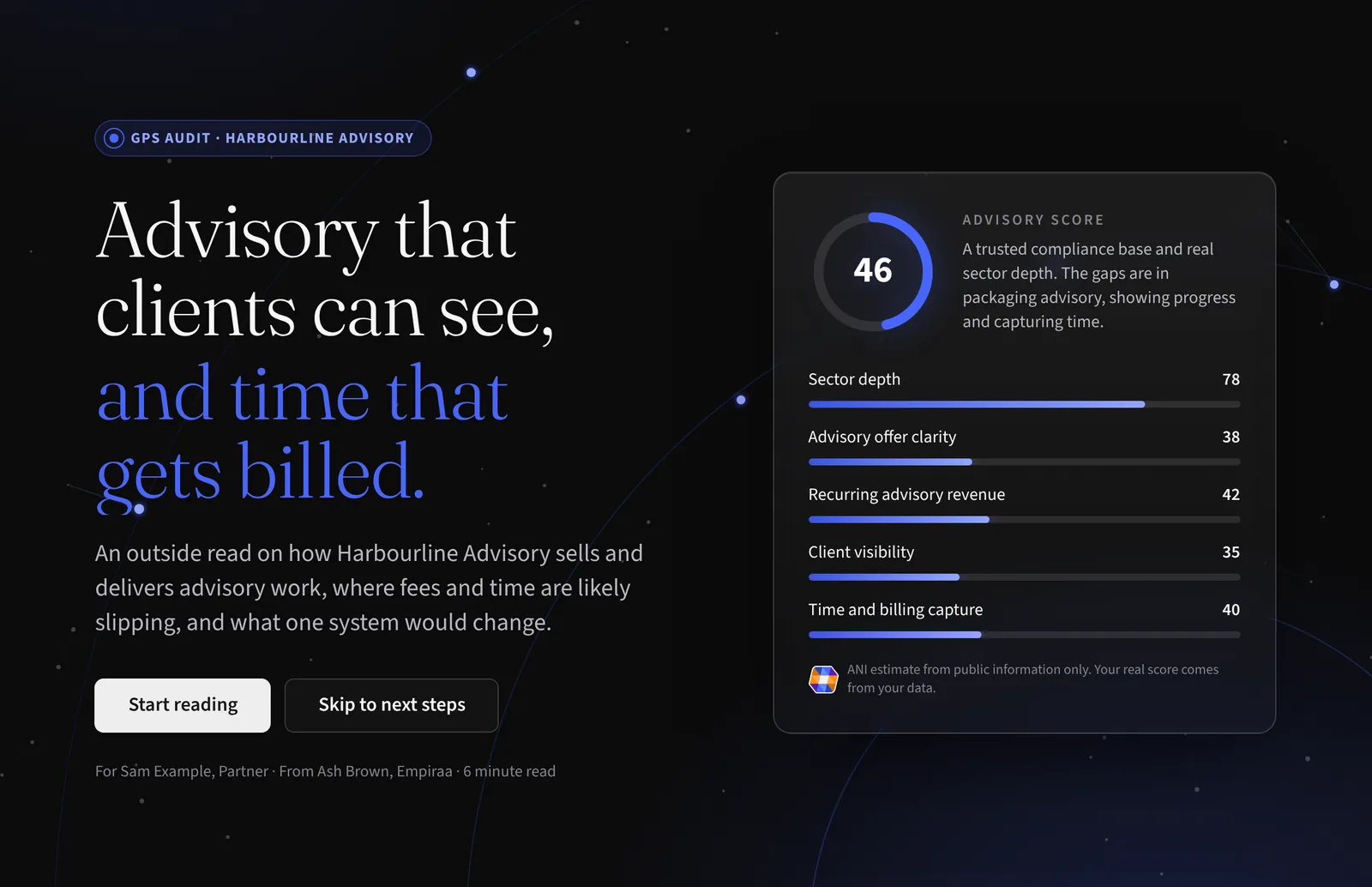
At the top sits an advisory score out of 100. In the sample, it breaks into five reads: sector depth, how clear the advisory offer is, how much advisory revenue is recurring, how much clients can see, and how much time and billing gets captured. It is an estimate from public information, and the audit says so on the page. Your real score comes from your own data.
1. Find the advisory services your firm is missing
This is the section most firms read twice.
The audit does not hand you a generic menu. Each suggestion is built from work your website says you already do, for clients you already have. Every one comes with a shape (a retainer, a program or a fixed fee), who it is for, what the client gets, and how GPS delivers it.
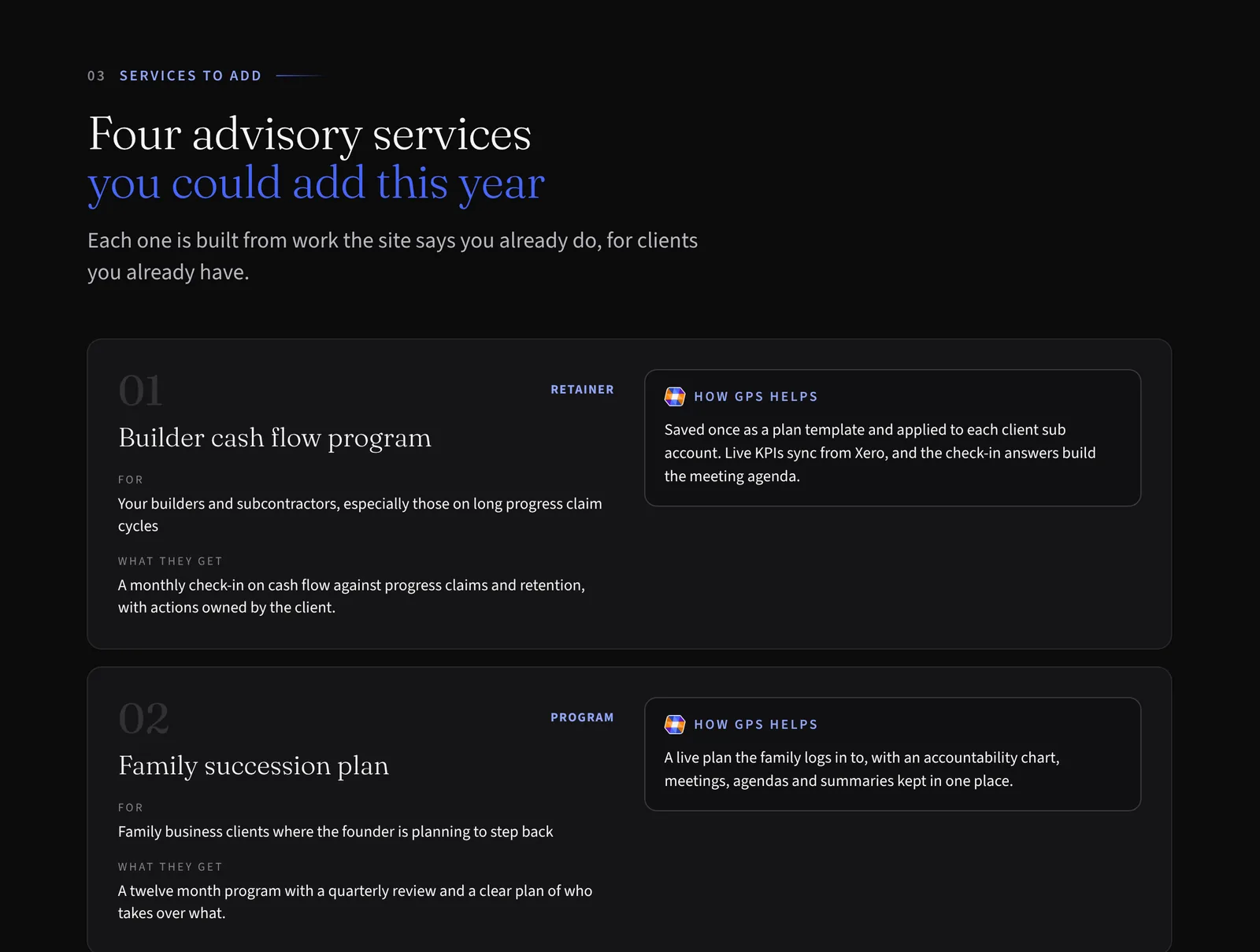
The sample audit is written for Harbourline Advisory, a made-up two-partner firm that serves builders, trades and family businesses. Its four suggestions are:
- Builder cash flow program, a retainer. A monthly check-in on cash flow against progress claims and retention, with actions the client owns.
- Family succession plan, a program. Twelve months, with a quarterly review and a clear plan of who takes over what.
- Strategy on a page, a fixed fee. One workshop that turns a growing client's goals into a one-pager and a plan for the next 90 days.
- Quarterly business review, a retainer. A quarterly meeting on the plan and the numbers, for any client already paying for monthly bookkeeping.
None of these needs a new client. Each is a way to sell what the firm already knows to the people who already trust it, in a form they can say yes to.
Alongside it sits What other firms do: the moves comparable firms are making with advisory, such as selling a named monthly program, giving every client a portal, running planning days for a sector, or publishing outcomes instead of a list of services. For each one, the audit shows where you stand today and the opening it leaves you. A real audit names the real firms and says where the information came from.
2. See where advisory fees and time are slipping
Most advisory revenue is not lost to a competitor. It leaks. A quick call runs for an hour. A retainer quietly doubles in scope. A client cannot see what moved, so the renewal conversation becomes a conversation about price.
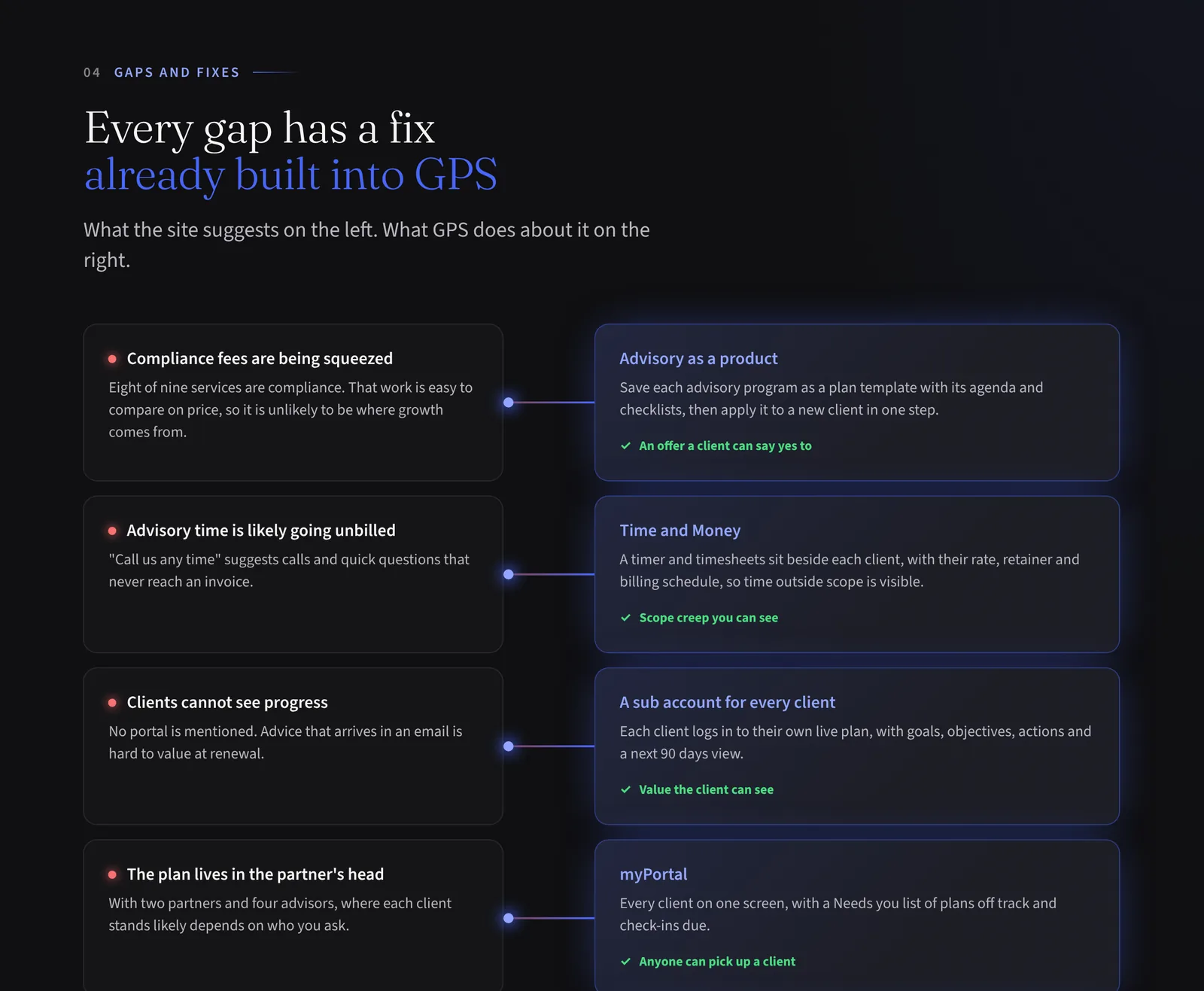
The Gaps and fixes section lists what your website suggests is happening, and pairs each gap with the fix:
| What the audit finds | What closes it in GPS |
|---|---|
| Compliance fees are being squeezed | Advisory saved as a product: a plan template with its agenda and checklists, applied to a new client in one step |
| Advisory time is going unbilled | Time and Money: a timer and timesheets beside each client, with their rate, retainer and billing schedule |
| Clients cannot see progress | A sub account for every client, with their own live plan, goals, actions and next 90 days |
| The plan lives in a partner's head | myPortal: every client on one screen, with the plans that are off track and the check-ins that are due |
| Every engagement starts from a blank page | DocuANI turns a client's existing strategy into a live plan, with 220 ready-made plan templates to start from |
If the unbilled hours line sounds familiar, the advisory revenue your practice already has and never bills goes deeper on where it happens and why.
3. Grow advisory from the clients you already have
You do not need new clients to grow the advisory line. The audit sets out the moves in order, written around your own firm:
- Start with your best clients. Pick the ten whose numbers you know best, and show each one a live plan built from what you already hold.
- Turn "call us any time" into a retainer. Ad hoc calls become a monthly rhythm with a fixed scope. The hours each client already uses are the evidence for the fee.
- Let your advisors run the program. Advisory stops growing when the partners' diaries fill. A saved program with its agenda and checklists means someone else can deliver it.
- Show progress every quarter. Clients renew what they can see.
It then turns those moves into six habits: review which clients need you every Monday, log advisory time as it happens, send a check-in before each meeting, raise advisory with two compliance clients every week, review time against scope each month, and run a planning session for a sector each quarter. Each habit shows how it runs in GPS, so it survives a busy month.
If raising advisory with existing clients feels like selling, how to sell advice without sounding like a salesperson is a good companion read.
See the practice run: a week in GPS
Advice is only half of it. The audit also shows what advisory looks like once it has a home: myPortal, the screen where your firm works on its clients.
It shows the client work due this week, the hours ready to bill, and the real cost and gross margin of every client. That is how billable work gets found, and how you see which clients the firm is quietly subsidising. In the sample, one client looks healthy until the margin column shows eleven hours of succession work this month against a fee that covers six.
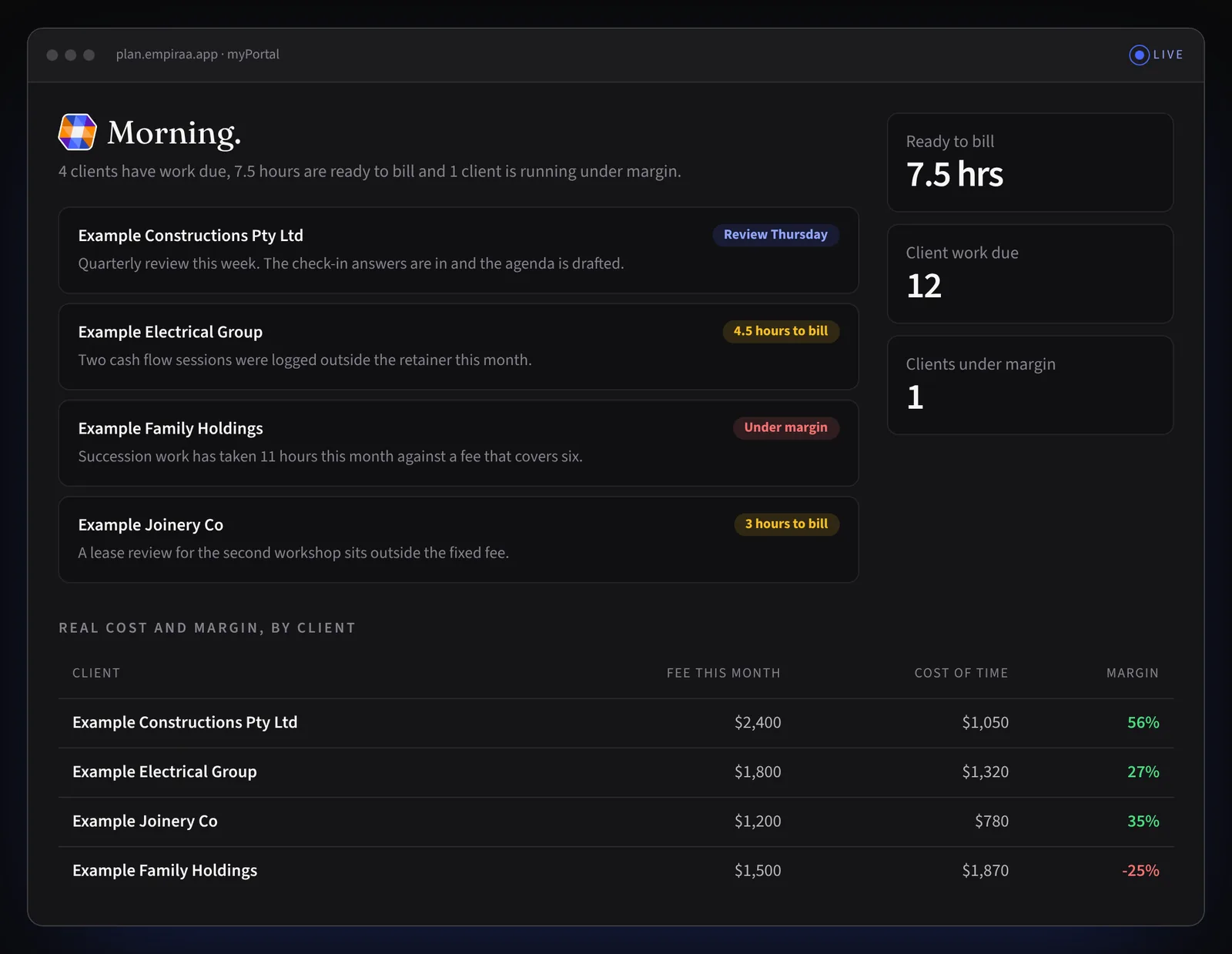
The audit walks through one engagement step by step. Load the client's plan with DocuANI in week one. Invite the client into their own sub account in week two. Run the monthly check-in that feeds the meeting, log the hours against the retainer, and check the margin each quarter. Your invoices still go out of your own accounting system. GPS shows what is ready to bill and what the work actually cost.
Claude and GPS: the hours your advisors get back
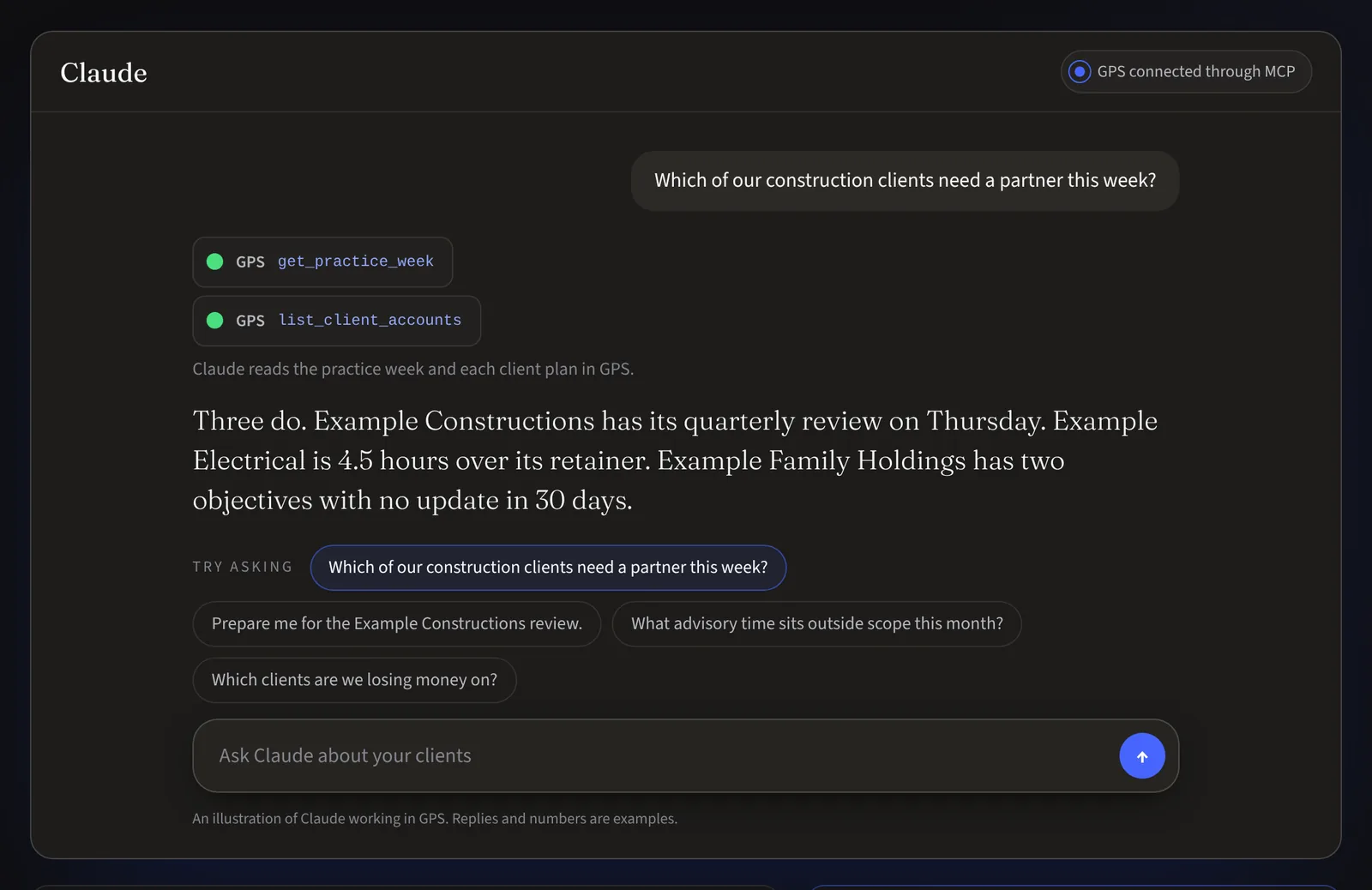
Empiraa GPS connects to Claude through the Empiraa MCP, the connection that lets an AI assistant work with GPS within your permissions. Your advisors ask in plain English, and Claude works across every client sub account, with a preview before anything changes.
The audit shows what your team could ask, such as "Which clients need a partner this week?" or "What advisory time sits outside scope this month?". It then estimates the time that gives back across meeting prep, chasing actions and documents, writing client updates, logging time and checking who is off track. You set the number of advisors and the value of an hour, and every figure is labelled as an estimate.
It finishes with a prompt written for your firm, ready to paste into Claude once GPS is connected. Claude is a separate subscription from Anthropic.
For what Claude can and cannot do inside a practice, see Claude for accountants.
The numbers, on your own figures
The audit does not tell you what to charge. Your fees are yours. The numbers section is a calculator you set with your own client count, average advisory fee, unbilled hours and charge-out rate, and it shows what GPS costs for each client against the advisory fees it runs. It uses the published GPS for Professional Services plans: every plan has every feature and unlimited users, and the only thing that changes the price is how many clients you run in it.
What the audit will not do
Being clear about the limits is part of what makes it useful.
- It will not access your systems. Everything comes from your public website and what comparable firms publish.
- It will not guess quietly. Estimates are labelled as estimates, and the score is a read from public information, not a verdict on your firm.
- It will not hand you a prospect list. It is about your firm and the clients you already have.
- It will not commit you to anything. No card and no obligation. We may email or call once to ask whether it was useful, and if GPS is not a fit, you keep the audit.
It is also not for every firm. If your clients only ever contact you at deadlines, the demand for advisory is not there yet, and an audit will not create it. It is built for firms whose clients already ask for advice between deadlines, and who want that advice to become a service.
How to get the most from it
- Read the short version first. The score, the gap to fix first, the service to add first and the first growth move are all on one screen.
- Pick one service and three clients. Not the whole menu. One offer, three conversations this month.
- Share it with your partners. The audit has a share link, so the conversation starts from the same page.
- Run the numbers with your own fees. Then decide whether the hours you are giving away cover the cost of fixing it.
- If it fits, run it inside a pilot. The 30-day free pilot has every feature and needs no credit card: brand it as your firm, add your first client sub accounts, turn a client strategy into a live plan, invite the client in, and run the first check-in.
Get your audit
It takes about two minutes to ask for, and it is yours to keep. Get your free advisory audit, or read the sample audit first.
Related reading: 93% of firms say they offer advisory, so why does compliance still pay the bills, what to charge for advisory in 2027, and what your client sees between meetings.