

Buyer guide
Strategy execution software. What it is, and how to choose one.
Strategy execution software holds the plan, its owners and its measures in one place, collects progress from the systems where the work actually happens, and reports on it from live data. It exists because planning and execution are different disciplines, and most organisations are much better at the first. This page explains the category, says who should not buy it, and links to ten dated comparisons, nine of them against named competitors, several of which conclude the other option is the better choice.
- Set up with your plan
- Unlimited users
- 30-day pilot
Why the category exists
The plan is rarely the problem.
Sull, Homkes and Sull found in Harvard Business Review in 2015 that only 55 per cent of middle managers surveyed could name even one of their organisation’s top five priorities. That locates the failure precisely.
What goes wrong without it
The plan lives in a document
A strategy produced over two days in an offsite becomes a slide deck that is opened at the quarterly review and nowhere in between. Nothing is wrong with the plan. It simply has no presence in the eleven months that follow.
Progress is collected by chasing
Someone spends the week before each review emailing owners for updates, assembling them by hand, and reconciling numbers that disagree. The report is accurate on the day it is presented and decaying from that afternoon.
Problems surface too late to fix
A commitment that stalled in week three is discovered in week eleven, when the quarter is gone and the only available response is an explanation. Execution and post-mortem are different activities, and most organisations only have the second.
The category
What separates it from project management.
Strategy execution, defined
A Goals tab is not a strategy layer
Most work platforms have added goals: Asana, monday.com, ClickUp and Jira all have some version. They are useful, and for a single team they are often enough. What they are built around is the task, with goals attached above it.
A strategy execution platform is built the other way round. The objective is the primary object, measures hang off it, and the work is what moves the measure. The difference shows up when somebody asks whether a commitment is on track, and the honest answer requires more than counting completed tasks.
- Project tool: tasks are the unit, goals are a view over them
- Strategy platform: objectives are the unit, work is what moves them
- The test: can it tell you a commitment is at risk before anything is overdue?
Progress has to arrive on its own
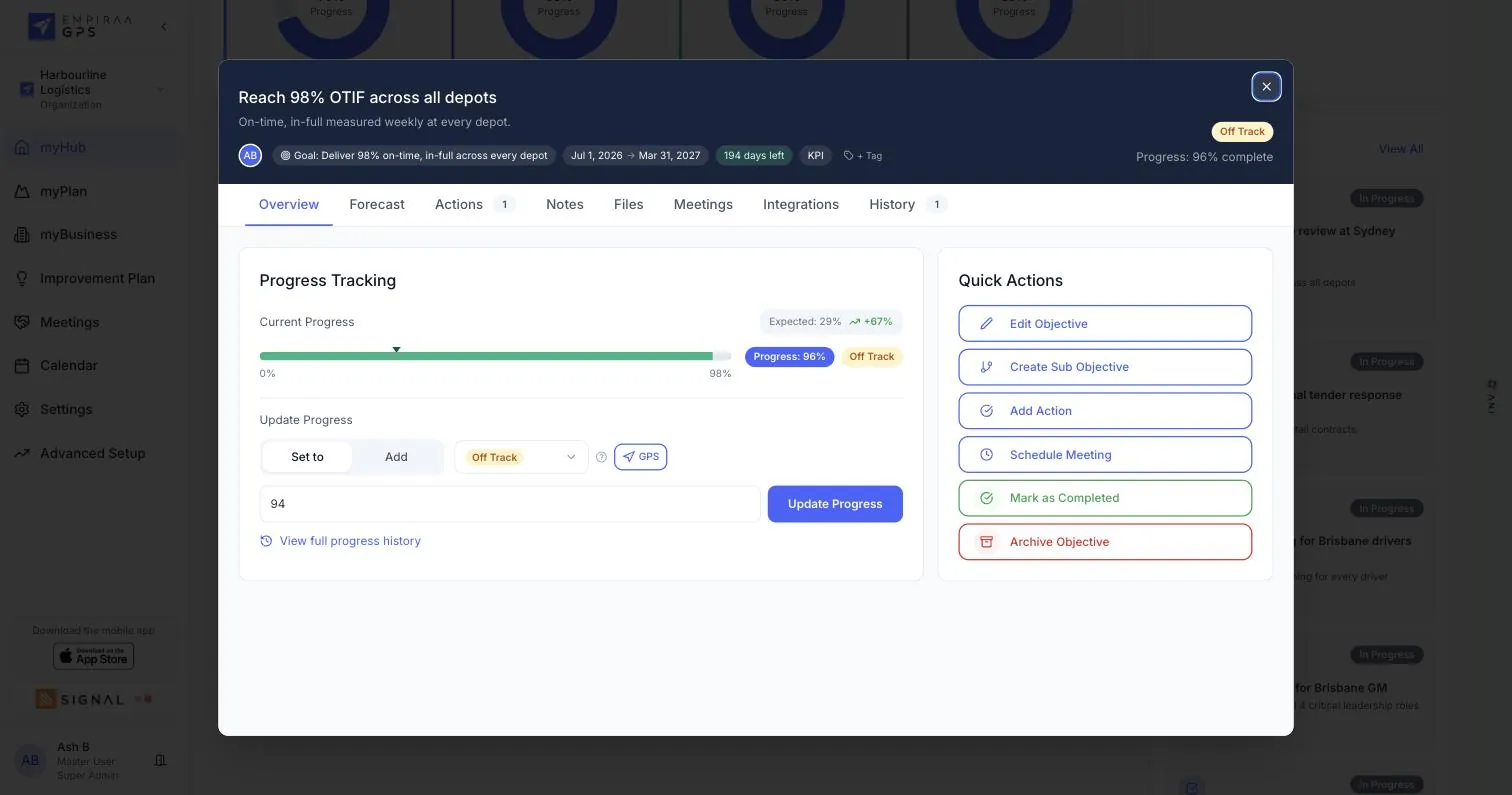
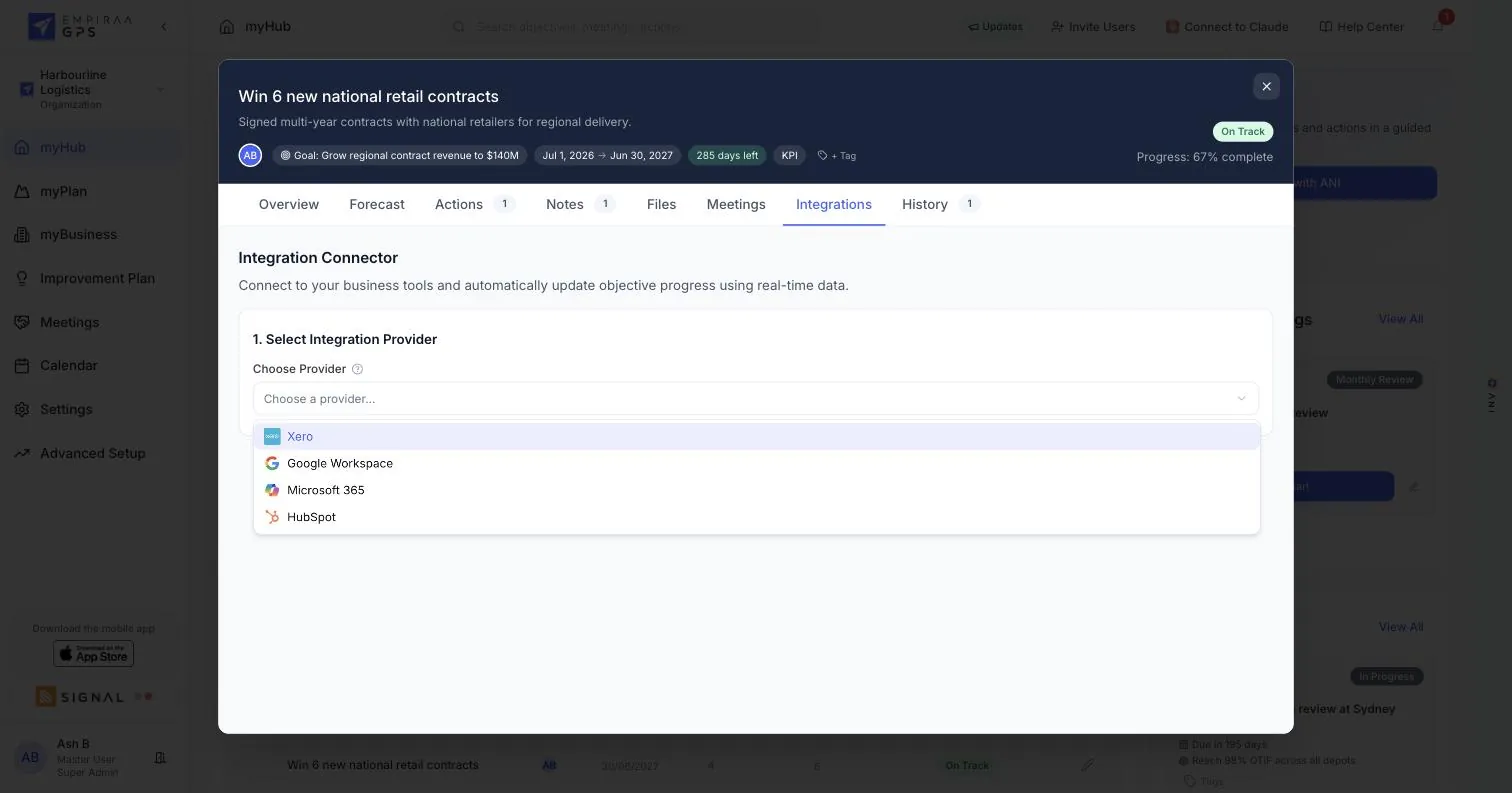
This is the capability that separates software that survives a busy quarter from software that does not. If reporting progress requires a person to remember to type a number in, that reporting will decay within two quarters however good the interface is. Progress that updates from the systems the work already happens in survives, because nobody has to remember anything.
Reporting is an output, not a project
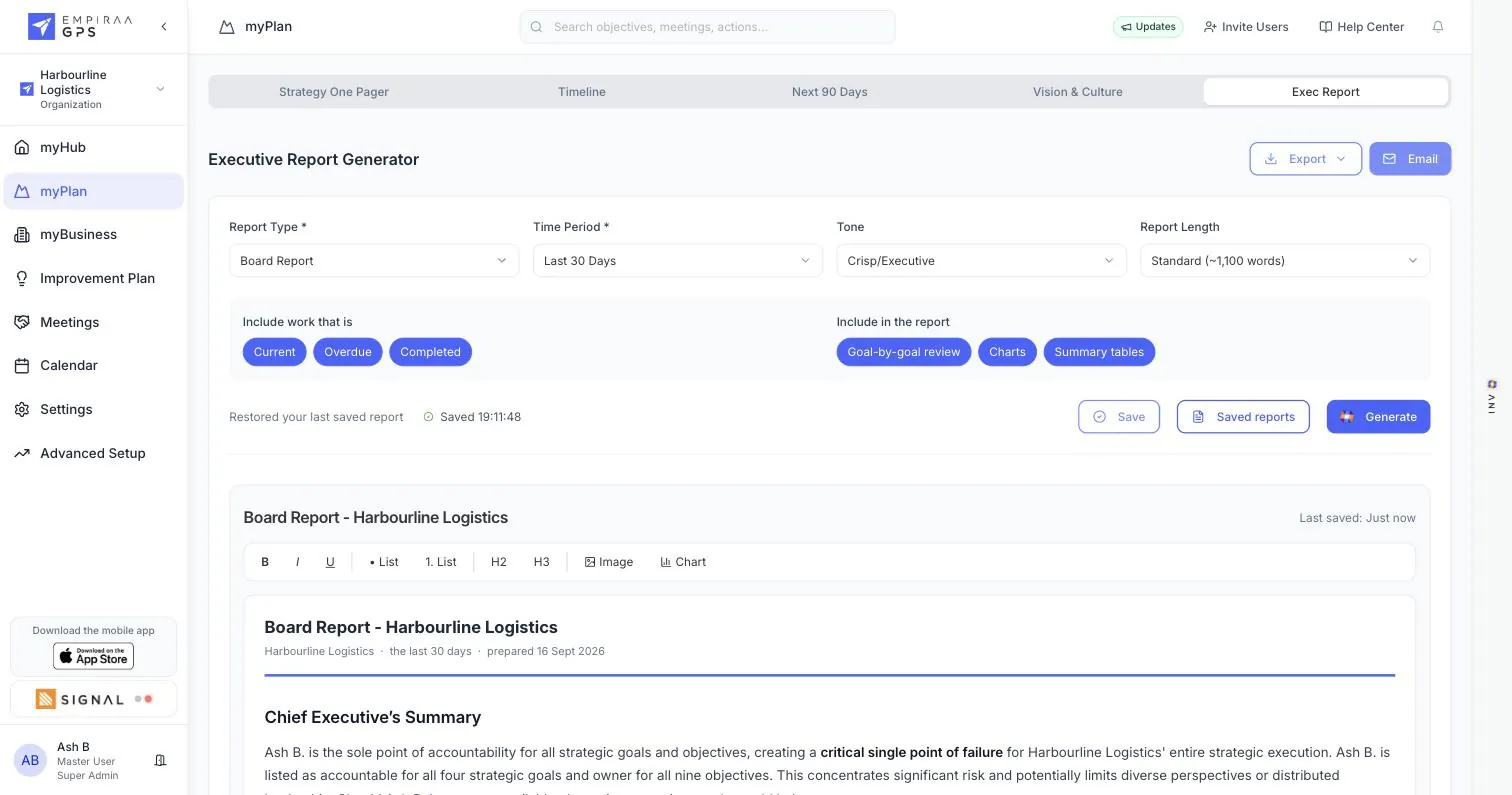
The board pack, the executive summary and the departmental dashboard should be generated from the same live data, not assembled by hand in the week before each is due. An organisation that spends a person-week a month producing a status picture is paying for a reporting problem, not a strategy problem.
Frameworks are a choice, not a religion
Some platforms are built around one method: OKRs, the Balanced Scorecard, or a specific operating system. That is a genuine advantage when the whole organisation runs that method, and a genuine problem when it does not. The most common cause of a failed rollout is a team being asked to express business-as-usual work in a framework designed for change initiatives, and quietly disengaging when the format stops meaning anything.
What to look for
Five questions that decide it.
These separate the options faster than a feature matrix, whichever vendor you end up choosing.
The buyer checklist
1. Where does progress come from?
If the answer is "someone updates it", assume the reporting will decay. Ask which of your systems it reads from and what happens to a measure nobody touches for a month.
2. Does it force one framework?
If different parts of your organisation genuinely work differently, a platform built around one method will make one of them miserable. Ask whether KPIs, OKRs and quarterly priorities can sit in the same plan.
3. How are seats priced?
Strategy execution only works when the people doing the work can see the plan. A per-seat price is a tax on exactly that, and a minimum user count is worth checking against your actual leadership headcount.
4. What does reporting cost in time?
Ask to see a board pack generated live in the demo rather than a prepared screenshot. The gap between those two is where most of the value in this category actually sits.
5. Who owns it after go-live?
Every platform in this category needs someone to run the rhythm. Ask what happens when that person leaves, and whether implementation and training are included or quoted separately.
Honesty section
When you do not need this.
The category is oversold, and three situations genuinely do not call for it.
Do not buy if
One team, a handful of goals
If a single team sets five objectives a quarter and checks in at a fortnightly meeting, a shared document works and a platform is overhead. This category earns its keep when the plan crosses teams or sites and nobody can hold the whole picture.
The strategy itself is unclear
Software will not decide what you are doing. An organisation whose plan is a list of everything in progress will get a tidier list of everything in progress. Sort the strategy first; the tooling problem is downstream of it.
Nobody will own the rhythm
Every platform here assumes somebody runs the check-in cycle and chases what stalled. Without that person the software becomes another place where stale data lives. That is a leadership commitment, not a procurement one.
The comparisons
Ten dated comparisons, including where we lose.
Each one names the alternative’s genuine advantages first and cites what was read and when. Several conclude the other option is the better choice. All checked 19 September 2026.
Compare the options
Compared with Cascade
Configurable strategy infrastructure for larger organisations.
Learn moreCompared with ClearPoint
Balanced Scorecard software with deep public sector roots.
Learn moreCompared with AchieveIt
Built for government, healthcare and education.
Learn moreCompared with Quantive
Acquired by WorkBoard, announced 28 May 2025. What that means now.
Learn moreCompared with Viva Goals
Microsoft retired it on 31 December 2025 with no successor.
Learn moreCompared with Ninety
Purpose-built for teams committed to a single operating model.
Learn moreCompared with monday.com
A work platform with Goals added, rather than a strategy tool.
Learn moreCompared with Asana
Goals sit above the task work they were built around.
Learn moreCompared with ClickUp
Goals in a work platform priced and built for task delivery.
Learn moreCompared with spreadsheets
Still the default in most organisations, and sometimes the right answer.
Learn moreRelated
Keep exploring GPS.
Related pages

Questions
Questions about the category.
What is strategy execution software?
Software that holds a strategic plan, its owners and its measures in one place, collects progress from the systems where the work happens, and reports on it from live data. The point is to remove the manual chase that makes execution decay, and to make a stalled commitment visible while there is still time to act on it rather than at the quarterly review.
How is it different from project management software?
What each is built around. A project tool treats the task as the primary object and adds goals as a view above them; a strategy execution platform treats the objective as primary and treats work as what moves a measure. The practical test is whether the system can tell you a commitment is at risk before anything is formally overdue. Counting completed tasks cannot do that.
What should strategy execution software cost?
Most vendors in this category quote rather than publish, including ClearPoint, AchieveIt, WorkBoard and Empiraa, so a like-for-like comparison generally needs two or three quotes. The structural question that matters more than the number is whether you are charged per seat, because strategy execution only works when the people doing the work can see the plan, and per-seat pricing discourages exactly that. Ask what the bill looks like at twice your current head count.
Do we need it if we already use OKRs?
Running OKRs is a reason to look, not a reason to buy. The question is where your OKRs live now and how progress reaches them. If they sit in a spreadsheet that someone updates before each review, that is the problem this category solves. If they update automatically from the systems your teams already work in and the reporting takes an hour, you may not need anything.
What is the most common reason these rollouts fail?
Asking every team to use the same framework regardless of what that team does. A team whose job is to keep something running steadily has no change initiative to express as an objective, so it submits its existing measures in the required format. The list never meaningfully changes, reviews teach nobody anything, and the programme is dropped within a year. That is a classification failure rather than a software failure, and choosing a platform that supports more than one framework removes it.
Is Empiraa GPS strategy execution software?
Yes, and it is built for established mid-market and enterprise organisations whose plan crosses several teams or sites. It is framework agnostic, supporting KPIs, OKRs, Rocks and custom models in one plan, includes ANI as a built-in AI strategist, and includes unlimited seats so the price does not rise as more of the organisation comes into the plan. It is not the right tool for a single team with a handful of goals.
Which is the best strategy execution software?
There is no single answer and any page claiming one is selling. The honest version is that it depends on whether you are committed to a framework, what sector you are in and how many people need access. ClearPoint is the stronger choice for a Balanced Scorecard organisation or a council. AchieveIt suits government, healthcare and education. GPS suits organisations whose plan crosses teams and whose teams do not all work the same way. The comparisons linked above go into each one properly.

Question not answered here? Ask ANI and get a straight answer.
See it running on a real plan.
A 15-minute demo, with reporting generated live rather than screenshotted in advance.