

Answers
How to cascade goals across teams and sites.
Cascading does not mean copying the company objective into every team's plan. It means each level answering a different question: given that, what part of it is ours, and how will we know. Get that wrong and you end up with an organisation where everybody owns the same number, which is the same as nobody owning anything.
- Set up with your plan
- Unlimited users
- 30-day pilot
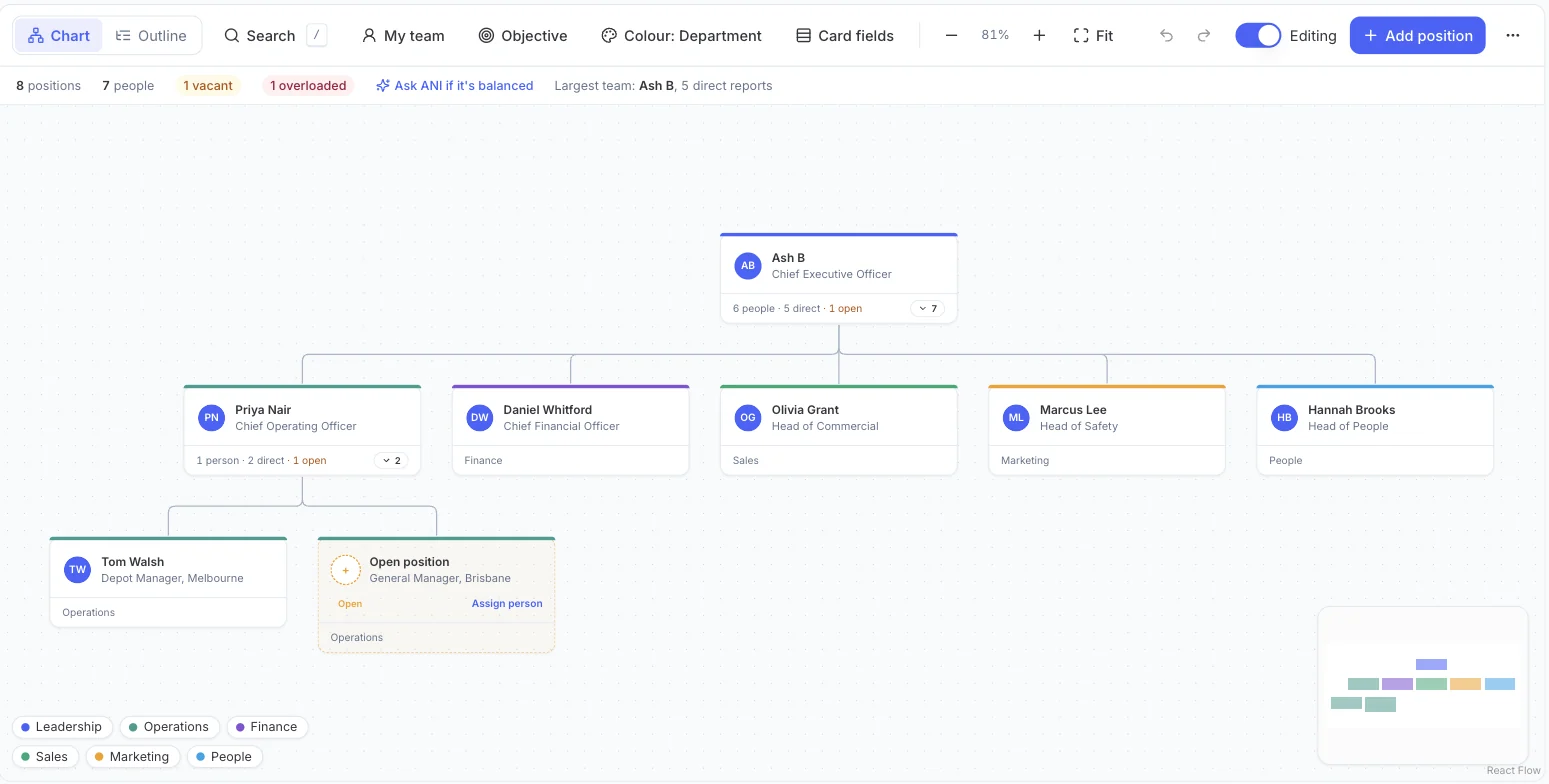
Two ways it goes wrong
Most organisations pick one of these and call it alignment.
They look like opposites and they produce the same result, which is a plan the teams do not use.
Failure modes
Cascading the words
The company objective is pasted into every team plan, so eleven teams all have "grow revenue 20 per cent" on their page. It looks aligned in a report and it tells nobody what to do on Monday. Shared ownership of one number is the most reliable way to produce no ownership at all.
Cascading nothing
Every team writes its own goals from scratch because that feels empowering. The goals are often good and there is no way to tell whether they add up to the company plan, because nobody ever checked whether they sum. This is the more common of the two and the harder to see.
The mechanic
Cascade the question, not the objective.
How it works
Each level answers the level above, in its own terms
The company says what has to become true. Each level below answers two questions about it: what part of that is ours, and what will we measure to know we delivered our part. The answer is written in that level's own language, using numbers that level actually controls.
That is the whole mechanic. The objective travels down as a question. What comes back up is a set of contributions that are different from each other and that add up to the objective.
- The company objective stays at the company level. It is not re-typed lower down
- Each level owns numbers it can actually move, not a share of a number it cannot
- The contributions have to sum. If they do not, either the plan is short or somebody is optimistic
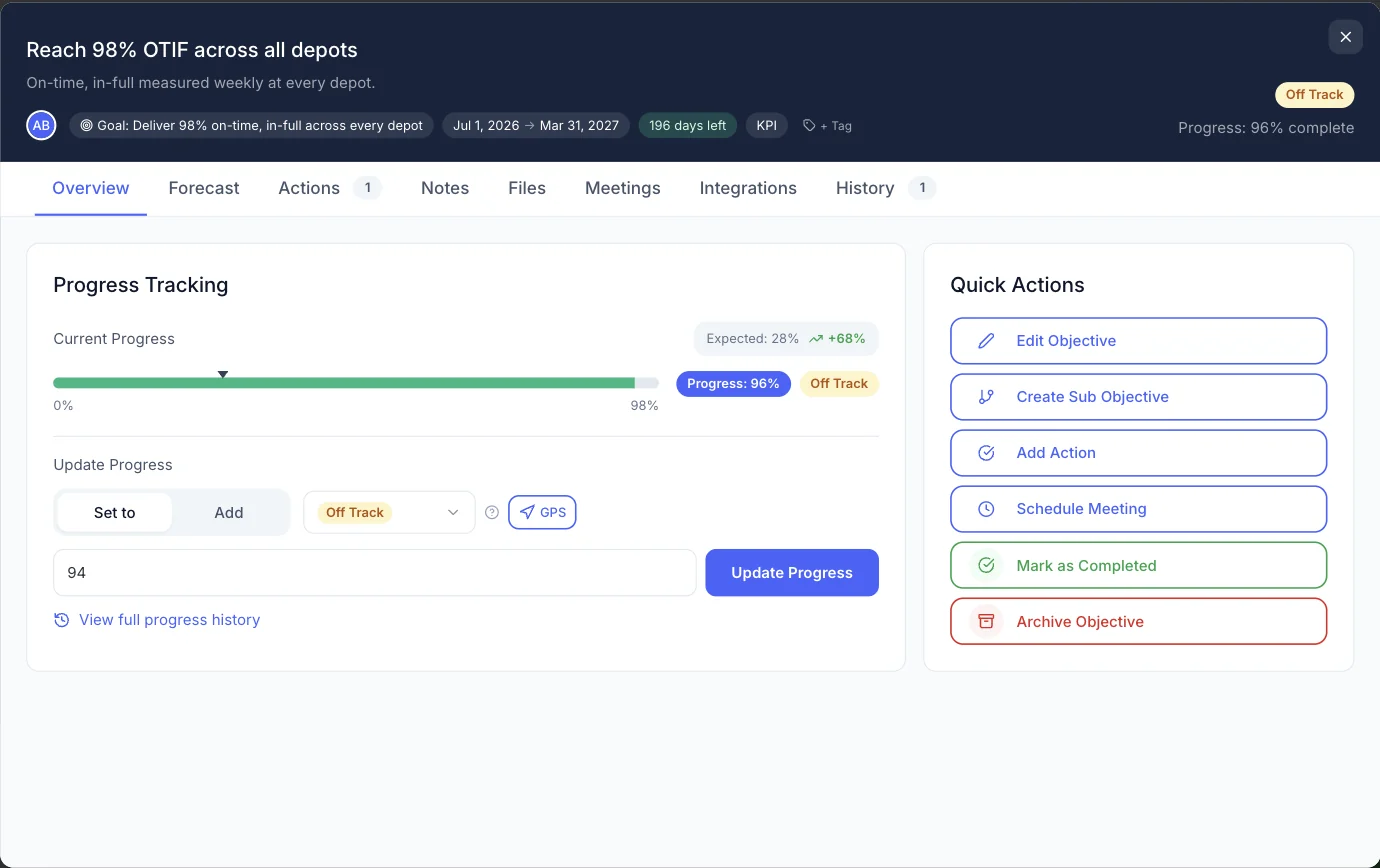
The test: does the level above move?
Here is the check worth running on an existing plan. Take any team-level measure and ask what happens to the level above it if that measure is hit. If the honest answer is nothing in particular, the cascade is decorative, however tidy it looks in the tool.
Run that upward through every level and you will usually find one or two places where the chain breaks. That is not a failure of the exercise, it is the output of it. Those breaks are where the plan was aspiration rather than arithmetic.
- Pick a team measure, trace it up, and say out loud what moves above it
- Where nothing moves, either the measure is wrong or the link was never real
- Do this before the quarter starts, not in the review, when it is a post-mortem
Sites and regions cascade differently from functions
A functional cascade splits an objective by contribution: sales, marketing and service each own a different part of the same outcome. A site or regional cascade usually splits it by the same measure across different places, so eight branches each carry a version of the same number.
The mistake is treating the second as the first. When every site carries the same measure, the useful work is in the weighting and the local constraint, not in inventing different goals for each. A site at ninety per cent on-time delivery and a site at sixty have the same measure and completely different quarters ahead.
- Functions split the objective. Sites usually split the volume
- Weight by capacity or baseline rather than dividing evenly, which quietly punishes the good sites
- Roll up the actual numbers, not the percentages, or the arithmetic stops working
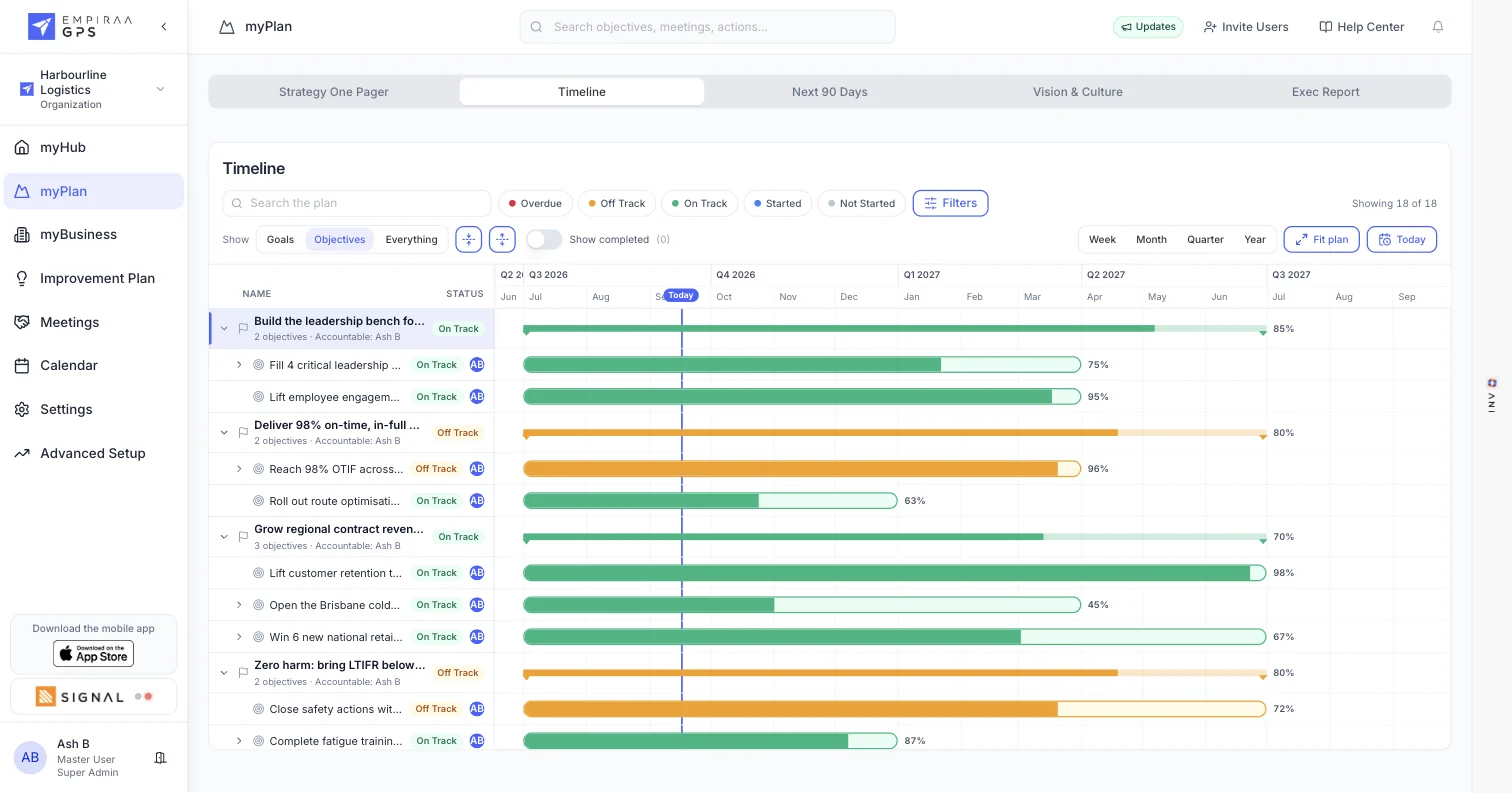
Worked through
One objective, three levels.
A manufacturer with four sites, one company objective, and what each level actually writes down. Notice that no two levels share a sentence.
Example
Company
On-time delivery across the network rises from 78 per cent to 90 per cent by 31 December, measured across every job closed in the quarter. One objective, one measure, one owner: the COO.
Site
Each site carries the same measure against its own baseline, weighted by volume rather than split evenly. The site at 62 per cent commits to 80. The site at 88 commits to 92. Both are stretching; only one looks impressive.
Function
Scheduling owns the lead time on job allocation. Procurement owns stockouts on the six parts that caused most of the delays. Neither writes "on-time delivery" on their page, and both move it.
A working order
Four passes, top down then bottom up.
The second pass is the one organisations skip, and it is the one that catches the plan that does not add up.
The method
1. Set the company level
A small number of objectives with measures attached. If this level is vague, everything below it inherits the vagueness and no amount of care lower down recovers it.
2. Ask, do not assign
Send the question down rather than the target. Each team comes back with its own contribution and its own measure, in numbers it controls.
- The pass most teams skip
3. Check that it sums
Add the contributions up against the company measure. A shortfall here is information, not a problem: it is the gap you have to close before the quarter starts.
4. Name one owner per measure
Every measure at every level gets one name, not a team. Two owners is zero owners, and a team is not a person.
Questions
Cascading goals, answered
What does cascading goals actually mean?
It means each level of the organisation answering the level above in its own terms: given that objective, what part of it is ours, and what will we measure to know we delivered it. It does not mean copying the company objective into every team plan, which is the most common implementation and produces an organisation where everybody owns the same number and nobody owns anything.
How do I know if our cascade is working?
Take any team-level measure and ask what moves at the level above if it is hit. If the honest answer is nothing in particular, the cascade is decorative however tidy it looks. Run that check upward through every level before the quarter starts, and the one or two places where the chain breaks are the output of the exercise.
Should every team have its own goals, or should they share the company ones?
Neither, which is why the question feels unanswerable. Teams should own different contributions to the same company objective, written in numbers they control. Shared goals produce diffuse ownership. Independently invented goals produce a set that has never been checked for whether it adds up. The work is in the middle.
How many levels should a cascade have?
As few as the organisation genuinely has. Each level is a translation and every translation loses something, so a cascade with five levels is usually describing a reporting structure rather than how the work actually connects. If a level cannot state a contribution in numbers it controls, it is probably a reporting layer rather than a planning one.
How do you cascade to sites or branches rather than functions?
Differently, and this is worth being deliberate about. A functional cascade splits the objective by contribution, so each function owns a different part. A site cascade usually carries the same measure across every location, so the work is in weighting by baseline and capacity rather than in inventing different goals. Dividing a target evenly across sites quietly punishes the sites already performing.
Does this only apply to OKRs?
No. The mechanics are the same for quarterly Rocks, a balanced scorecard or any set of measures with more than one level. The test of whether a lower measure moves a higher one does not care what the framework is called. Empiraa GPS is framework agnostic for exactly this reason.
What if the contributions do not add up to the company target?
That is the most useful finding the exercise produces, and it is much better discovered in planning than in the review. A shortfall means the plan is currently short, so either the target moves, the resourcing moves, or somebody names the initiative that closes the gap. What you must not do is accept the shortfall silently and hope, which is how a plan quietly becomes fiction by March.

Still deciding? Ask ANI and get a straight answer.
See a plan where every level rolls into the one above it
GPS holds the whole cascade in one place, so a site number and the company number are the same number rather than two spreadsheets that agreed once.